Date: Saturday April 25, 2026
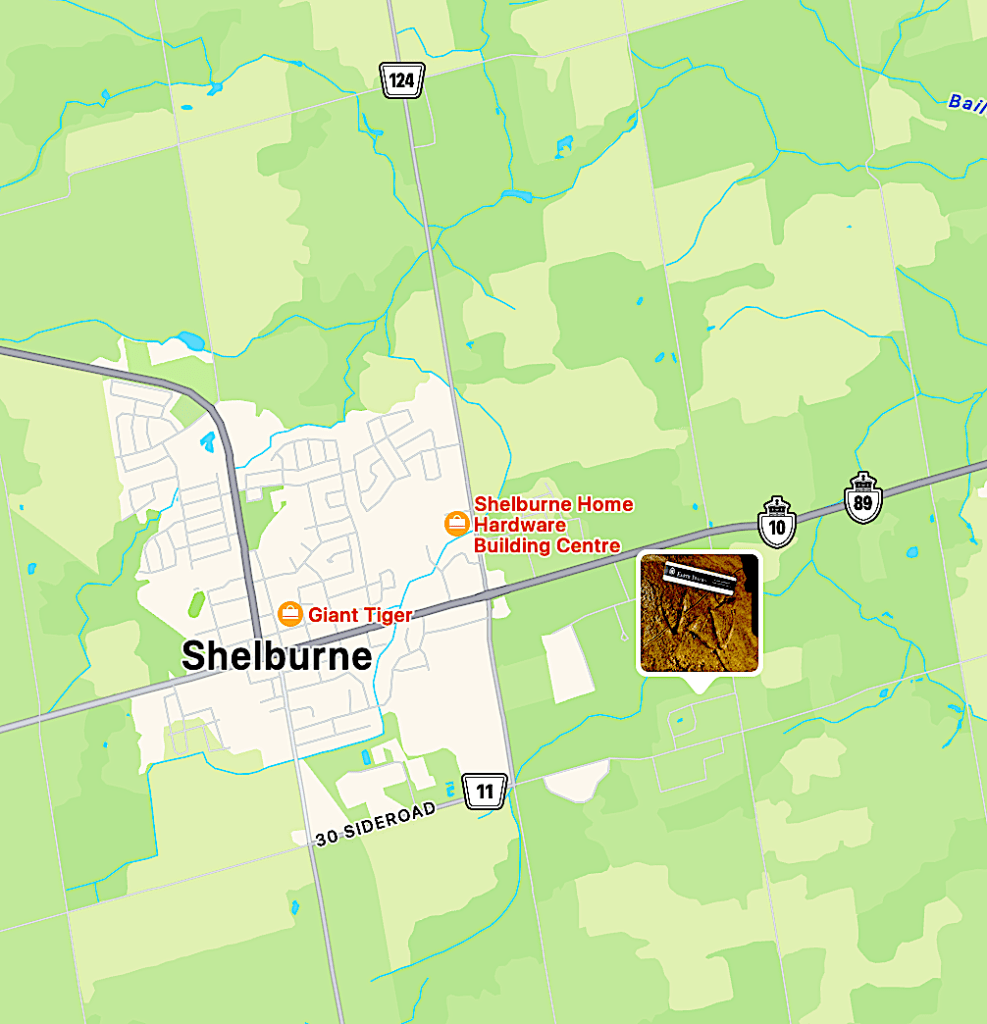
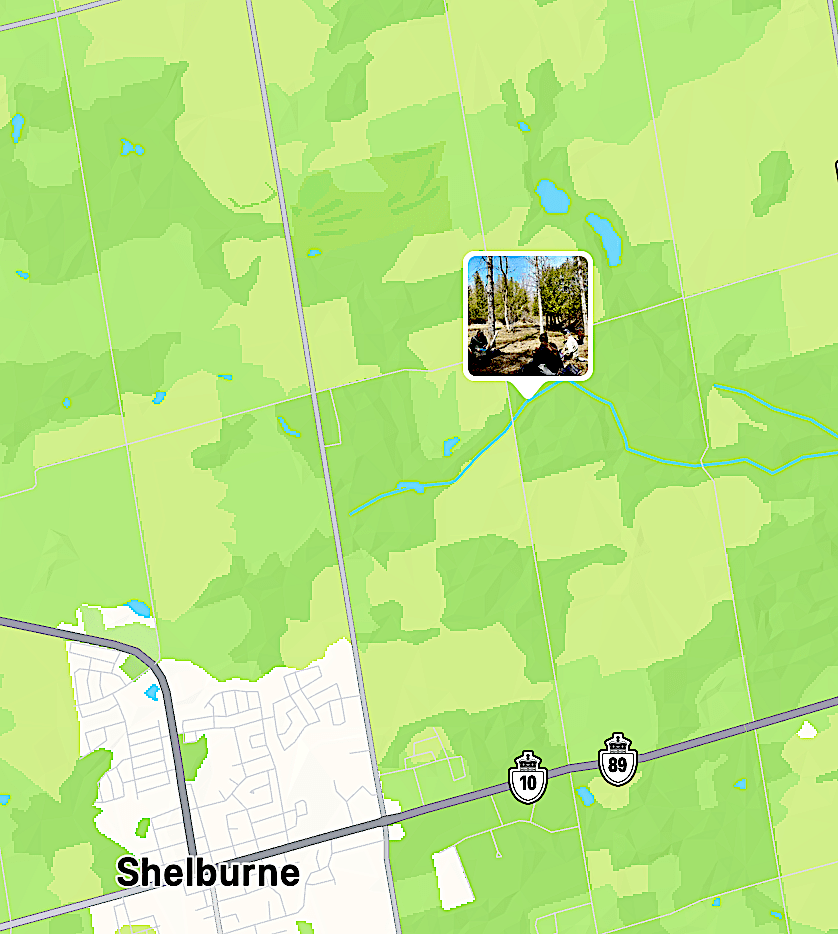
Place: Two locations near the town of Shelburne, Southern Ontario. The first place was on the muddy fields of a new housing estate, and the second was on the edge of a small river surrounded by Cedar forests. See the maps below.
Context:
This was the second day of the first weekend of the 2026/27 Tracking Apprenticeship Program with Earth Tracks (see https://www.earthtracks.ca/). Unlike on the first day, many of our observations were tracks rather than just other forms of sign. There were many interesting observations, so I had to be selective about which ones to discuss.
General References:
– [1] ‘Mammal Tracks & Sign: A Guide to North American Species’, Mark Elbroch, Stackpole Books (2nd Ed.), 2019
– [2] ‘Bird Tracks & Sign’, Mark Elbroch and Eleanor Marks, Stackpole Books (1st Ed.), 2001
Observations:
After arriving at the building site location, we very quickly found red fox tracks in a side-trot:
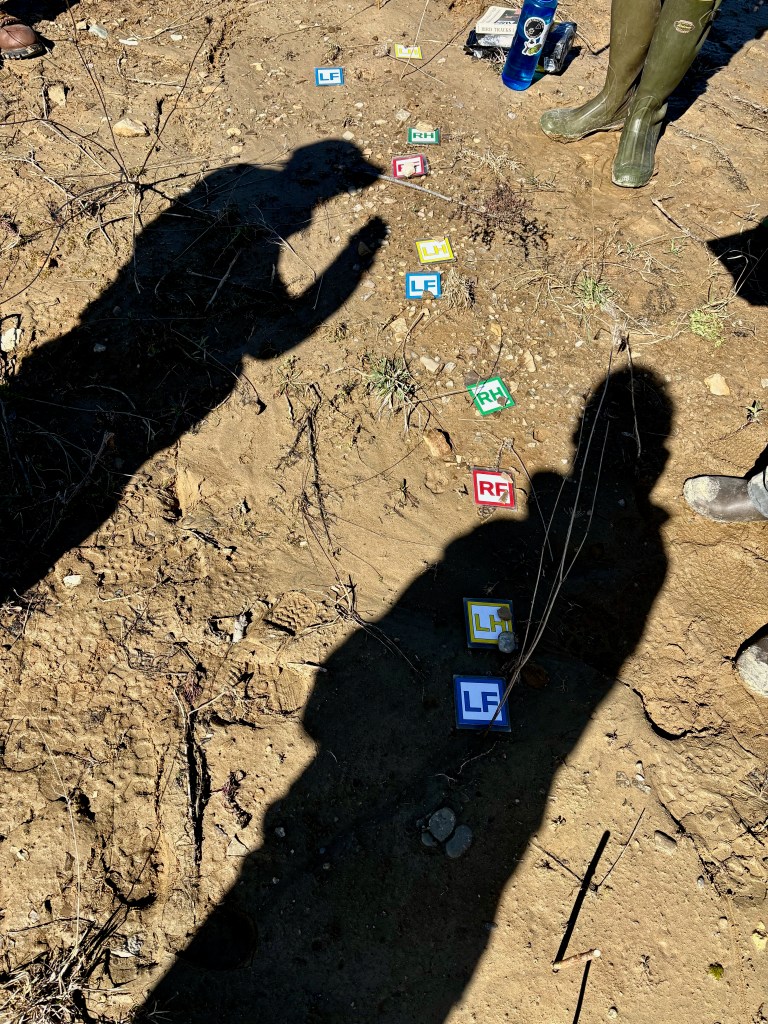
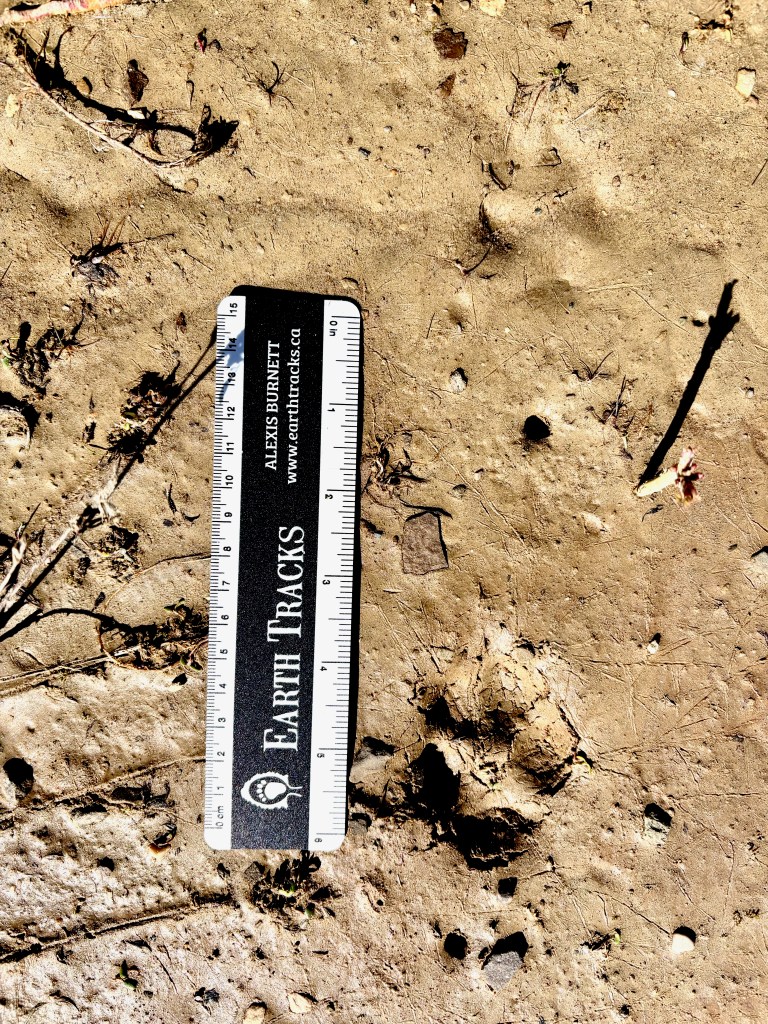
It is hard to see the individual tracks in the first photo without zooming in, but the cards show the pattern of a side-trot. Each pair of tracks consists of a front track followed by a hind track. A side-trot is one of the overstep trot gaits of canids; the other is the straddle-trot. If we draw a median line down the centre of the trail, the left and right pairs alternate on either side of this line.
In the second photo, we see a front-hind pair of tracks. The distinctive chevron-shaped bar is clearly visible in the front track, and to a lesser extent in the hind track. We also see a lot of negative space in the tracks, since red fox feet are heavily furred. The only part of the foot without hair is the rough central pad, which registers as a chevron shape. The front track is about 2 1/2 inches long, so it was probably made by an adult animal (see next set of observations).
The next set of red fox tracks is smaller, with the front tracks measuring about 2 inches long. At first, I wondered whether this might be a young individual, but this measurement is well within the range given for the red fox on page 431 of [1]: 1 7/8 in -2 7/8 in.
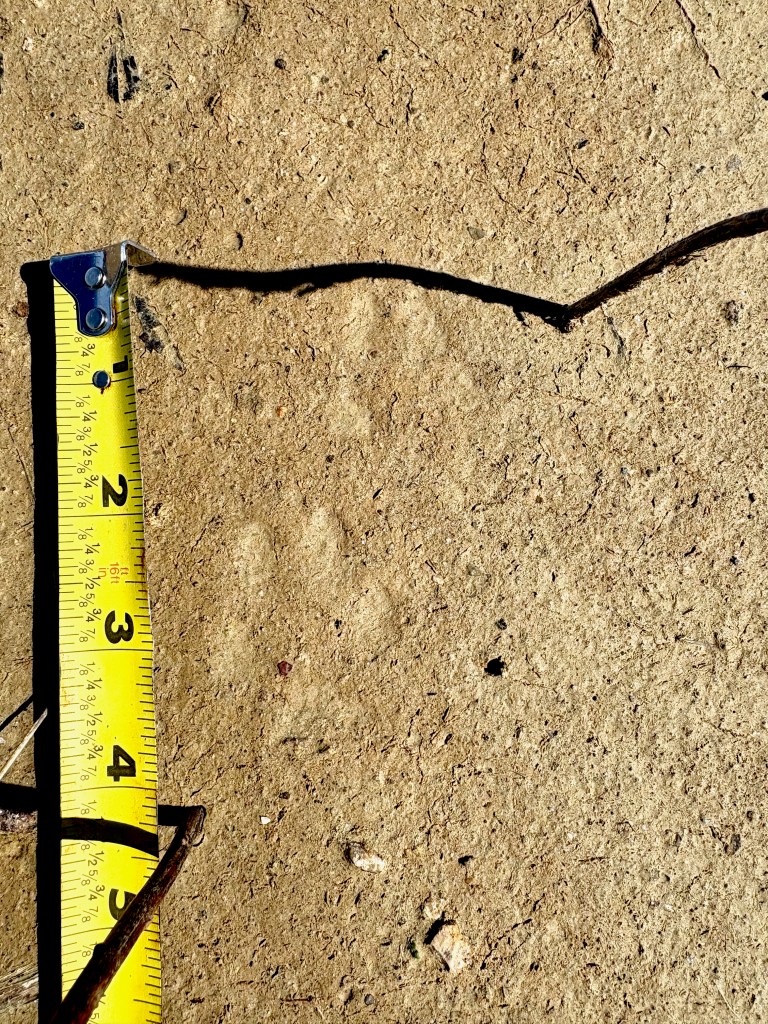
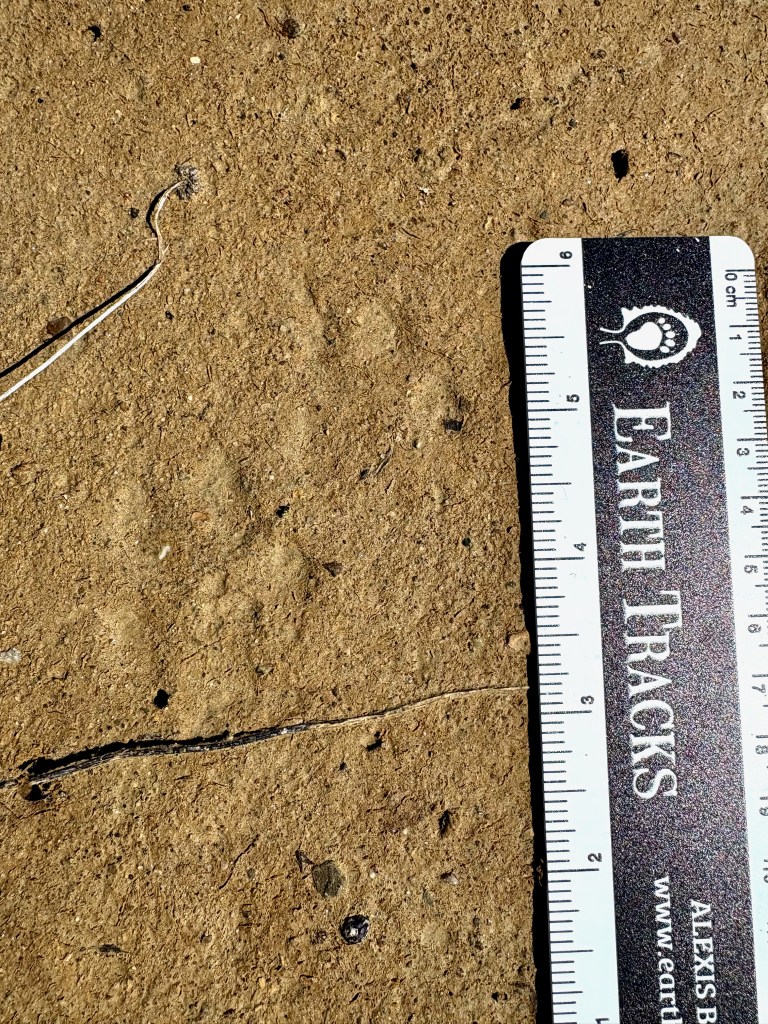
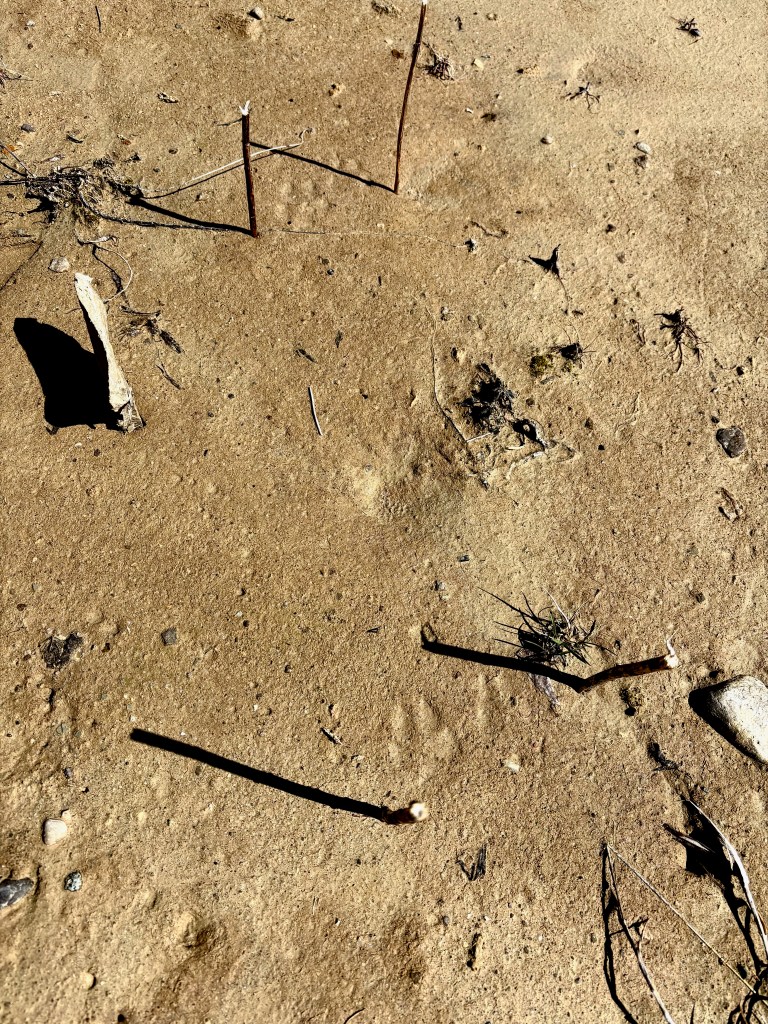
The next set of observations shows a canid in an overstep walk. As I learned in my online SWOTT tracking course (https://www.swott.net/), in an overstep walk, the hind foot lands ahead of the front foot, often close to halfway between two successive front tracks. In a trot, by contrast, the hind foot typically lands much closer to the preceding front track, usually no more than about one-third of the distance between two successive front tracks.
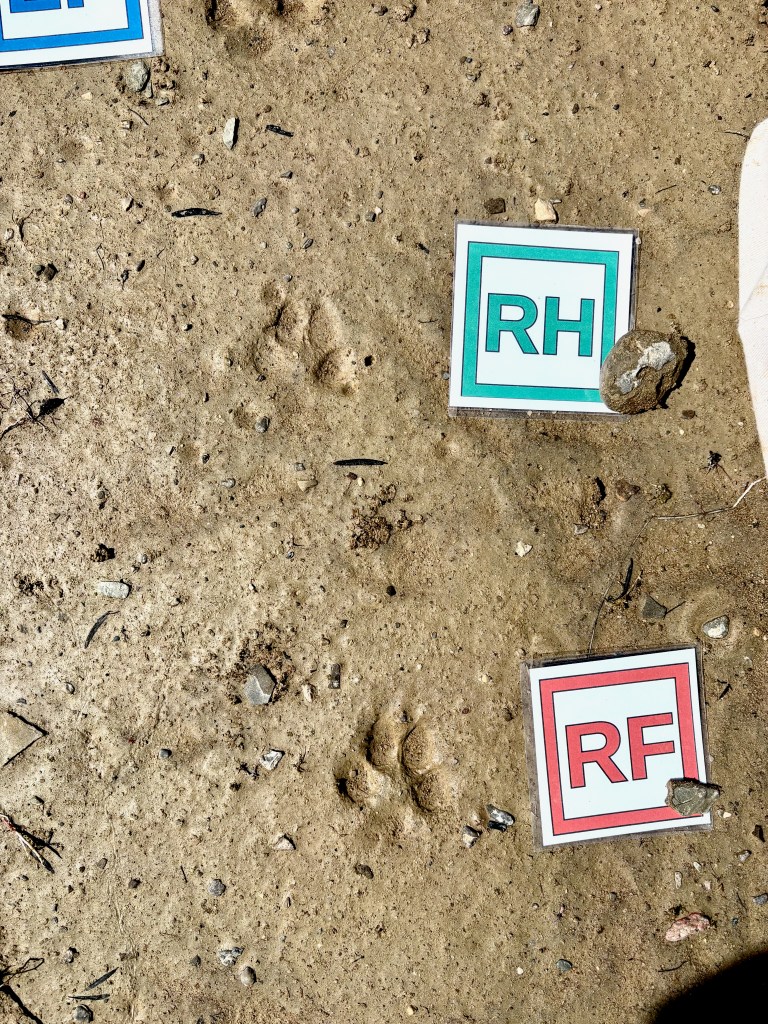
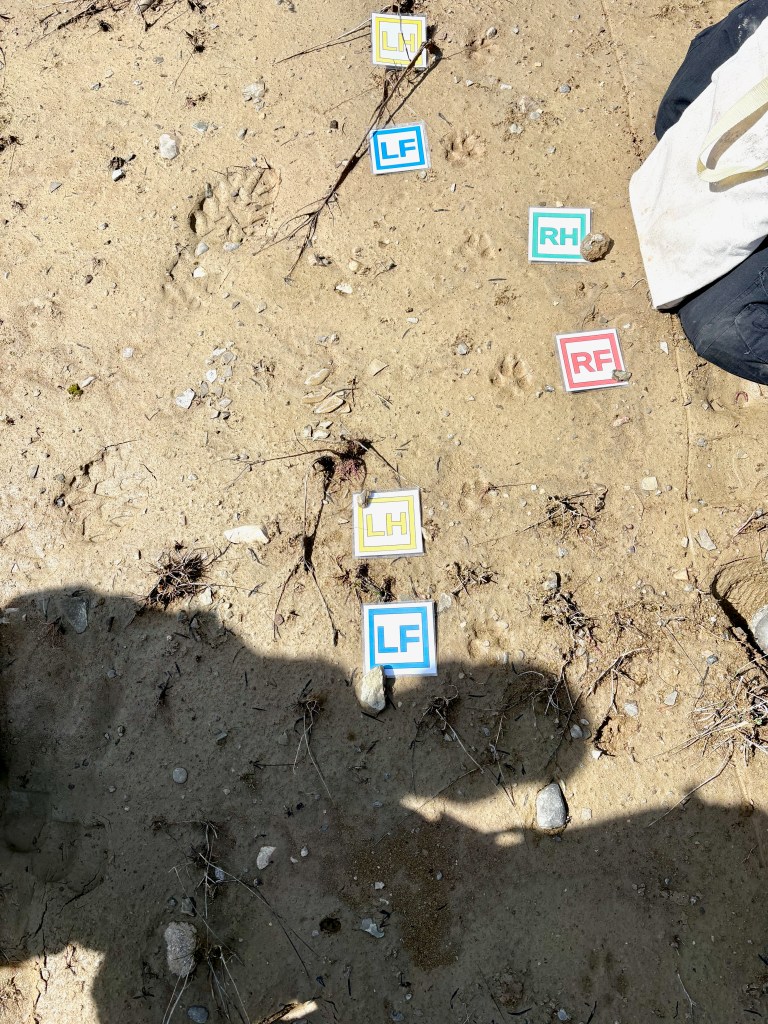
We debated whether these tracks were from a coyote or a domestic dog, since they appeared to show features of both. The tracks were quite oval, with a good amount of negative space and very little toe splay. However, some of the tracks showed fairly large, blunt claw marks that were continuous with the toes, which suggests a domestic dog. But this might be because the tracks were made in mud. The cards have dimensions 4 in × 3 13/16 in.
The next set of tracks is from a Canada Goose.
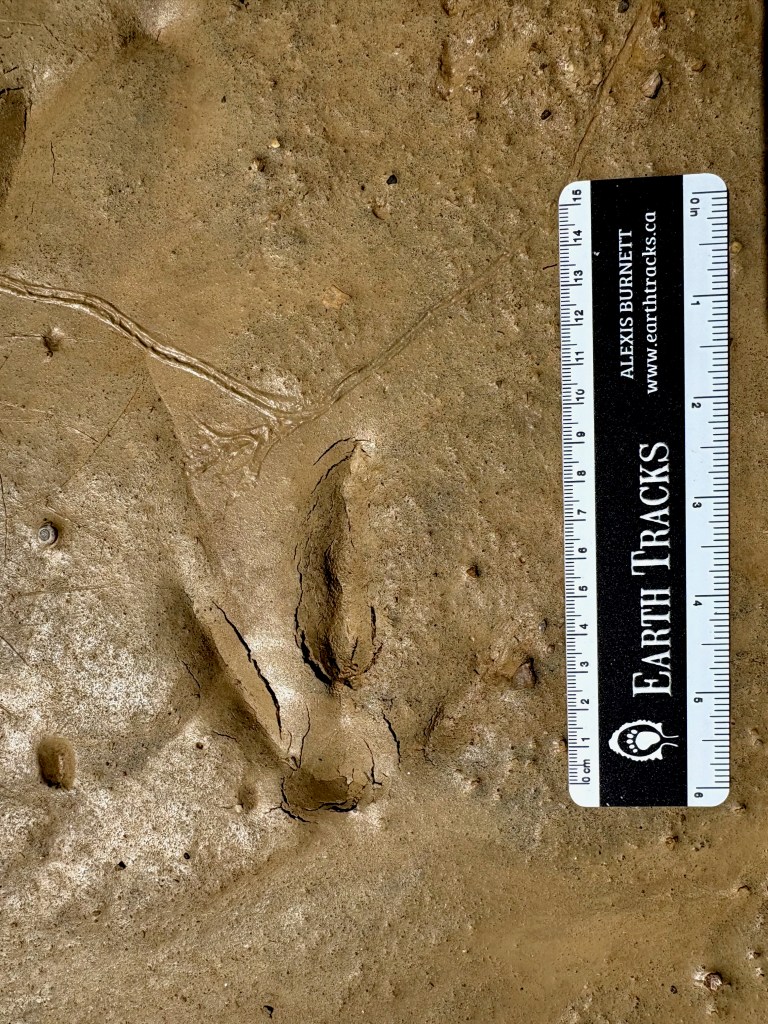
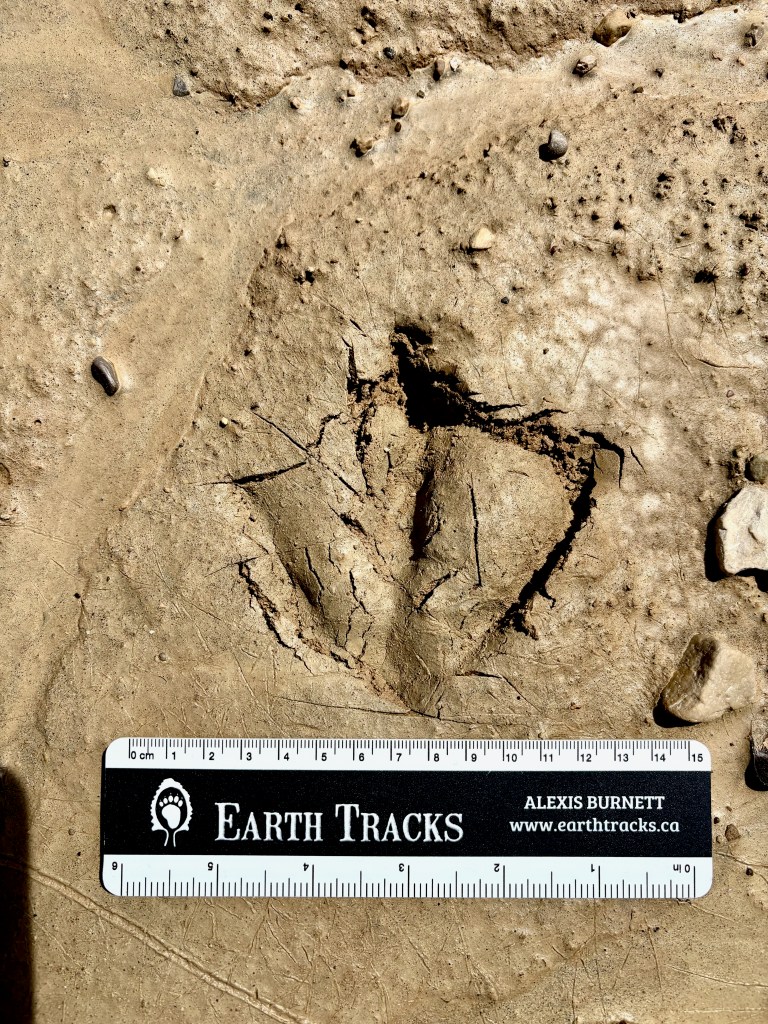
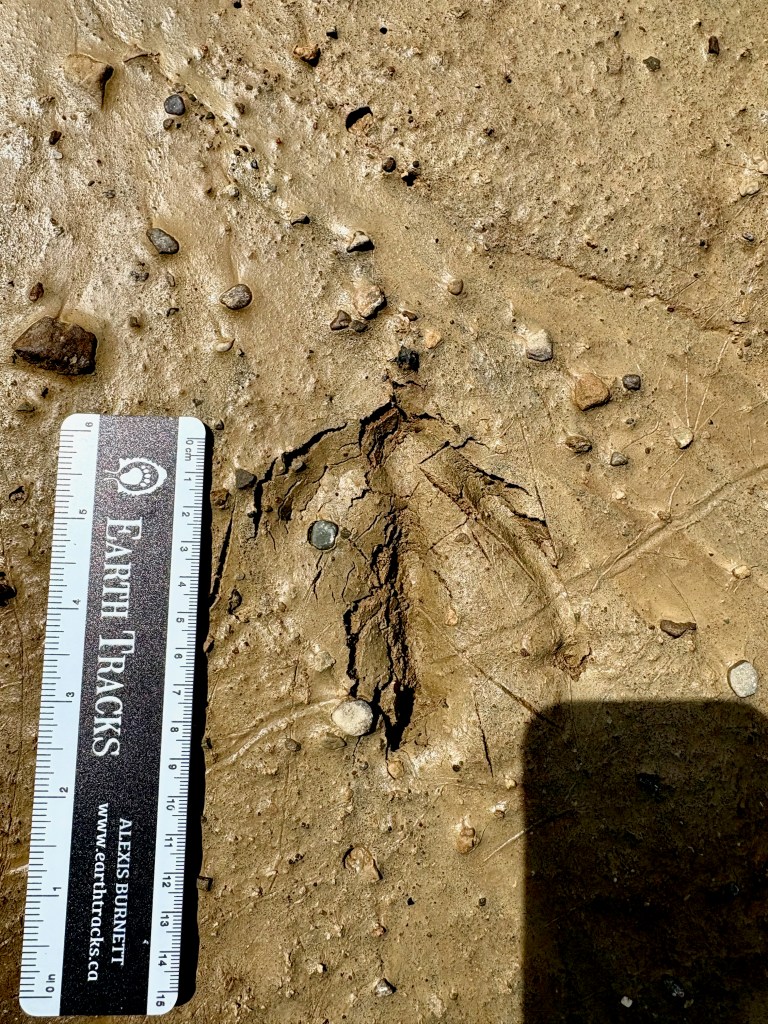
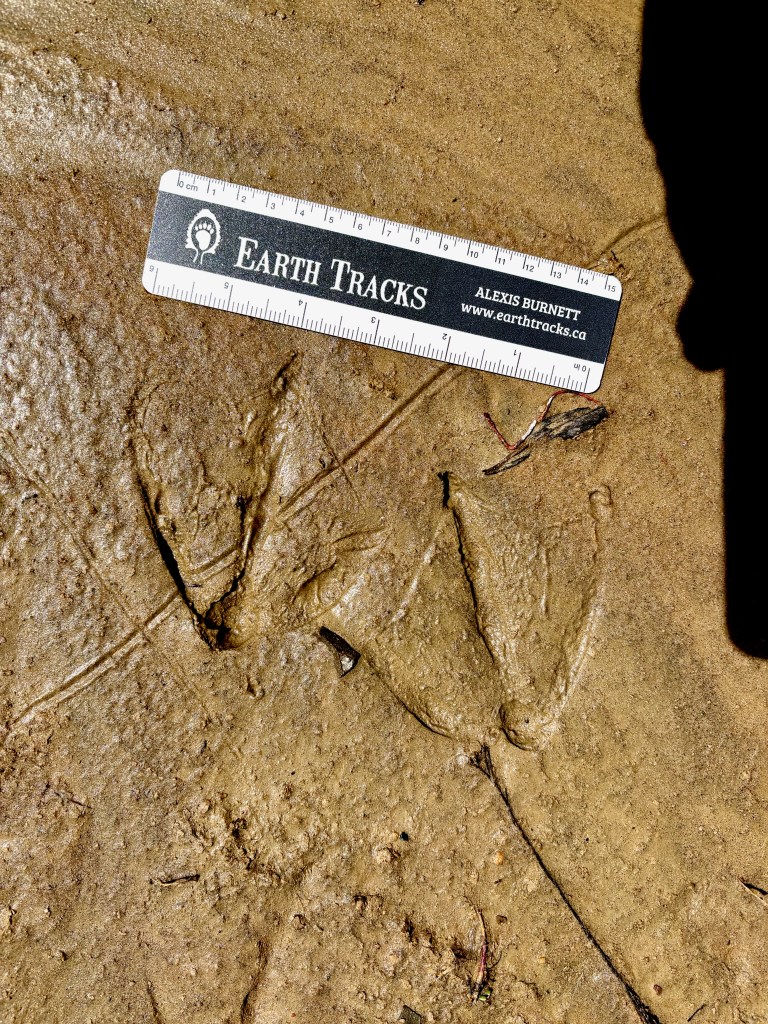
Measuring one of the tracks gives dimensions of 4 in x 4 1/2 in, which is within the range stated for goose on page 151 of [2]. These are webbed tracks, as seen from the second and fourth photos. Technically, the tracks are anisodactyl, meaning that the bird has three toes pointing forward and one toe pointing backward. They are also palmate, meaning that there is webbing between the three forward-pointing toes. Toe 1 often does not register, but the round metatarsal pad often does, as seen in the photos above. Notice also that, as in some other palmate tracks (e.g., gull tracks), the outer toes 3 and 4 curve inward. Another feature, which I did not photograph here, is that the tracks in a trail are usually pigeon-toed.
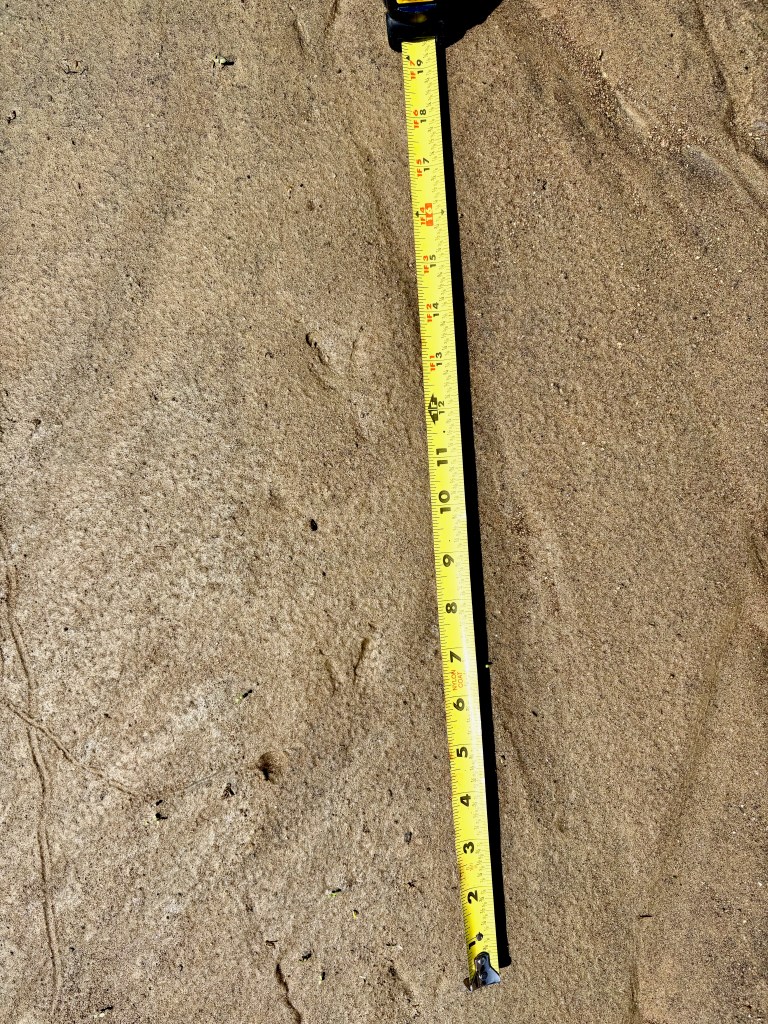
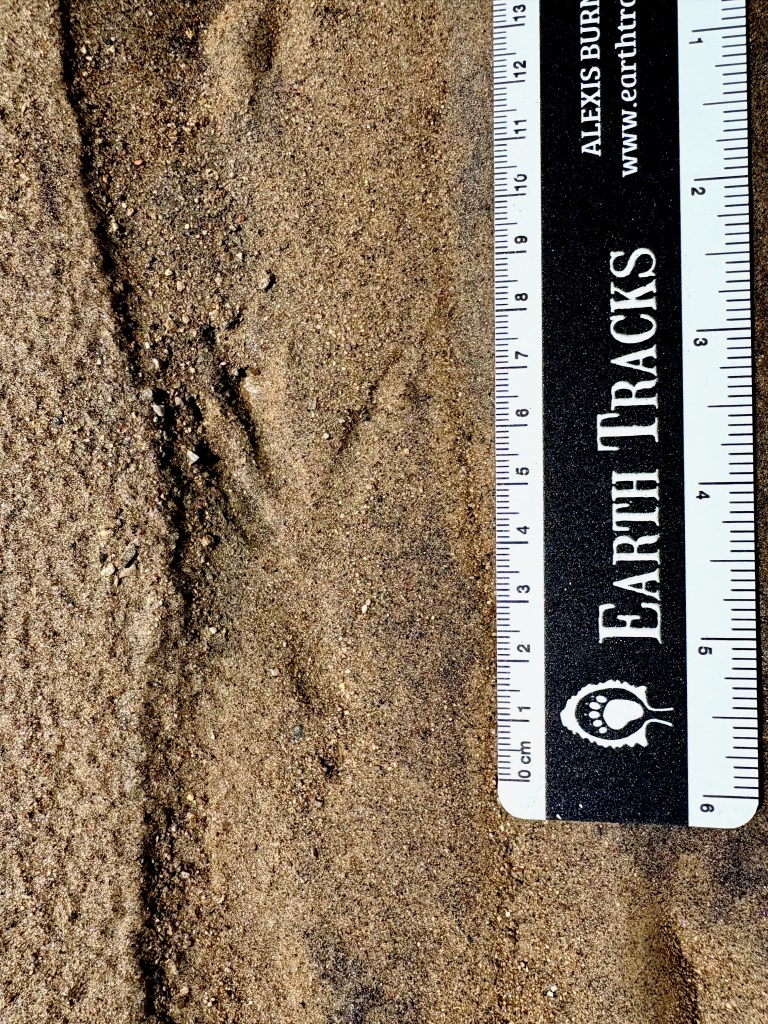
Another bird whose tracks we saw was an American Crow. The tracks are just under 3 inches long. These tracks are worth measuring because they can easily be confused with Common Raven tracks, which are larger. The cut-off point between these two species is about 3 3/4 inches (see page 86 of [2]). These tracks are also anisodactyl, but unlike the goose tracks, toe 1 usually registers and is long. The metatarsal pad registers weakly or is absent from the track. In the second photo, we see that the stride is about 6 1/2 inches, which is still within the range for a walk. For many birds, a walk transitions to a run when the stride is between 2 and 5 track lengths; here, the stride is about 2 track lengths, which is more indicative of a walk. Finally, we can see that the angle between toes 2 and 3 is smaller than the angle between toes 3 and 4, which is characteristic of corvid species.
We went next to the river edge location and had some lunch.
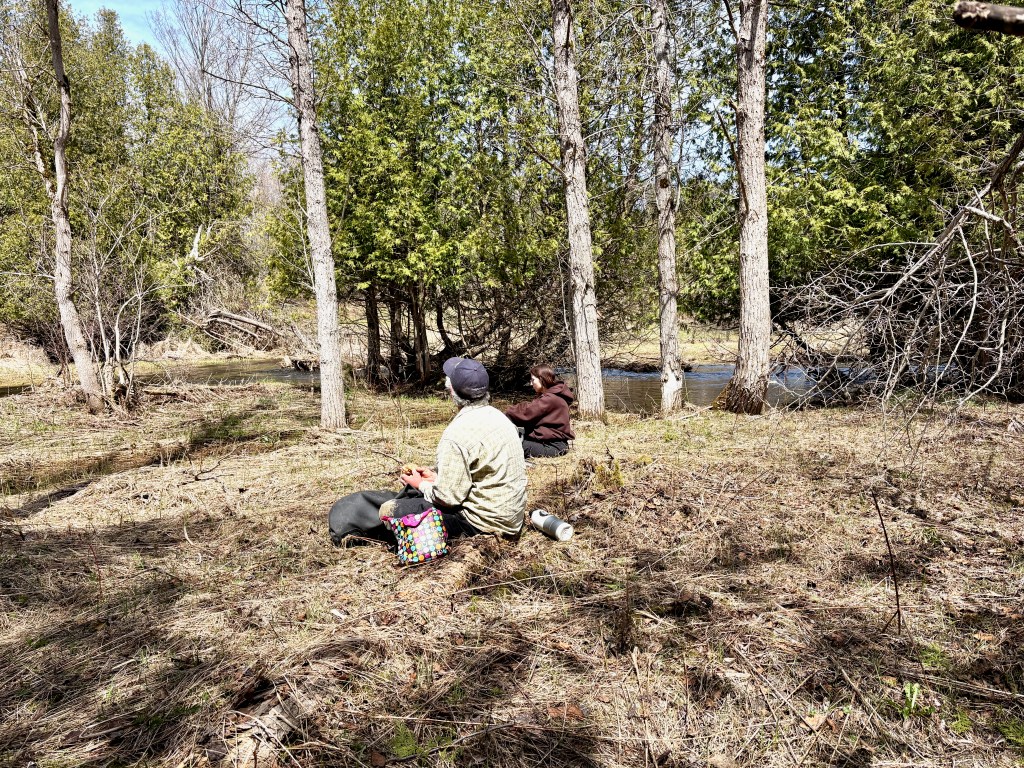
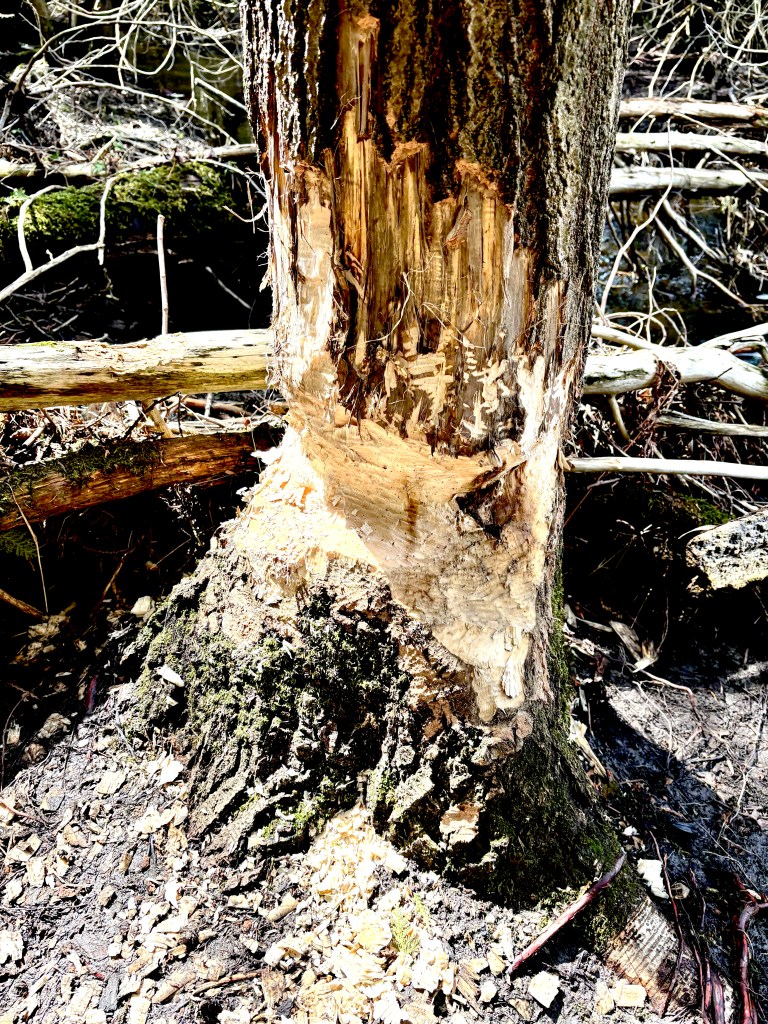
There were signs of beavers everywhere.
We also found some beaver tracks, but these can be surprisingly hard to find because they are often “erased” by the beaver’s tail drag or by trees and branches being carried.
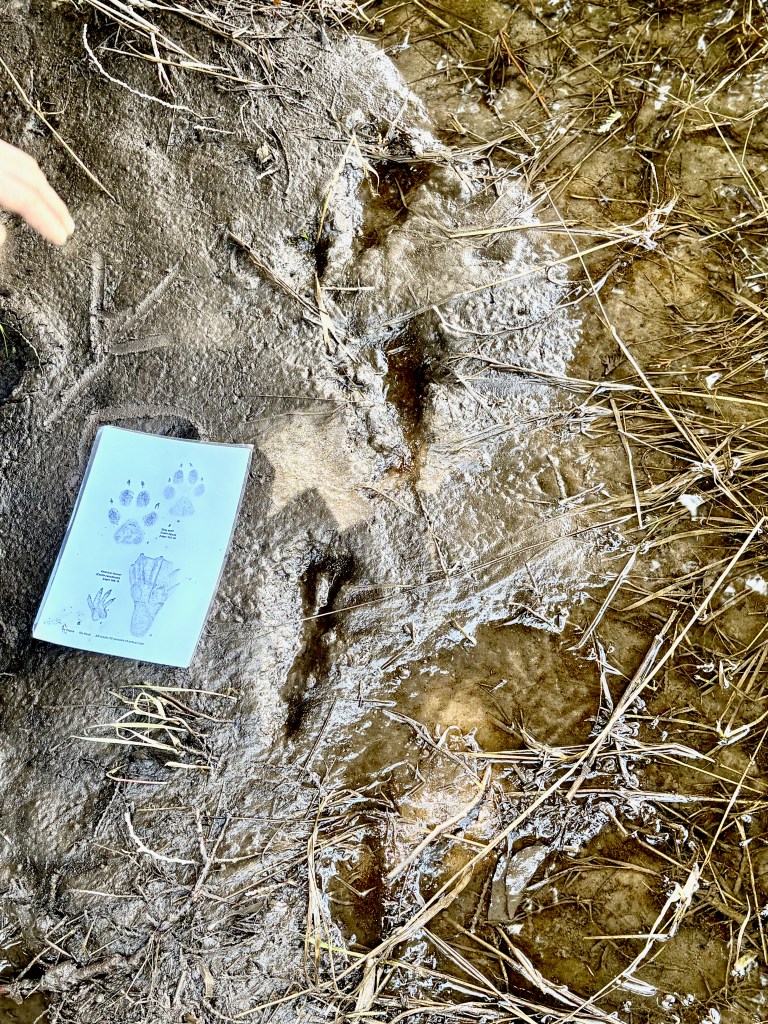
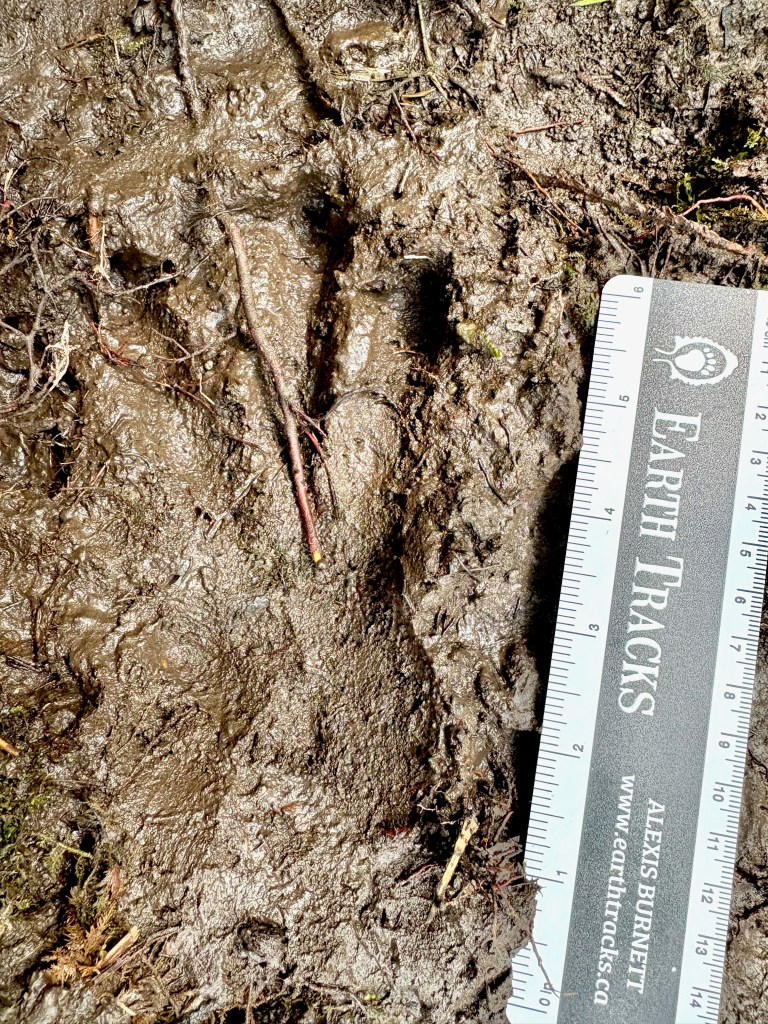
I think the track in the photo on the right is a left hind. As is often the case, the hind tracks obscure or partially cover the smaller front tracks. Also, in all the hind tracks I have seen, the inner toes, 1 and 2, either do not register or barely register at all. Kim Cabrera says in one of her YouTube talks that this is because the animal’s flat tail drags down the middle of the trail, removing the inner toe impressions. Notice also the large, rounded heel of the beaver.
I then moved from the river’s edge up into the cedar forest surrounding the river. The next track led to some debate: who came first, the deer or the turkey? At first, I thought I could see the toe 1 impression over the top of the deer track, which would mean that the deer had come first. That was also the consensus among the other trackers. However, looking more carefully at the photo now, it seems clear that the larger cleave impression pushed up a circular ridge of mud over the toe 3 of the bird. So the turkey must have come first! I have indicated this ridge in red in the second photo.
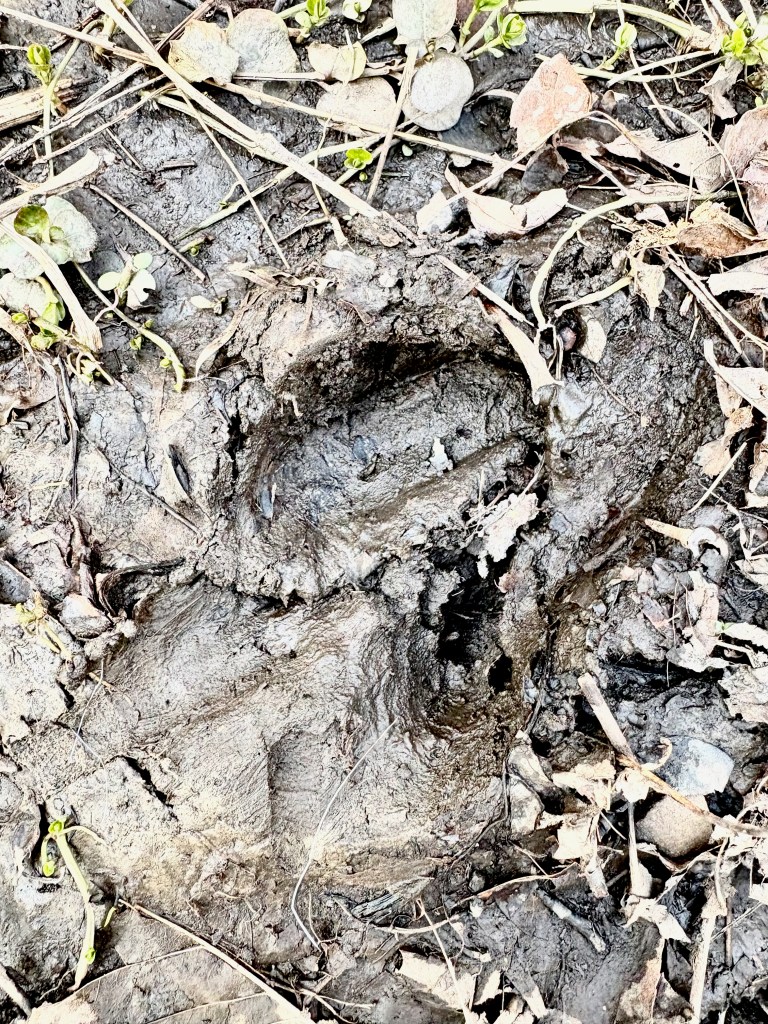
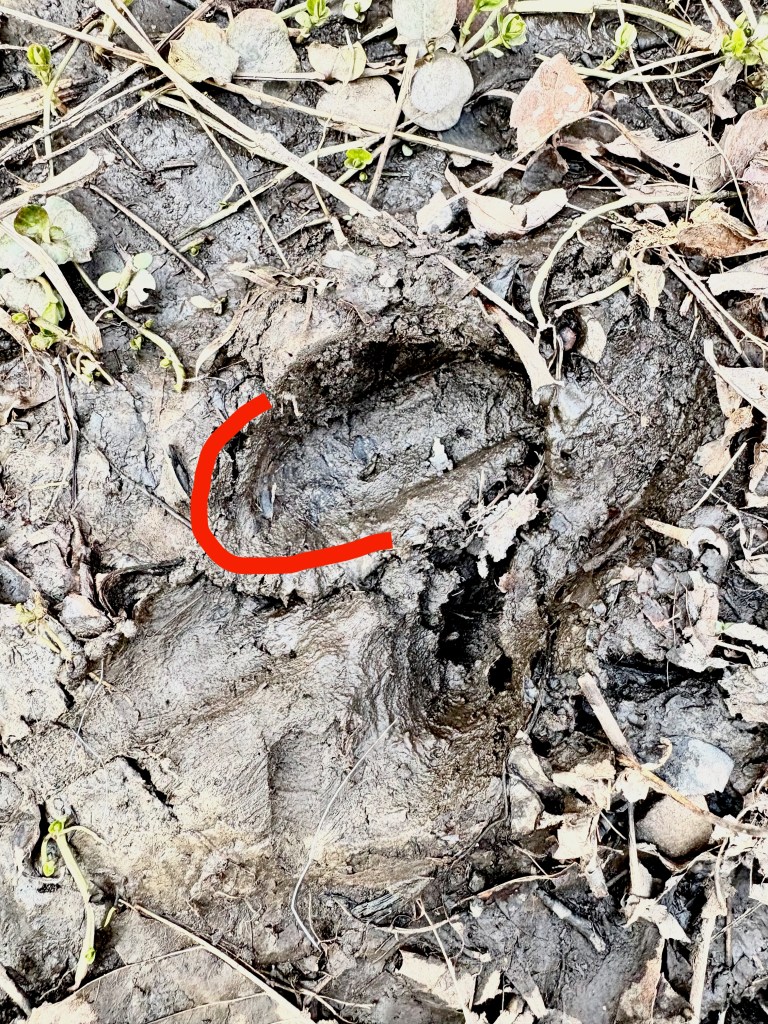
The cedar forest provided ample opportunity to find scat. It was interesting to see the different forms of deer scat, which vary according to the animal’s diet.
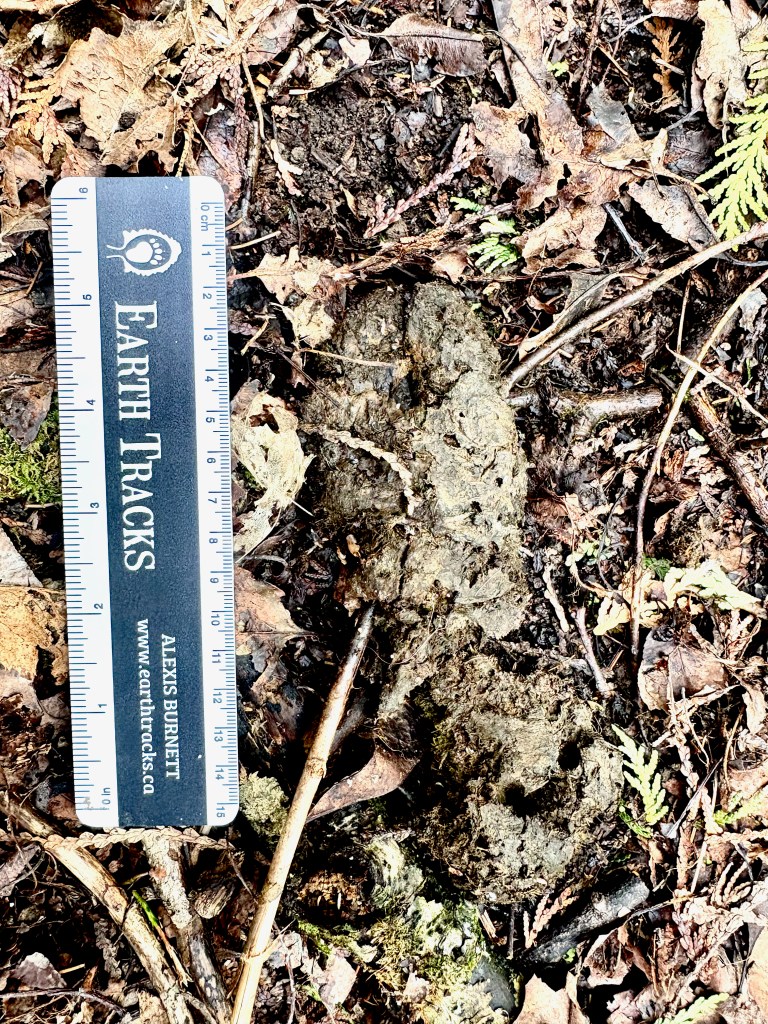
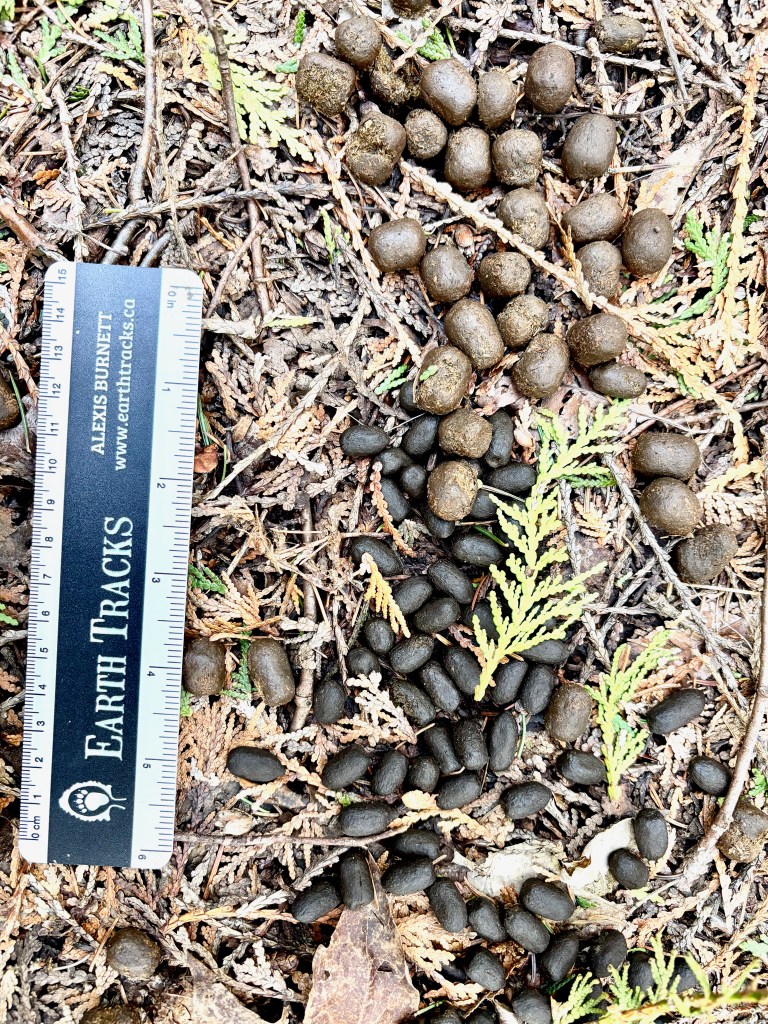
In the first photo, we see that the scat is soft and not in pellet form; it is more like a cow pat, likely due to a diet of fresh green plant material. The second photo shows how deer scat pellets can vary in size, colour, and shape.
There were also numerous other scats:
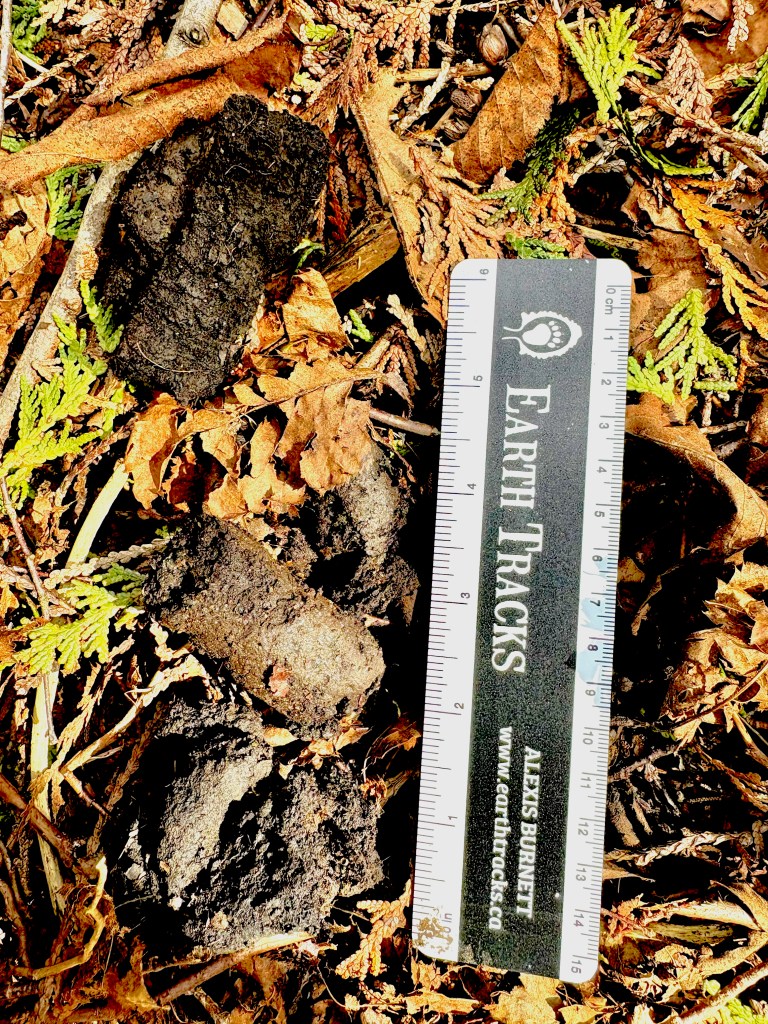
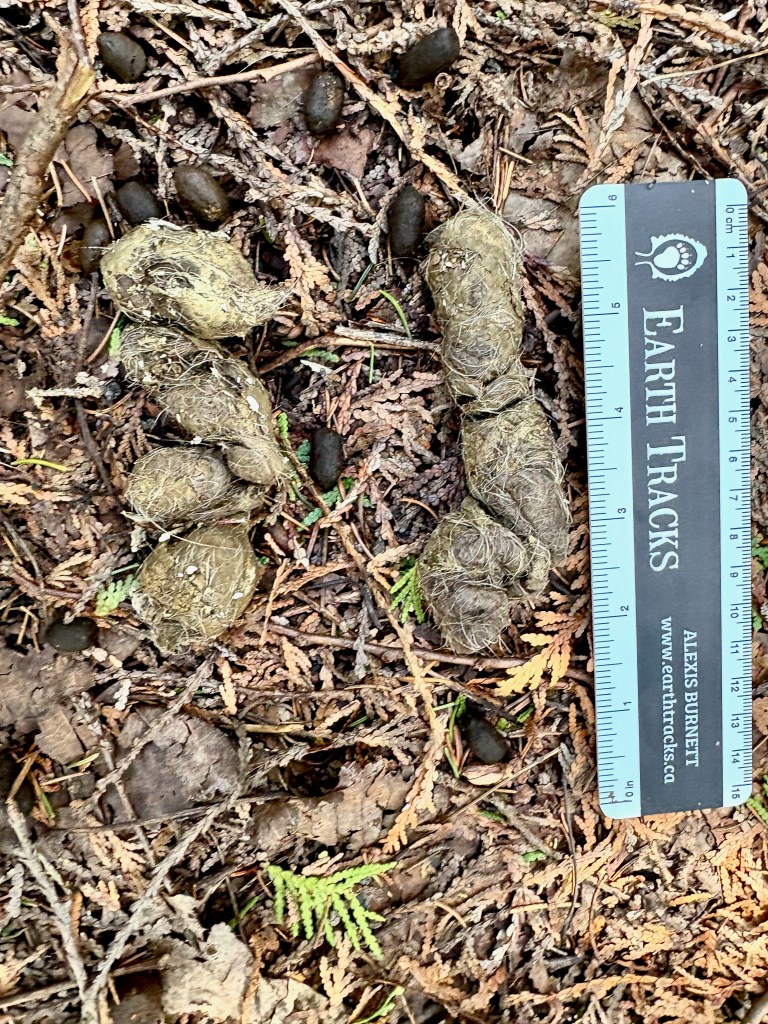
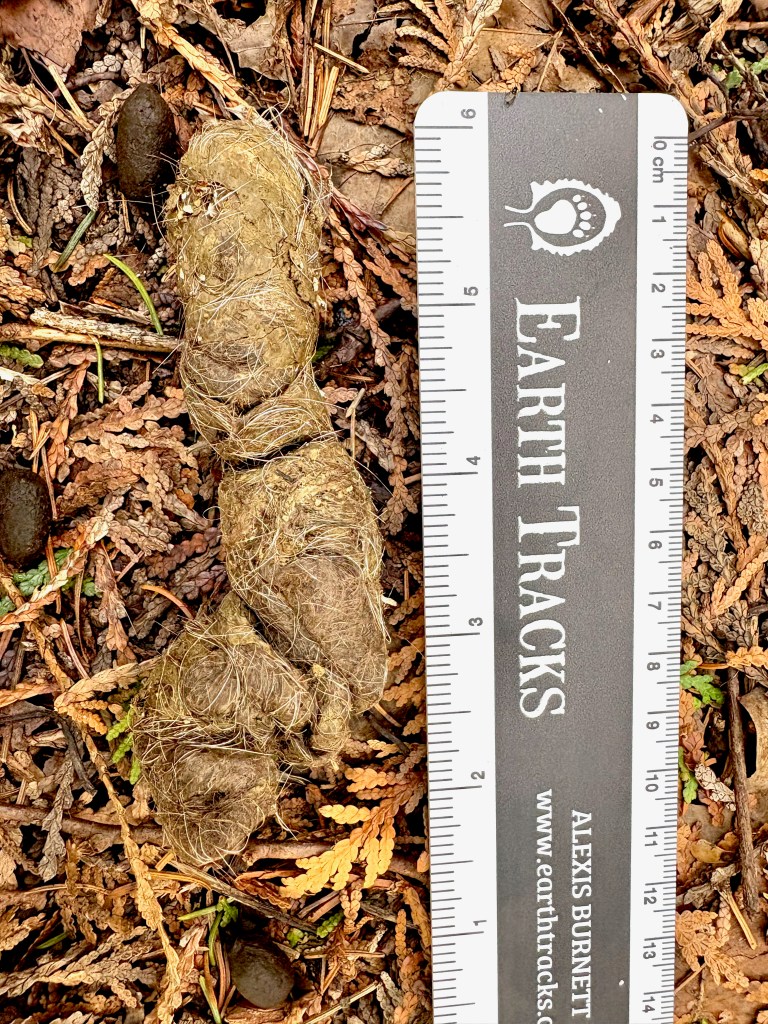
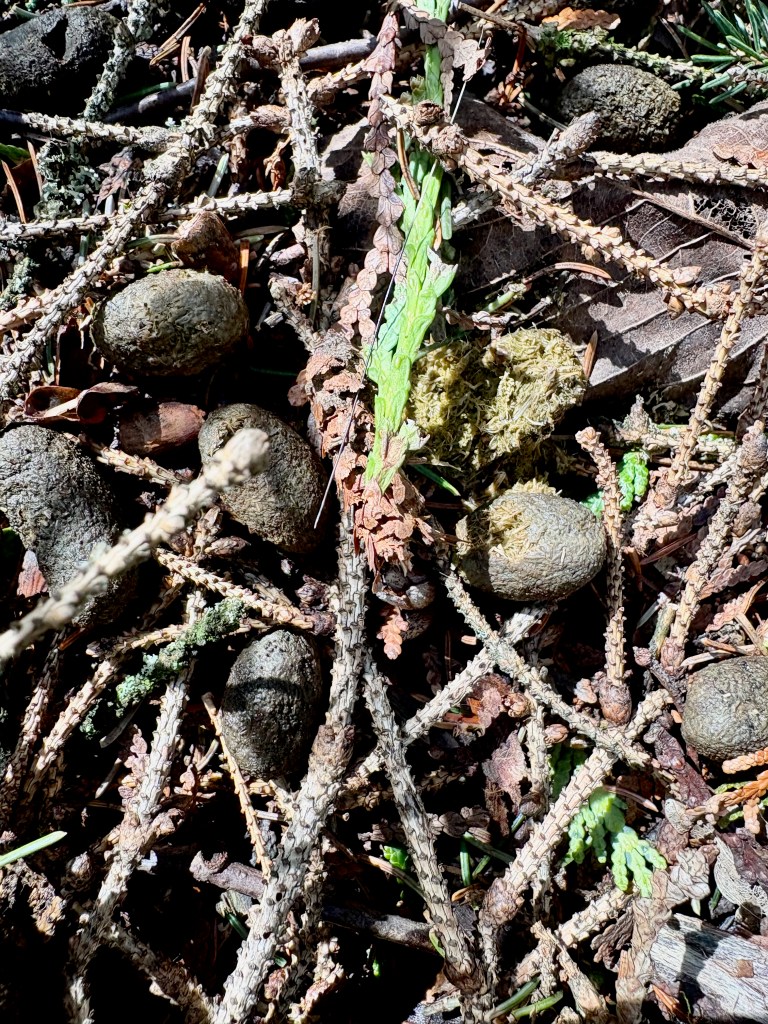
These are likely from: raccoon, fox (& deer), coyote, and porcupine.
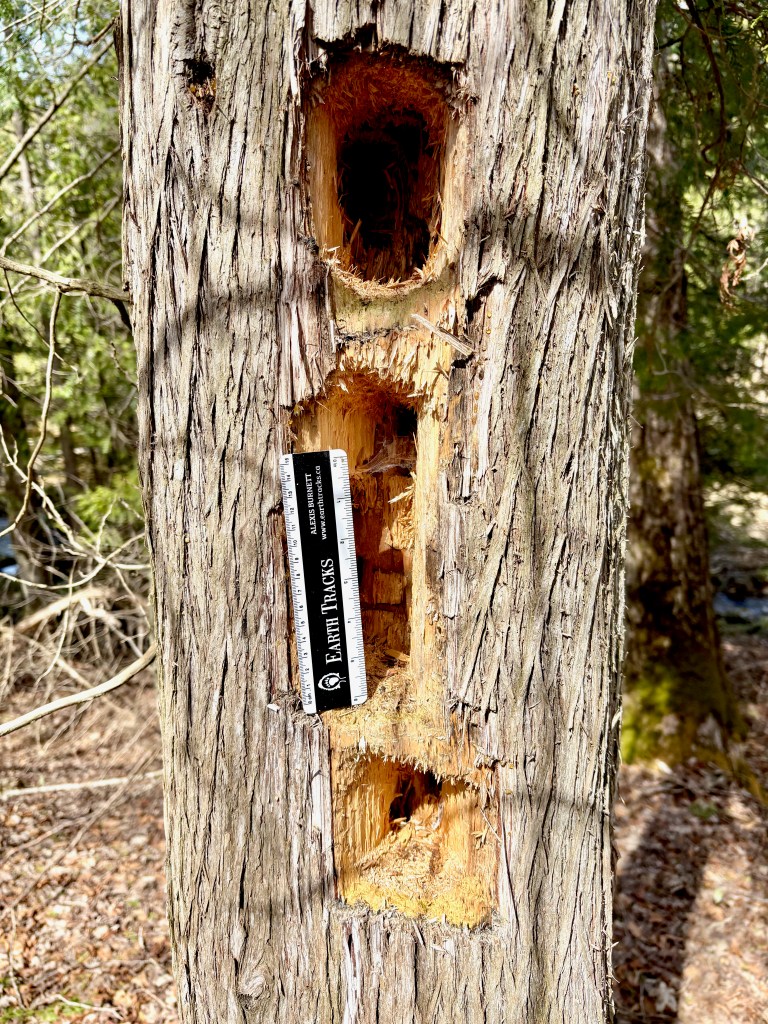
I also saw some fresh Pileated Woodpecker sign, where the woodpecker had been hunting for carpenter ants. If you zoom in on the middle hole in the photo, you can see one of the horizontal carpenter-ant chambers. This is the only woodpecker in our region that can make such large vertical holes in living trees.
Elbroch discusses the many secondary users of Pileated Woodpecker holes, including other birds, mice, and voles (see page 257 of [2]). Next time I see a Pileated Woodpecker hole, I will pay more attention to the associated sign of these secondary users, such as vole scat.
There were many other observations, particularly skulls from porcupine and woodchuck, as well as the smaller bones of shrews inside owl pellets. Hopefully, one of the other trackers will document these observations in more detail.
 Field Notes of a Tracker
Leave a comment