
Date: June 7, 2026 (11 am – 4 pm).
Place: The location is beside Sauble Falls Parkway and the Sauble River, just east of where the river enters Lake Huron and north of Sauble Beach North. On both sides of the highway, white sandy roads and open sandy areas used by ATVs extend into the surrounding forest and shrubland. See the map below.

Context:
This was the second day that participants in the Earth Tracks Tracking Apprenticeship, led by Alexis Burnett, met in the Sauble Beach area. In addition to tracking on the west side of the highway, we also looked for tracks on the east side, along the sandy roads and banks of the Sauble River. However, because good, clear tracks were scarce, I discuss only a few of our observations.
Weather conditions:
The day quickly became hot and brightly sunny, which made observing and photographing tracks more challenging. A light wind was blowing from the north and northeast. As the day wore on, the tracks degraded in quality because of drying and the action of the wind.
References:
– [1] ‘Mammal Tracks & Sign: A Guide to North American Species’, Mark Elbroch, Stackpole Books (2nd Ed.), 2019
– [2] ‘Bird Tracks & Sign’, Mark Elbroch and Eleanor Marks, Stackpole Books (1st Ed.), 2001
Observations:
A. West side of the highway in one of the open circular sandy areas:
My first observations were of lagomorph tracks, which display the typical bounding pattern with the larger hind feet ahead of the front feet. There is considerable overlap in track measurements between Eastern Cottontail and Snowshoe Hare. I recorded the following measurements:
Group length: 8 in
Trail width: 4 in (just under)
Hind track width: 1 in, 1 1/4 in

Looking in [1], I think these measurements are more consistent with Eastern Cottontail. There is also a fair amount of detail in the tracks, especially in the toe impressions, which further suggests cottontail. Although the feet of both Eastern Cottontail and Snowshoe Hare are furred, Snowshoe Hares have especially large, heavily furred feet. For that reason, I would expect Snowshoe Hare tracks to show less fine detail than these tracks, at least under similar substrate conditions.
I have noticed that it is sometimes easier to identify a set of tracks in the field than from measurements taken from a photograph. As was discussed in a recent tracking podcast I was listening to (Tracker Tuesday #4), this may be the difference between knowing facts about an animal, such as the trail width of a cottontail being 2 to 5 inches, and being truly familiar with a species through extensive dirt time. In the field, I often find that I have an intuitive sense of which animal made the tracks I am seeing. Of course, that intuition can be wrong, which is why measurements and careful observation are still important.
The following lagomorph tracks are larger, with less detail visible in the impressions, likely because of the extensive fur on the feet. I think these tracks were made by a Snowshoe Hare.


Many of the tracks were older, showing considerable weathering. For example, the tracks below are also clearly Snowshoe Hare:

And the next photos show a Wild Turkey, a Striped Skunk in an overstep walk, and a Raccoon, respectively. The turkey tracks are hard to see.


Sometimes I could not figure out what had made a particular set of tracks. For example, were the scrapes shown below made by a turtle’s claws? This seems plausible, as there appear to be two parallel sets of claw marks about 3 1/4 inches apart. If these were made by a turtle, the trail width seems too small for a Snapping Turtle.
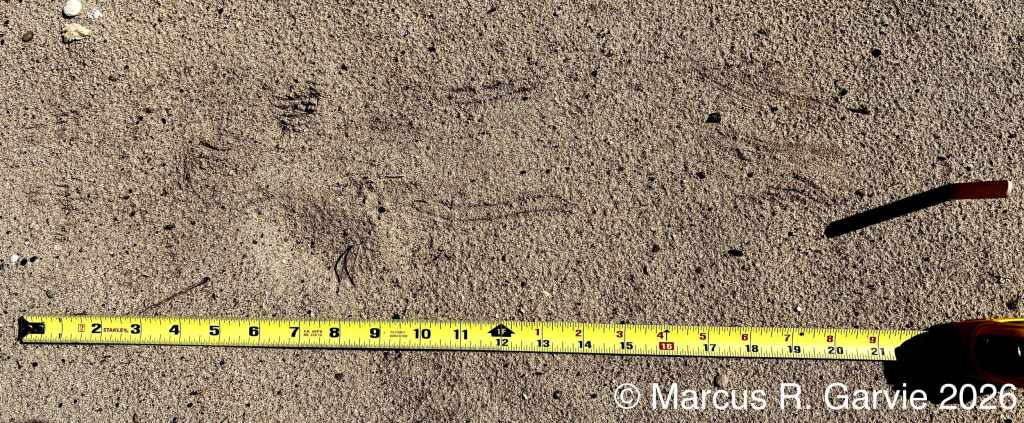
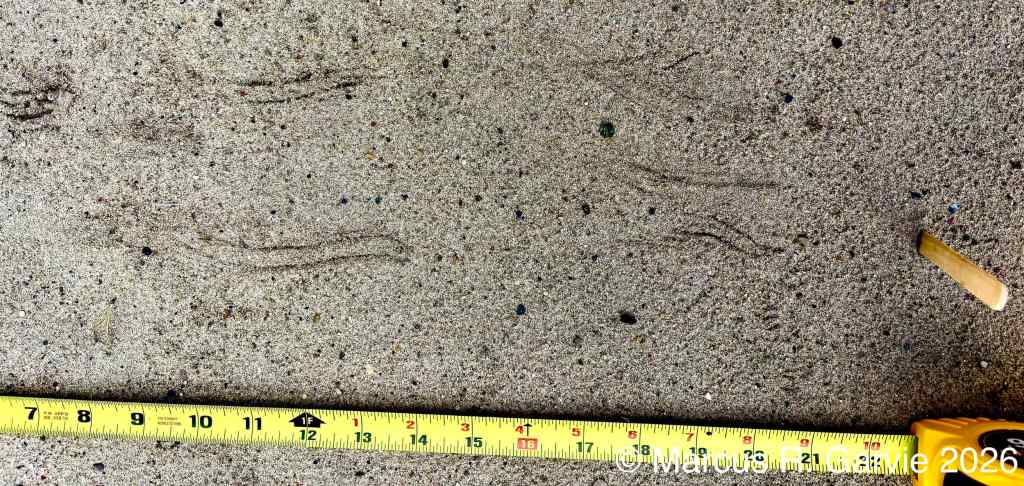
There were several small mammal tracks, but the details were often too faint or incomplete to photograph well. The photo below is fairly clear. Because of the small size, the toe impressions do not clearly connect to the pads, and the smaller heel pads behind the front feet, my best guess is that an Eastern Chipmunk made these tracks. I think the upper track may be from a hind foot, and the lower track from a front foot.

We also found some very recent White-tailed Deer tracks, including examples of both a direct register walk and a direct register trot. In some of the tracks, moisture was still visible, changing the colour of the sand within the impressions. As the morning progressed, this moisture dried, and the tracks gradually faded back to the lighter colour of the surrounding dry sand.


In the first photo, the difference between the left and right tracks is obvious, and the stride, or half-step, is about 22 inches. This suggests a walk rather than a trot (see [1]). In the second photo, the tracks are almost in a straight line, indicating a trot. If you look carefully at the top of the first photo, you can see faint turkey tracks, while at the bottom of the second photo there is another trail. Could this be from a trotting canine?
After investigating these tracks, I crossed the highway to be along the Sauble River.
B. East side of the highway on the sand-covered trails alongside the Sauble River:
The following observations are beautiful examples of coyote tracks.


Here are some coyote characteristics that I have learned:
- Oval, compact track
- Front track wider than hind track
- Four toes usually register
- Claws often show as fine pinpricks
- Claws may point inward
- Claw marks, usually disconnected from toes
- Front pad usually triangular
- Hind pad narrower, sometimes oval with small “wings”
- Little negative space between toes
- Toes usually point forward, with little splay
- May show fur in fine substrate
- Weight more forward, particularly in the hind feet
The only other species to consider here is Red Fox. However, the front track seems too large, at about 3 inches long, and there is more detail visible in the track than I would expect for Red Fox, whose tracks often show more negative space because of the fur on the feet. I also do not see the characteristic chevron shape in the palm pad for a Red Fox.
The only puzzling thing about these tracks is the gait. I looks to me as though the front tracks are ahead of the hind tracks, which would suggest an understep walk, which is less common for this species. However, I know from my reading in [1] that an understep walk in a canine suggests extreme caution, or maybe stalking behaviour.
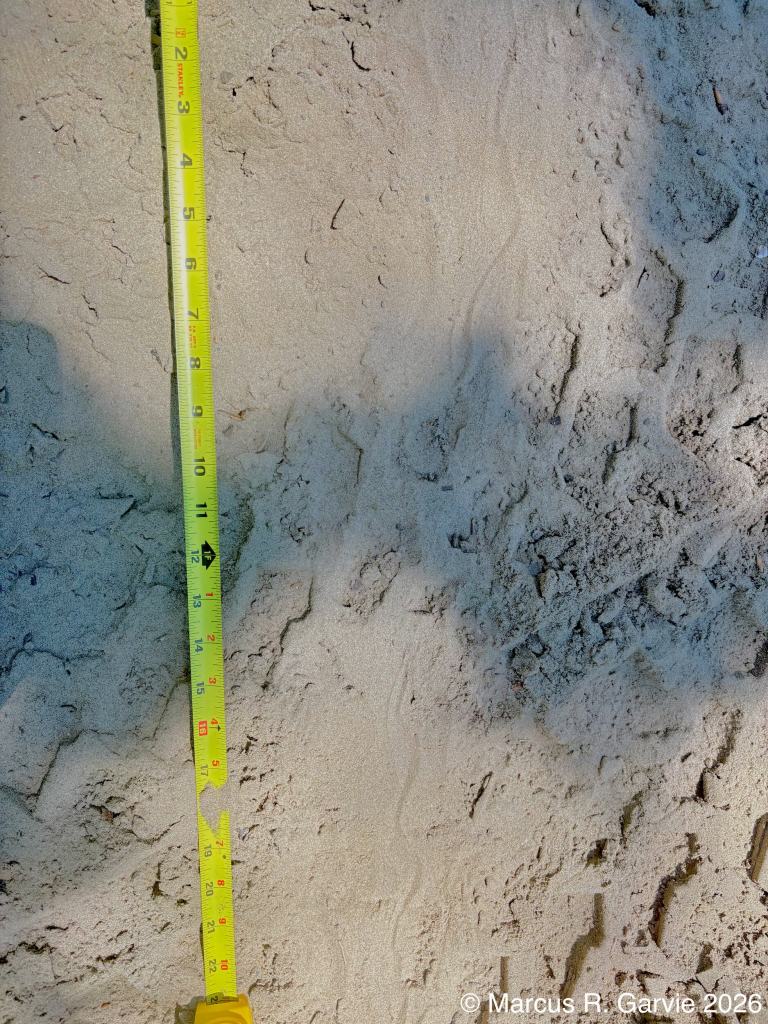
In the next set of tracks, I am seeing what look like drag marks across the sandy road. I wondered whether these were made by a turtle. Unlike the previous suspected turtle tracks, however, these marks may have been made by the plastron, the underside of the shell, rather than by the claws. In the last picture, I think we can also see tail drag marks. The trail width is about 2 1/2 to 3 inches.
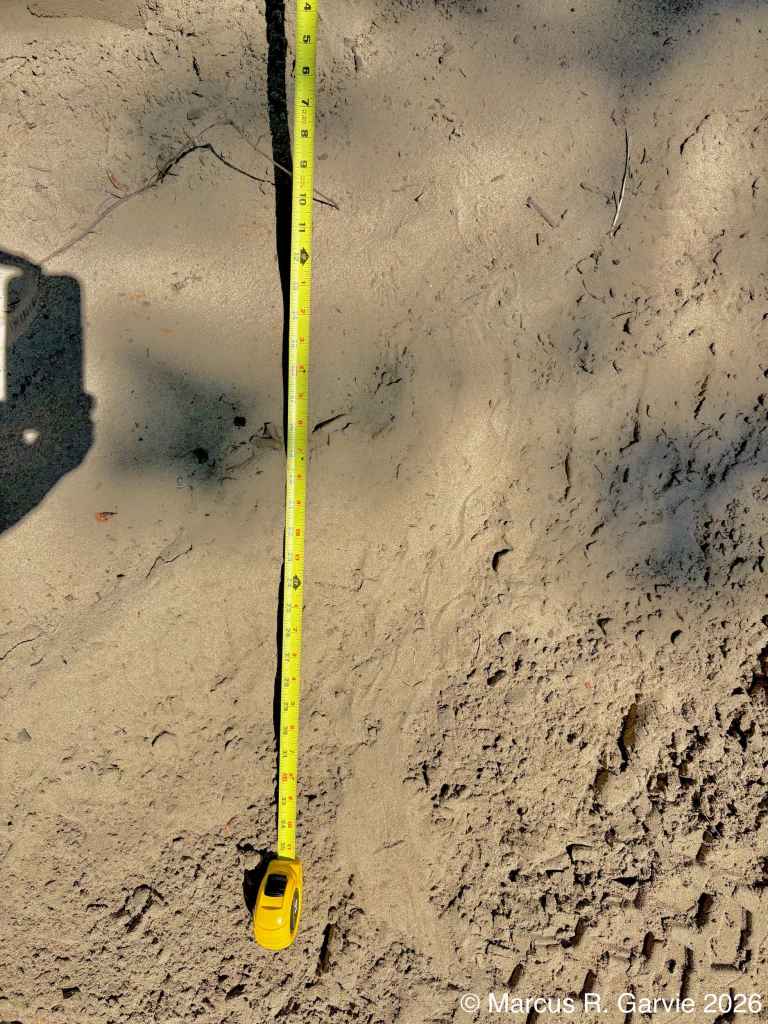
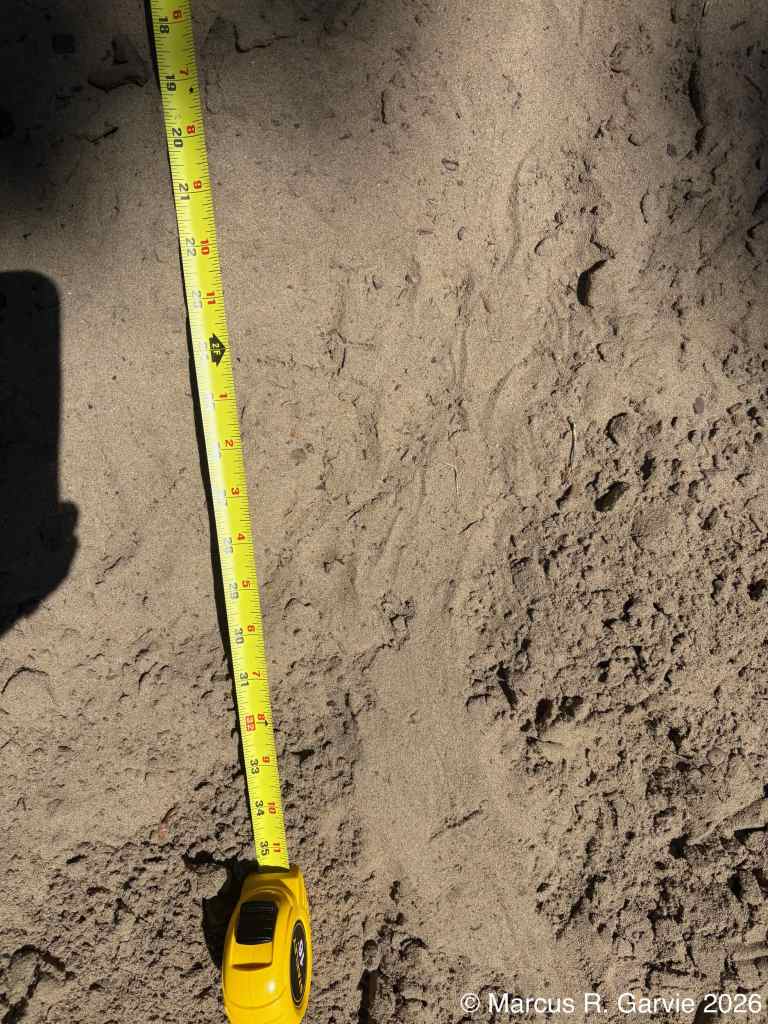
At the end of the day, I decided to search for tracks in the forested area along the river’s edge. I was hoping to find bear tracks, but travelling through the dense undergrowth was difficult, and there were hordes of mosquitoes. I did not find any bear tracks, but I did find a porcupine den, with a large amount of scat nearby. The hole in the tree seemed to have been enlarged by gnaw marks. Could the porcupine have done this?

Final thoughts:
Sand is my favourite substrate for tracking. What I like about it is that it presents so many mysteries for us to try to solve. In his tracking videos, Tracking Pack One, Jon Young explains that many of the world’s most renowned Indigenous tracking traditions developed in sandy places, including those of the Apache in the southwestern United States, the San Bushmen of the Kalahari, and Aboriginal peoples in Australia.
Leave a Reply