Date: March 18, 2023
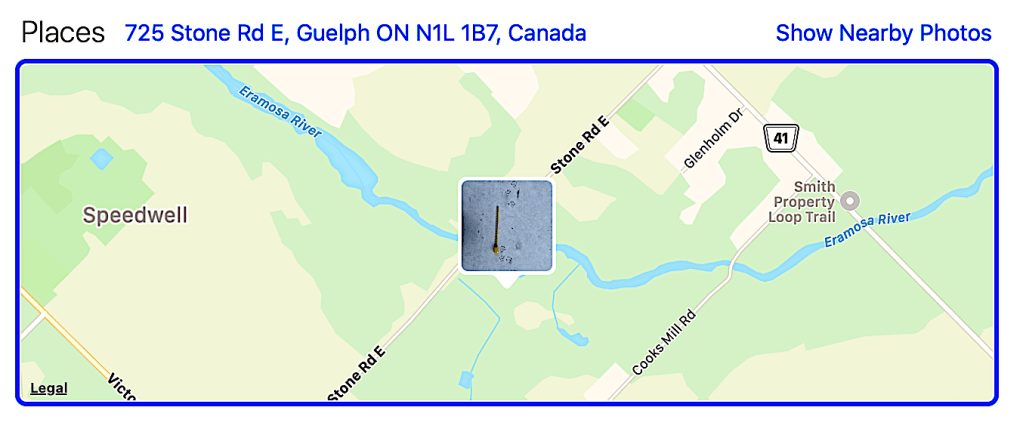
Place: Guelph Outdoor School (GOS), Guelph ON. See the map below:
Time: around 4:15pm.
Main references:
‘The Tracker’s Field Guide: A Comprehensive Manual for Animal Tracking’, James C. Lowery, Second Edit., A Falcon Guide
‘Mammal Tracks & Sign: A Guide to North American Species’, Mark Elbroch and Eleanor Marks, First Edit., Stackpole Books
Photos and discussion: about a year ago while waiting to pick my son up from the GOS I found some very confusing tracks. I photographed them and promptly forgot about them! Now re-looking over my old photos (as we currently have no snow!) I was motivated to try and figure out who made them. Let me first show the tracks that I also measured with a tape measure:
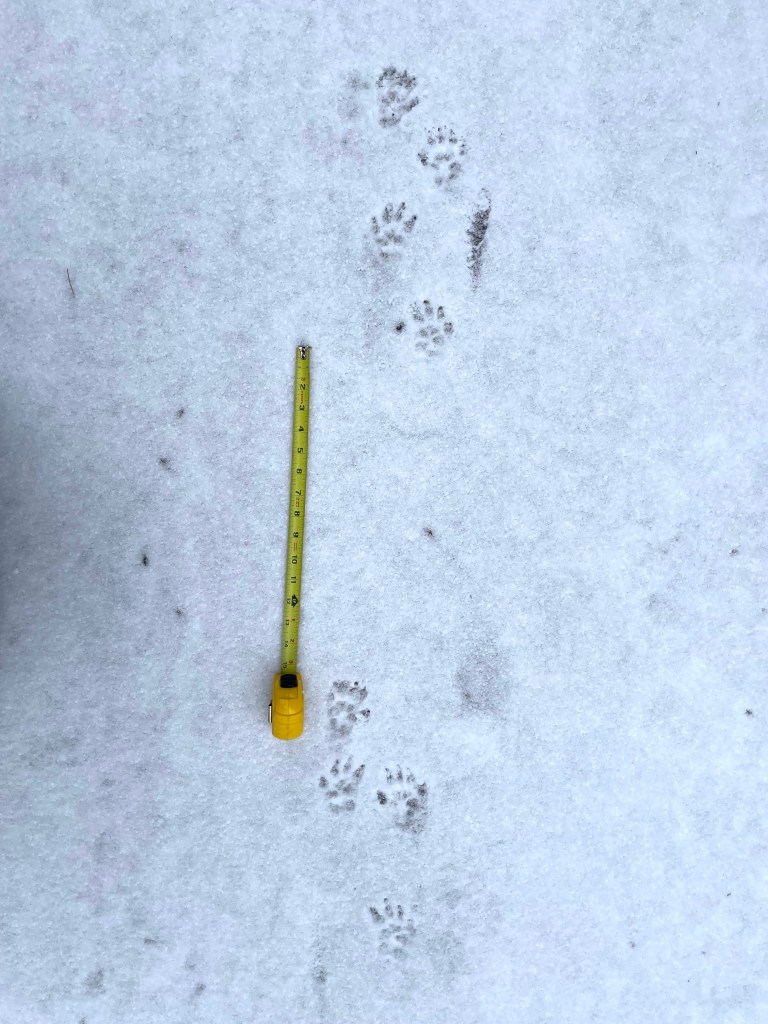
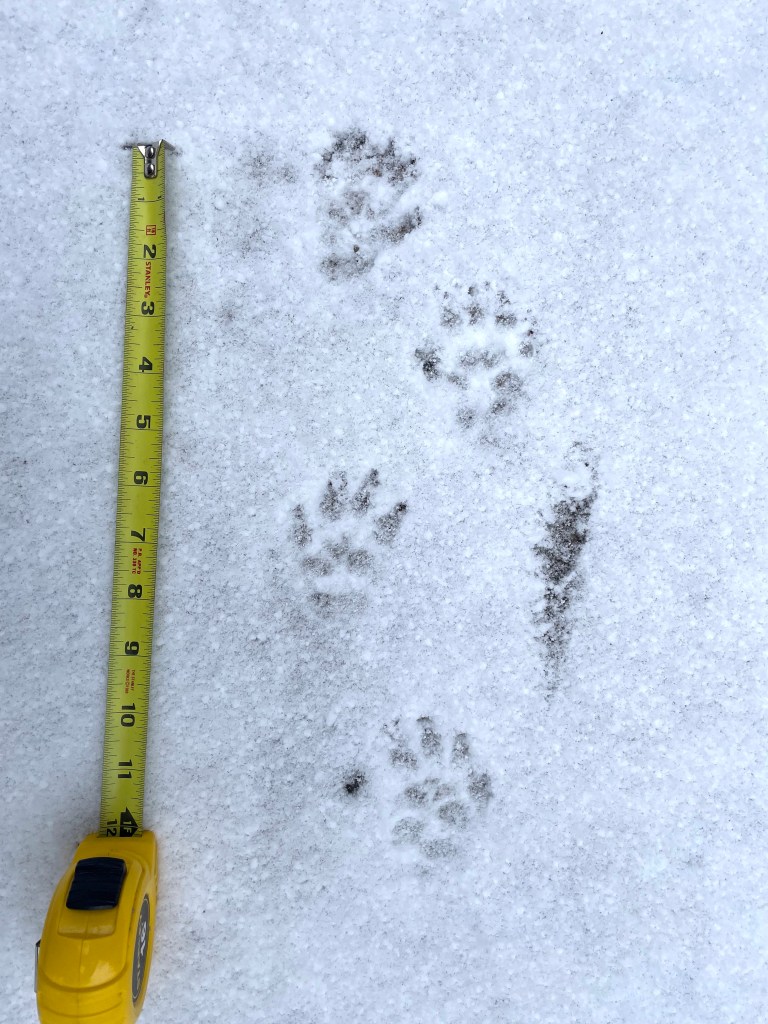
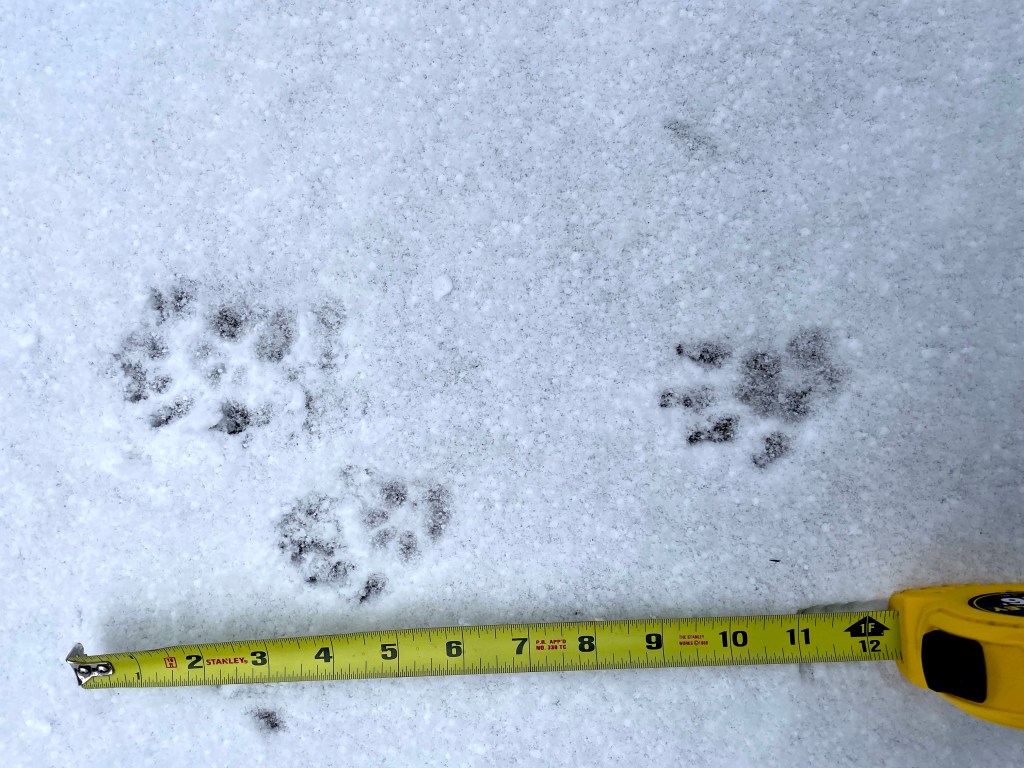
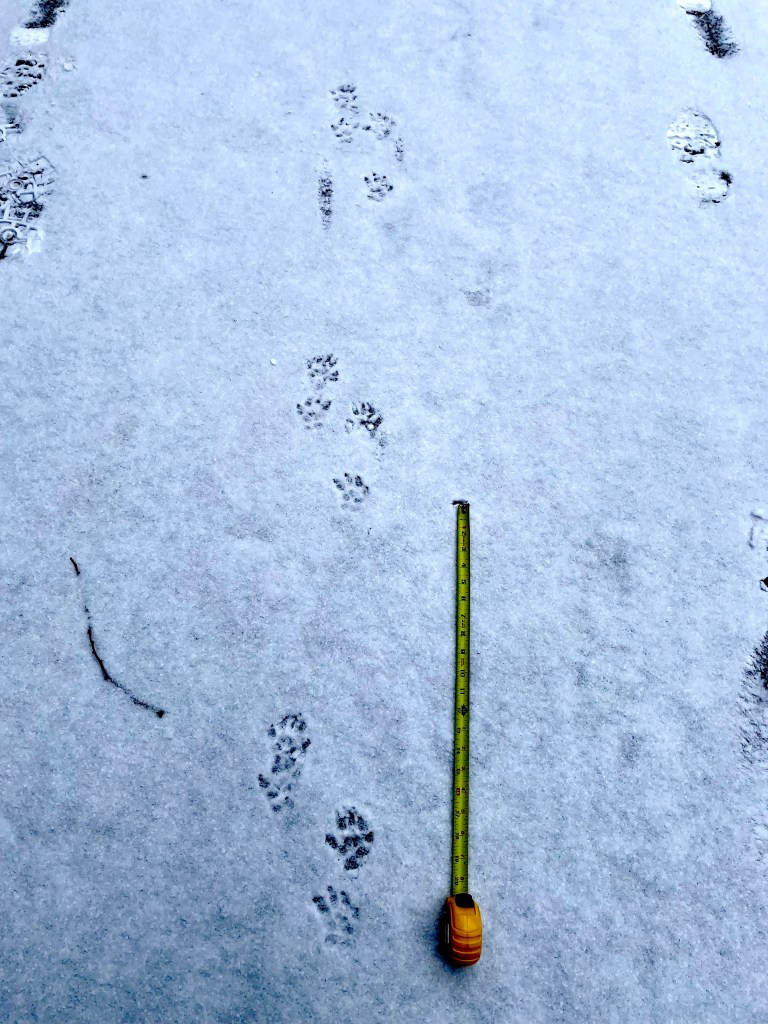
So why are these tracks confusing me? At first glance, I thought they were made by a raccoon because of the approximate size and the elongated toes. But several features don’t fit a raccoon, the main one being that none of my books suggest or show a raccoon doing this gait, which looks to me like a transverse lope (or maybe a 3×4 lope). But as Byron said to me in a text “Sometimes the animals don’t read the books.” LOL. When confused by a set of tracks I think at that point it is particularly important to set aside any ideas one may have and collect some data. Before giving some measurements, my definitions of stride and group length follow Elbroch (1st inside cover page):
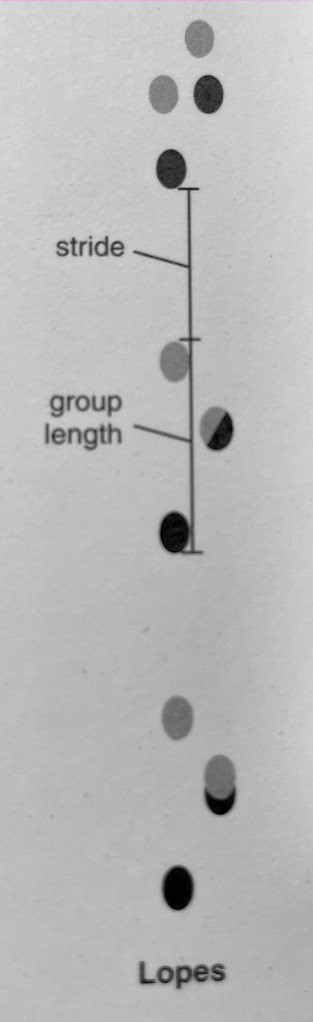
stride (inches): 15 1/2, 12
group length (inches): 13, 13
trail width (inches): 5, 4 1/2, 5
Unfortunately, these measurements approximately fit several animals (raccoon, fisher, woodchuck, etc). Let’s look at some individual track sizes. But first I need to know which are the front tracks and which are the hind tracks. My designation is based on the gait being a trot and I also notice that the toes of what I think are front tracks angle slightly to the left, while the tracks that of what I think are hind tracks angle slightly to the right:
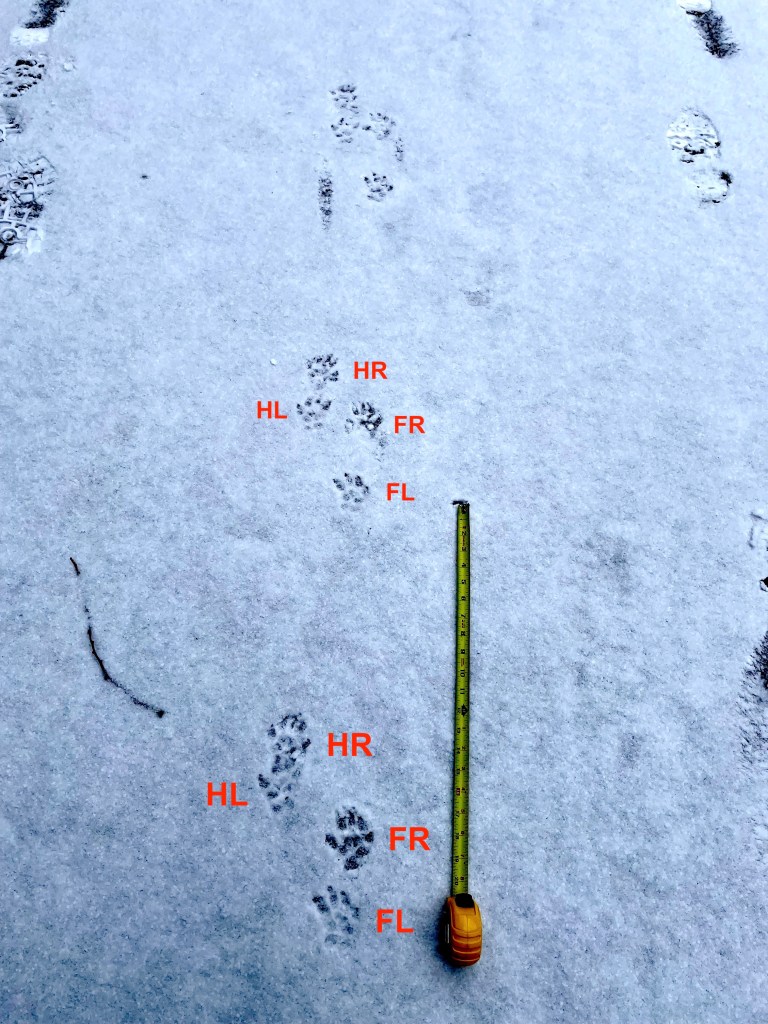
Here are some approximate measurements:
Front length (inches): 2 1/2, 2 1/2, 3, 3
Front width (inches): 2 1/2, 2 1/2, 3, 3
Hind length (inches): 2 3/4, 2 1/2, 2 5/16
Hind width (inches): 1 15/16, 2 1/4, 2
Again, these measurements could approximately correspond to several different animals and I’m not sure how accurate they are.
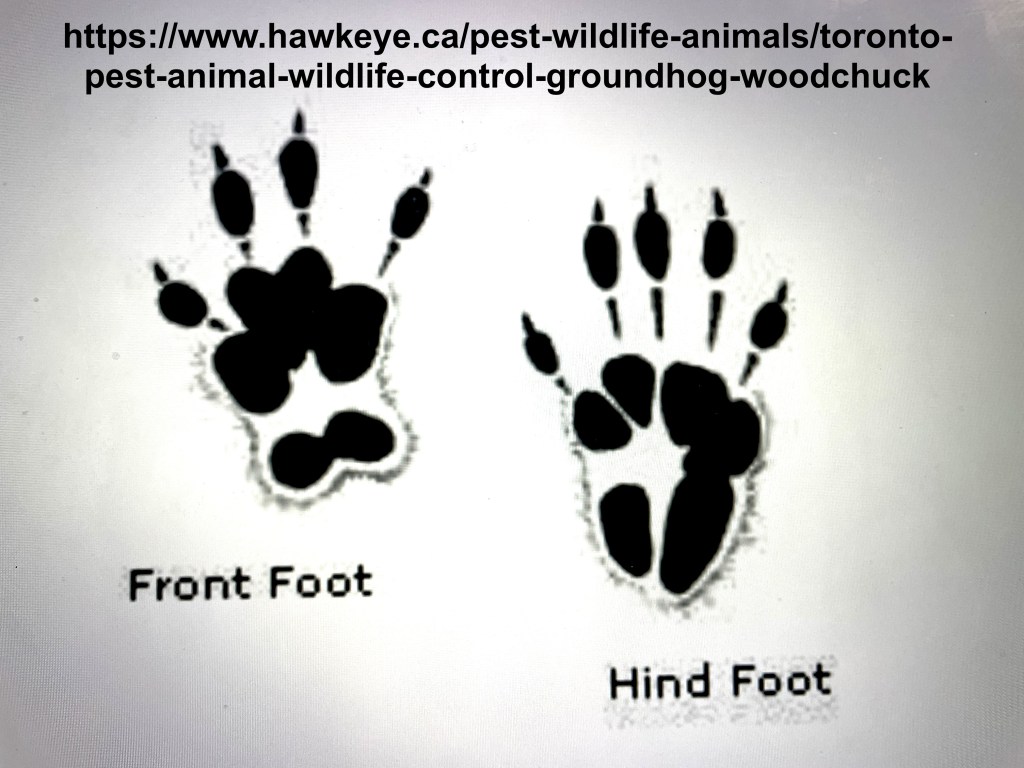
What I also noticed about these tracks are the distinctive heal pads (4 above and 2 below). I like the picture below for a woodchuck because it clearly accentuates the heal pads:
Conclusions:
These tracks exhibited characteristics of various animals, including raccoons, fishers/martens, and woodchucks. Raccoon tracks typically feature elongated toes, yet the observed gait does not match. Additionally, the heel pads differ from raccoon norms. The tracks likely do not belong to fishers or martens because they are uncommon in our region, and their toes tend to be more spread out. Despite seeming improbable, the combination of elongated toes, toe angles on both front and hind feet, unique heel pads, observed gait, and consistent measurements leads me to hypothesize that a woodchuck created these tracks. I welcome any evidence to the contrary.
PS: At first I thought, ‘what is a groundhog doing in the snow? But according to
https://www.wildliferescueleague.org/animals/the-groundhog-our-underground-architect/
“The majority of males come out of their burrows in mid-to late February; females appear from late February to mid-March.”
PPS: Some experts at the facebook page ‘Animals Don’t Cover Their Tracks: Animal Track Identification Help Group’ agree that the tracks are made by a Woodchuck. Yay! But I have labelled the feet wrong. Silly me. One of the contributors wrote:
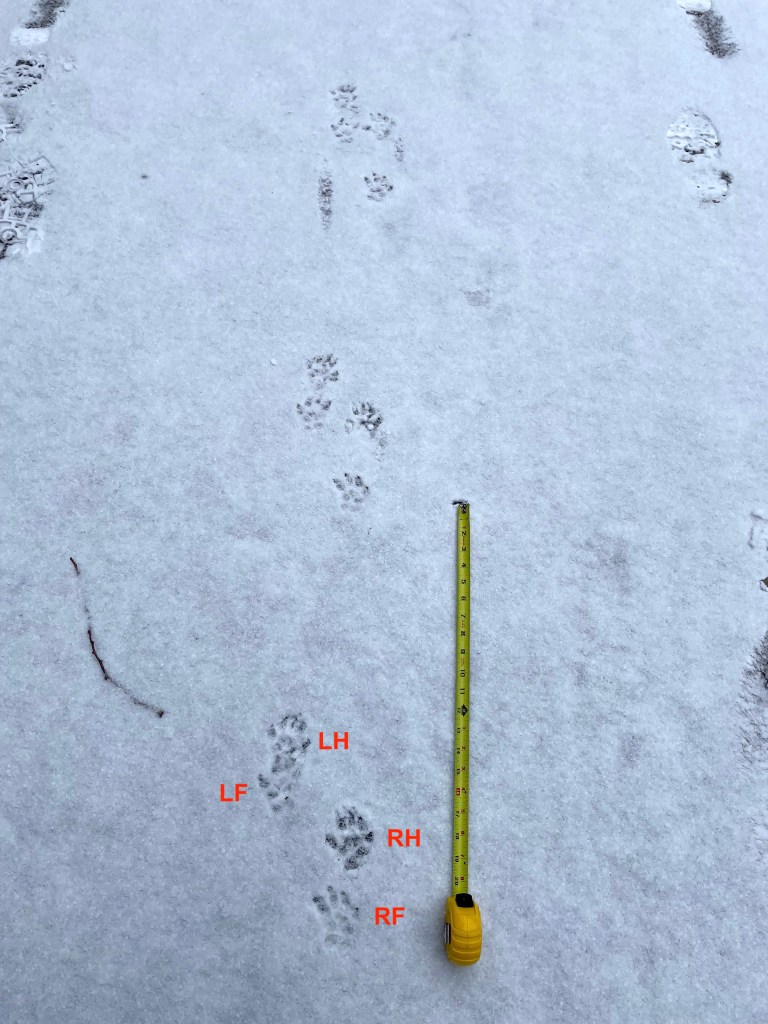
“I agree with groudhog, assuming you don’t have marmots, as their tracks are similar. However, I would label the tracks in the gait differently. The hind tracks of all squirrels show five toes, with the middle three closely grouped together. In addition, if they are ground squirrels (i.e., a groudhog) those three toes will be swept inward. The front tracks, however, show four toes and also two dots for the carpal pads, at the rear of the palm pad. This info should help you rethink the labeling of the feet in the gait.”
Thus with this information, my revised diagram is given below (one contributor said this is still technically a transverse lope, and another person said that these animals do a sort of ‘groundhog shuffle’.):
 Field Notes of a Tracker
Leave a comment