Date: Mar 1, 2024
Place: South end of Guelph ON.
Time: 7:15am – 7:20am.
Main references:
‘Mammal Tracks & Sign: A Guide to North American Species’, Mark Elbroch and Eleanor Marks, First Edit., Stackpole Books
Discussion: there was still some fine snow around our house from the previous day. It was quite cold (-9 C) and I had a few minutes to check out if there were any new tracks! The first thing I noticed on our front decking was some very small tracks (mouse) that were clearly quite a bit smaller than the tracks of chipmunk that I showed in my previous post (actually, there were some chipmunk tracks nearby at the same time that I could compare with, but unfortunately not side-by-side). Here are the photos of the mouse:
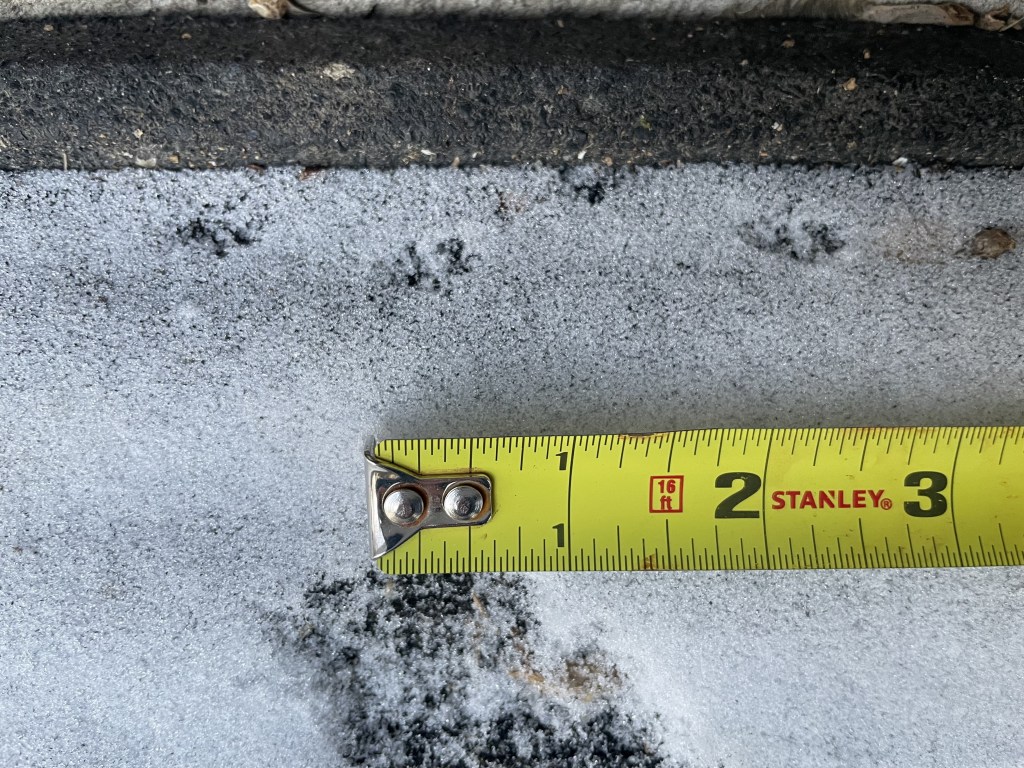
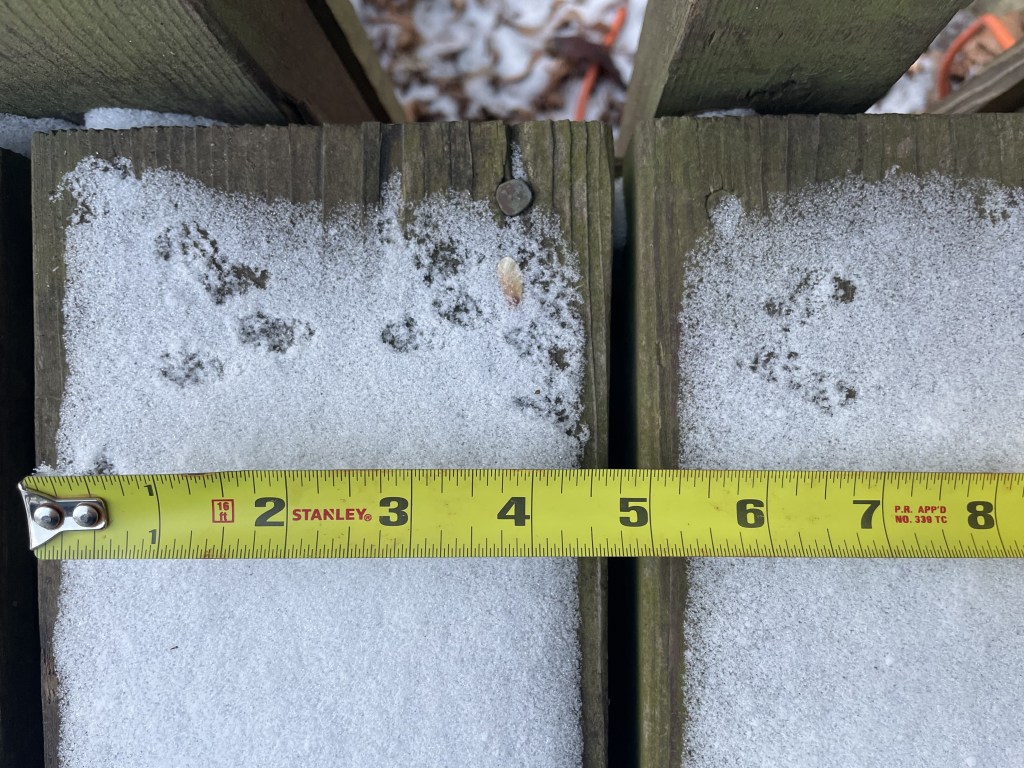
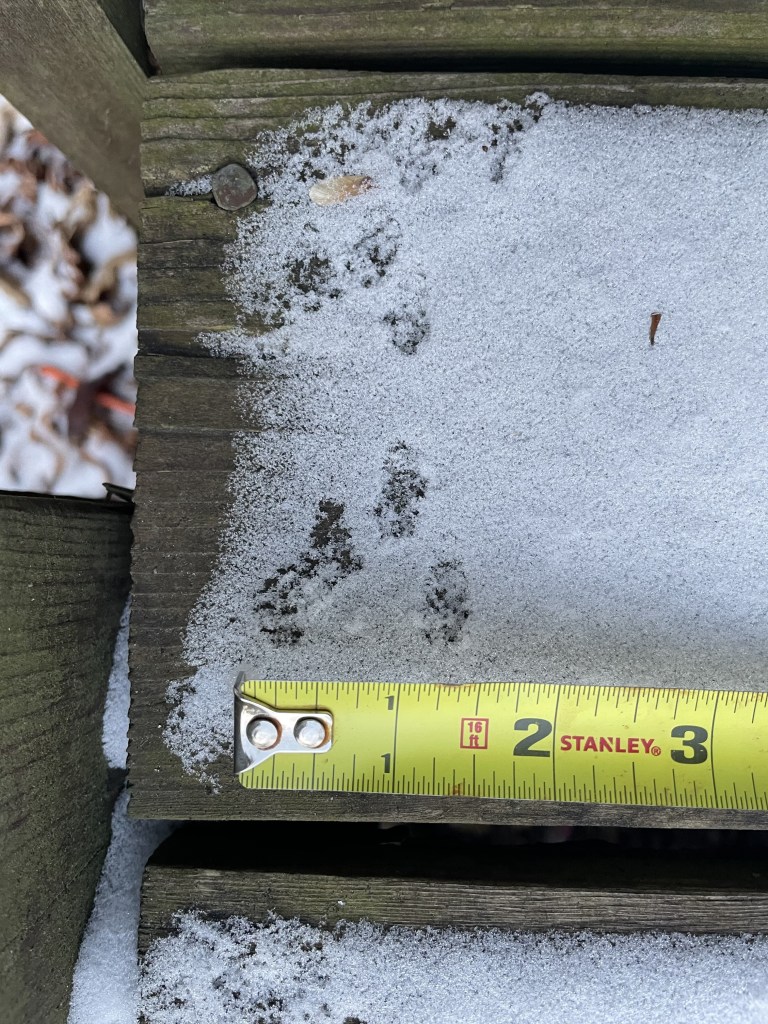
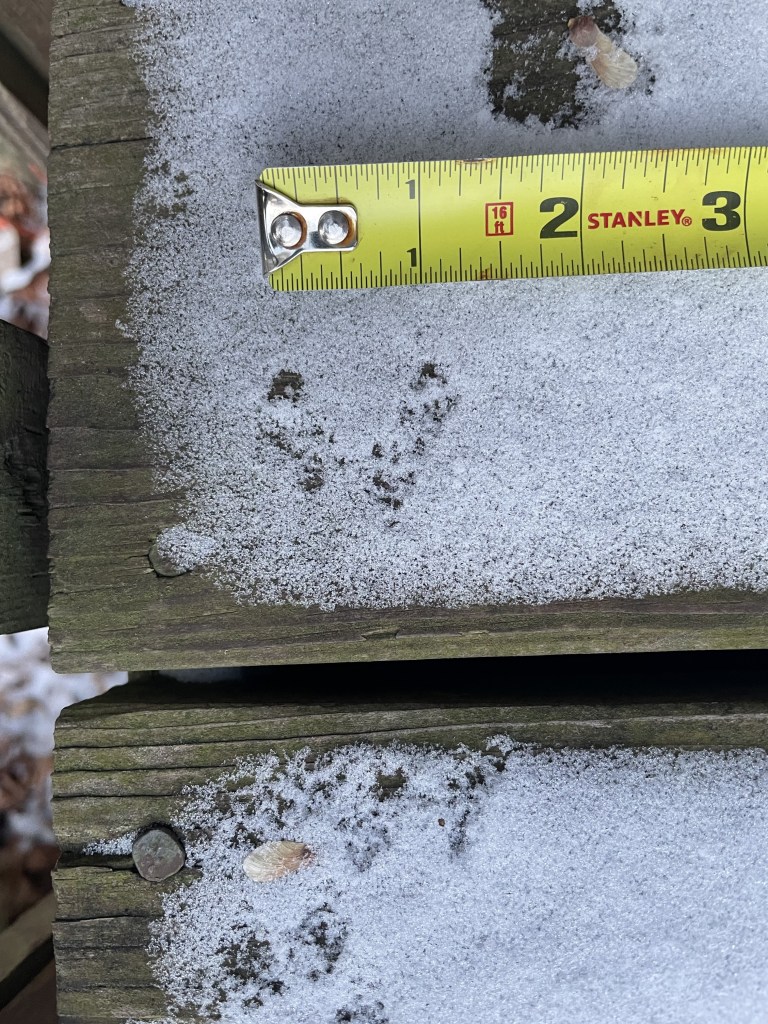
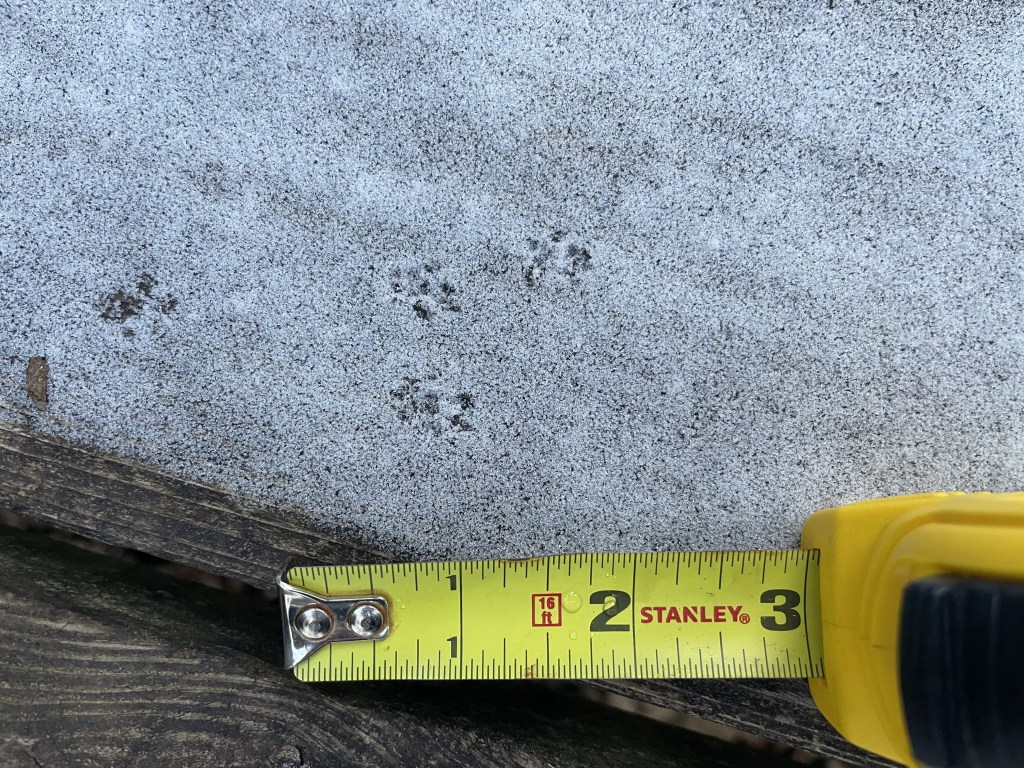
In the first photo, the mouse is walking. This was right up against our back door from the kitchen where I often throw out crumbs from cutting my bread as a small snack for the mice that often come here. I am guessing the mouse was walking because it was finding some of the crumbs? The remaining photos show the mouse bounding in a classic ‘W’ (like squirrel tracks), or in the last photo possibly in a ‘Y’ shape (like rabbit tracks).
The only measurements I made that seemed reliable were trail width and approximate tracks widths and lengths:
bound trail widths (inches): 1 3/8, 1 1/8, 1 3/8, 1 3/16, 1 1/4
front width x length (inches): 3/8 x 7/16
hind width x length (inches): 5/16 x 5/16
Although these tracks are so small I’m not that confident in the measurements. These measurements are more or less in agreement with the measurements given on page 316 of Elbroch.
The next set of tracks, although very familiar, were notable because of how regular they were. They are for a raccoon doing the classic 2×2 walk (or ‘pace’ according to Lowery). See page 201 of Elbroch. Now for some measurements:
stride (inches): 13 1/2, 13 1/2
trail width (inches): 3 1/2, 3 1/2
front width x length (inches): 1 3/4 x 2
hind width x length (inches): 1 3/16 x 3
These measurements are mostly in agreement with those on pages 201 – 202 of Elbroch, but I noticed that the tracks are not splayed at all, which might explain why the track widths are on the small side. Something else I have noticed is that raccoons do this gait more often in thin snow and reserve a diagonal walk for deeper snow. By the way: the tracks came up my driveway to our bins. On many garbage nights, the raccoons have managed to overturn the green bin and access the contents.
Final question: For the 2 x 2 walk of a raccoon, how does one measure the stride? The distance from toe to toe of tracks on the same side? Or, the actual distance from front (back) toe to the next front (back) toe (measured diagonally)? Or maybe just the distance between each group of 2 tracks? Distances were so large in this case that it didn’t really make that much difference.
Answer: I see now from page 74 of Elbroch that it is the diagonal distance between front tracks or hind tracks.
 Field Notes of a Tracker
Leave a comment