Date: March 19, 2025
Place: Guelph, ON.
References:
– [1] ‘Mammal Tracks & Sign: A Guide to North American Species’, Mark Elbroch, Stackpole Books (1st Ed.), 2003
– [2] ‘Bird Tracks & Sign’, Mark Elbroch and Eleanor Marks, Stackpole Books (1st Ed.), 2001
– [3] ‘Bird Tracks’, Jonathan Poppele, Adventure Publications, 2023
Quick record of observations:
I returned to my route on the edge of the Speed River and found some additional late Winter observations, including the tracks of a large bird that shows partial migration in Southern Ontario.
First, two signs that I have often seen but not documented. These are, the Goldenrod Ball Gall and the Black Knot Fungus:
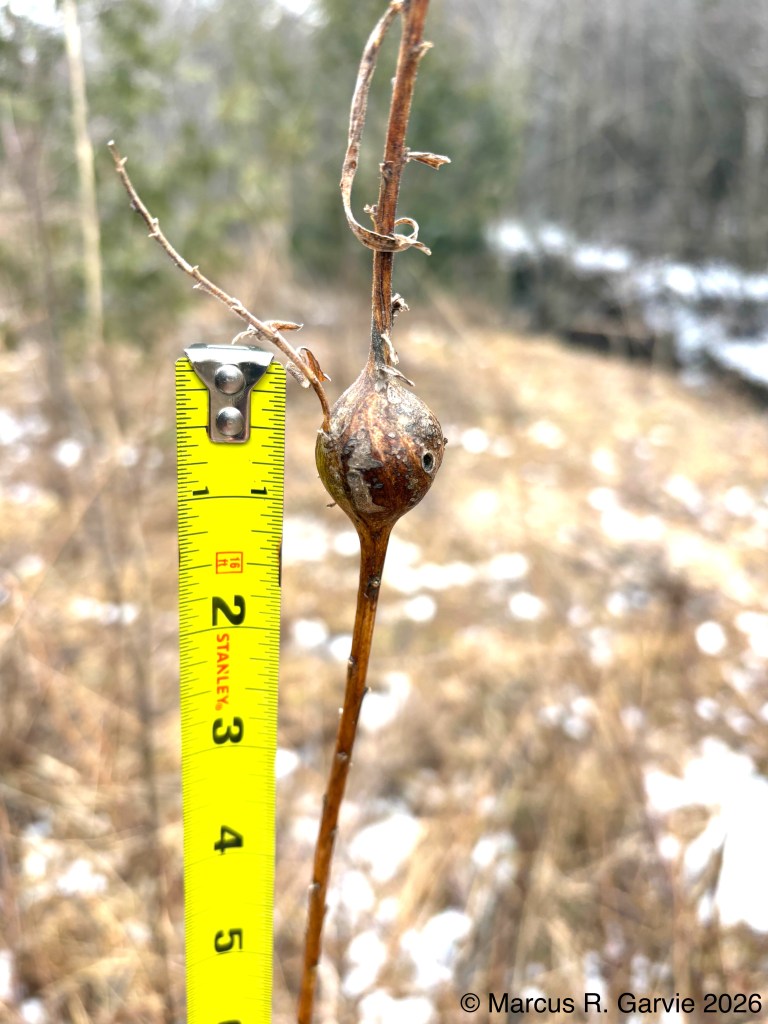
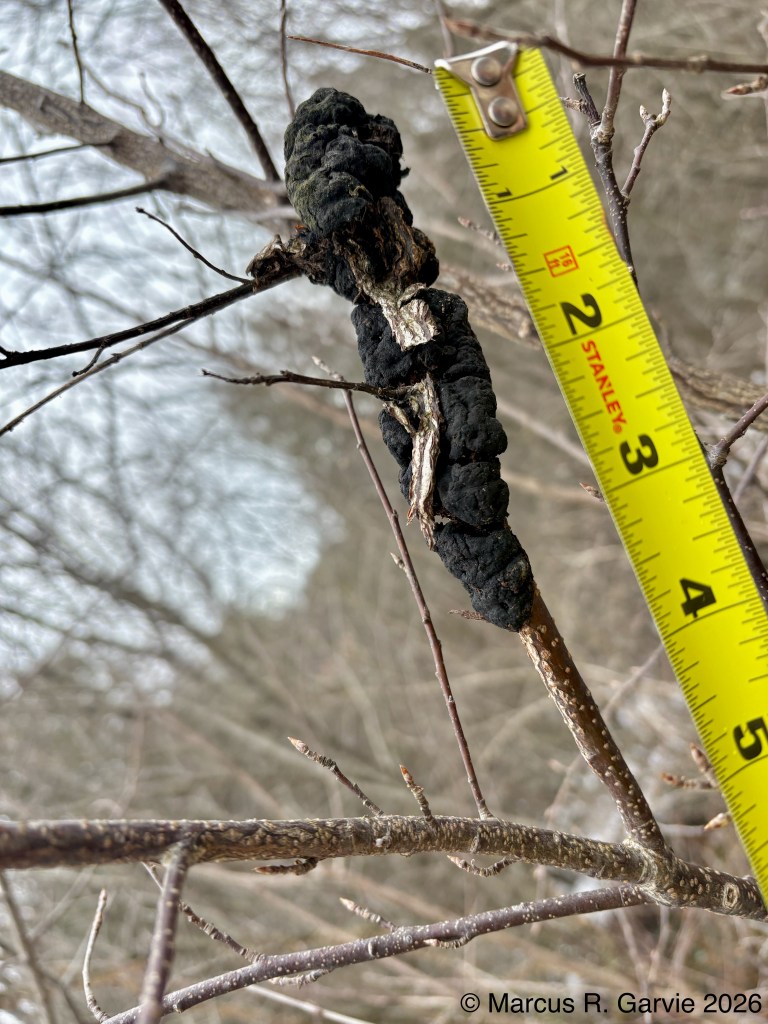
The first is due to a small spotted-winged fly, laying eggs in the
stem of the plant. If you look closely, I think we can see a small hole where the adult goldenrod gall fly likely emerged after overwintering inside the gall. In the second picture, black knot fungus appears as a hard, swollen black mass on the branch. It is a fungal disease of Prunus trees that is especially noticeable in fall and winter, and it can eventually girdle and kill the branch beyond the infection (see https://extension.umn.edu/plant-diseases/black-knot).
My next observations were raccoon tracks. No matter how many times I see them, I am always excited to do so. In this case, a raccoon, or perhaps more than one animal, was walking on a thin layer of snow over ice, giving the tracks wonderful contrast.
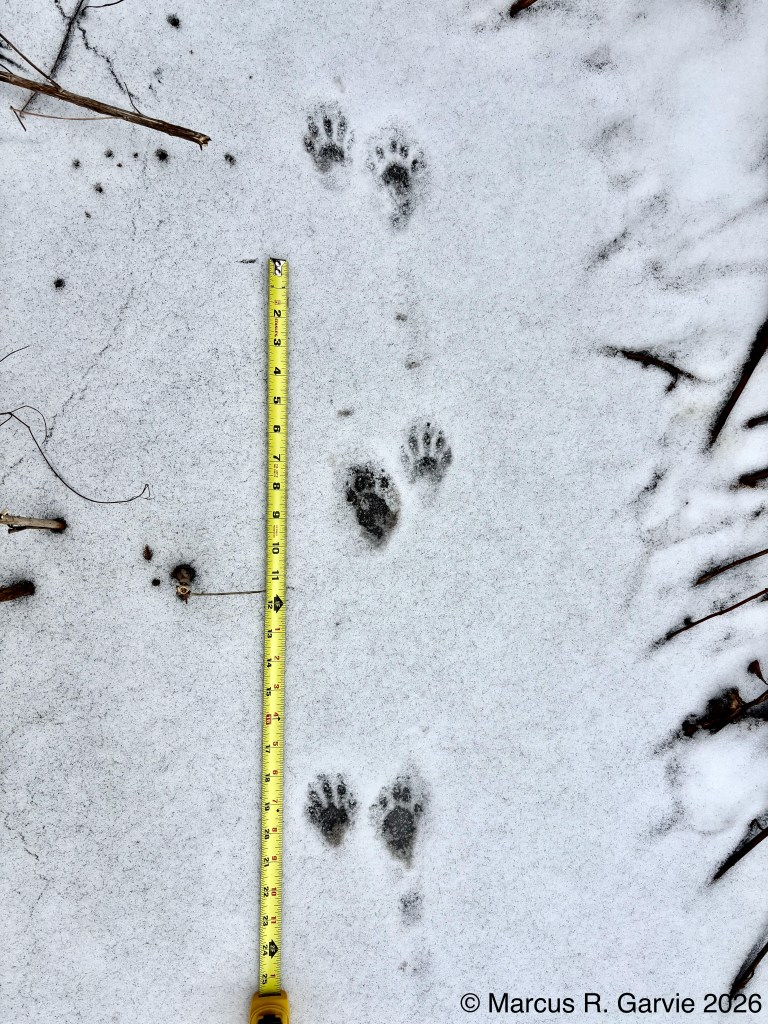
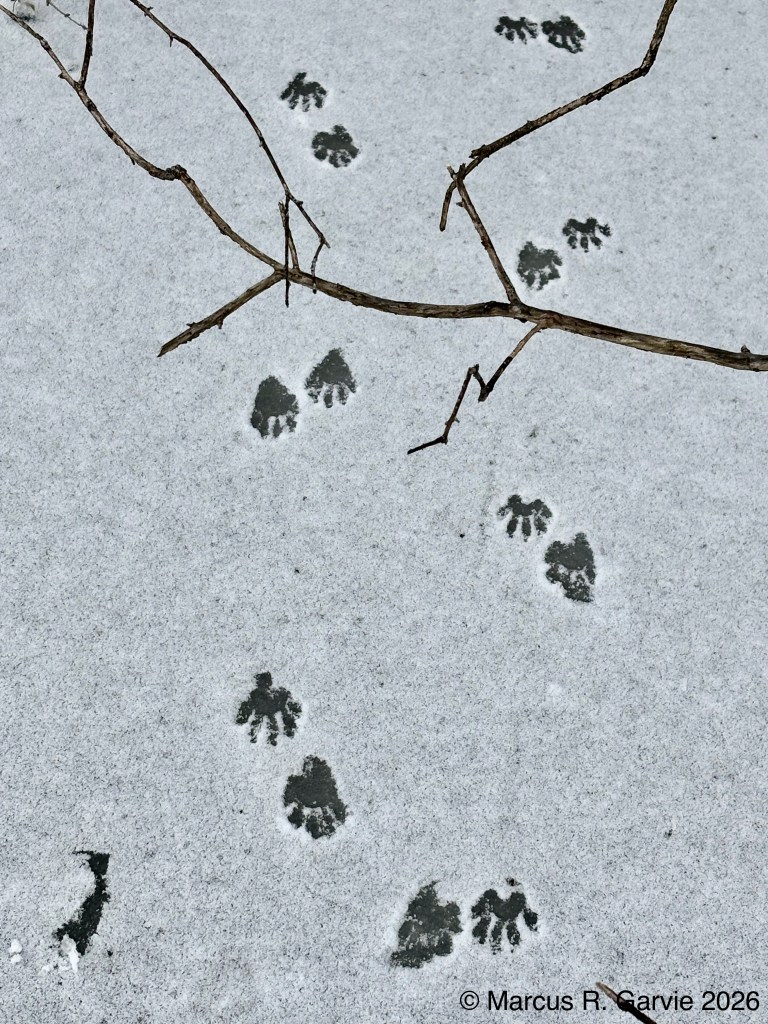
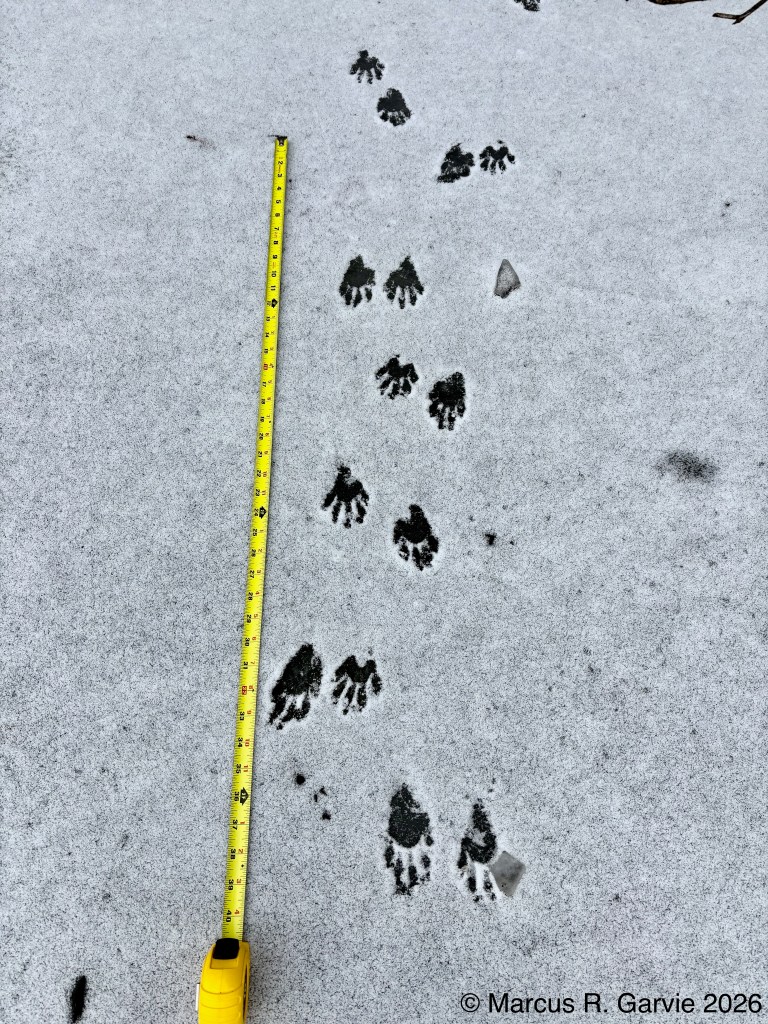
In addition to the hind tracks being slightly longer, the front tracks tend to be more splayed than the hind tracks.
Once I reached the river’s edge, I was delighted to see the tracks of a large bird. I had seen similar tracks before, though not in Canada, but on a riverbank in Texas. I believe these are Great Blue Heron tracks. That is especially interesting because most Great Blue Herons migrate south of Ontario for the winter, yet some remain in southern Ontario where open water allows them to keep feeding. Since herons live near rivers, marshes, swamps, and lake edges, and hunt patiently in shallow water for fish and other prey, finding these tracks along the river in winter seems quite plausible after all.
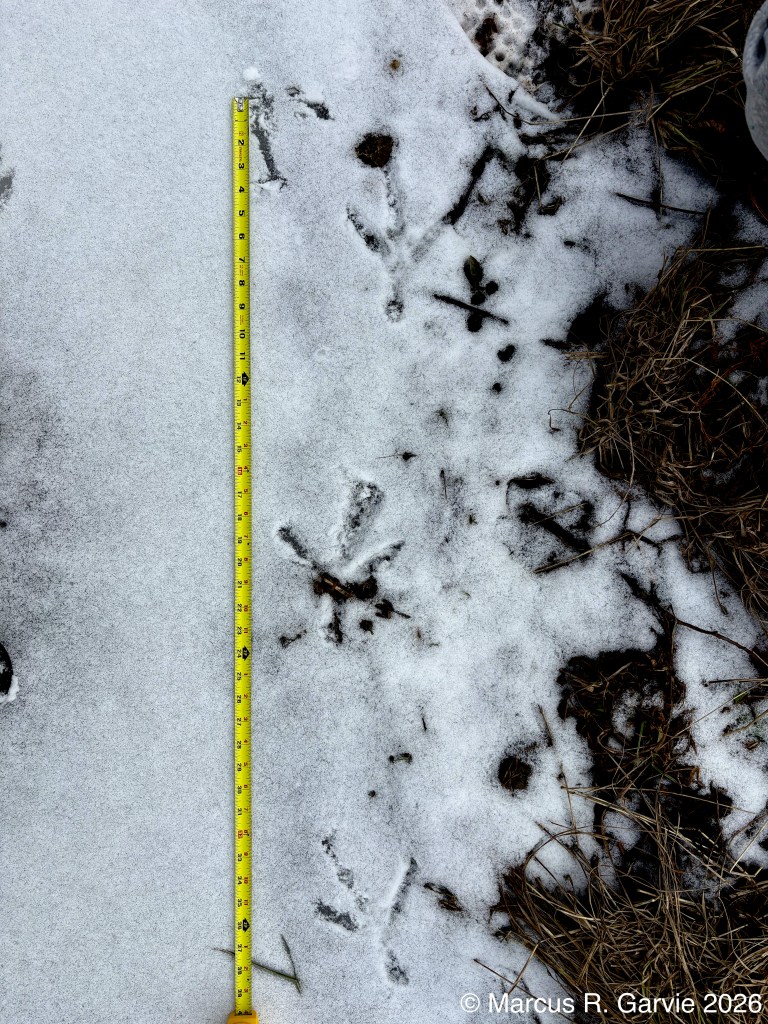
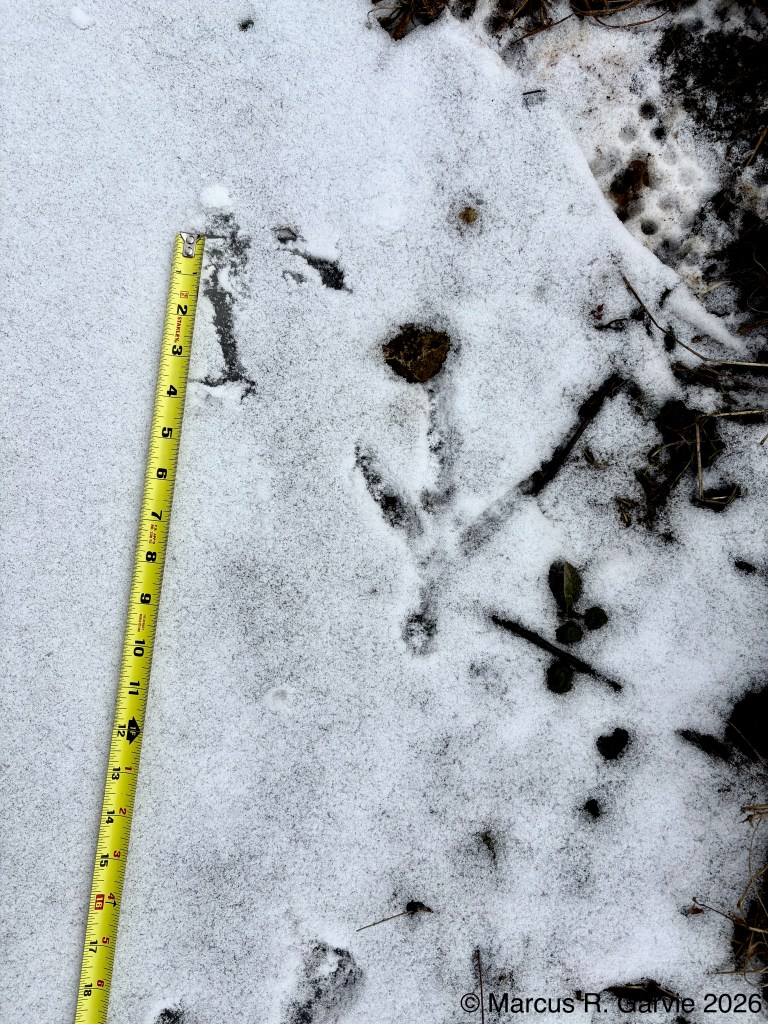
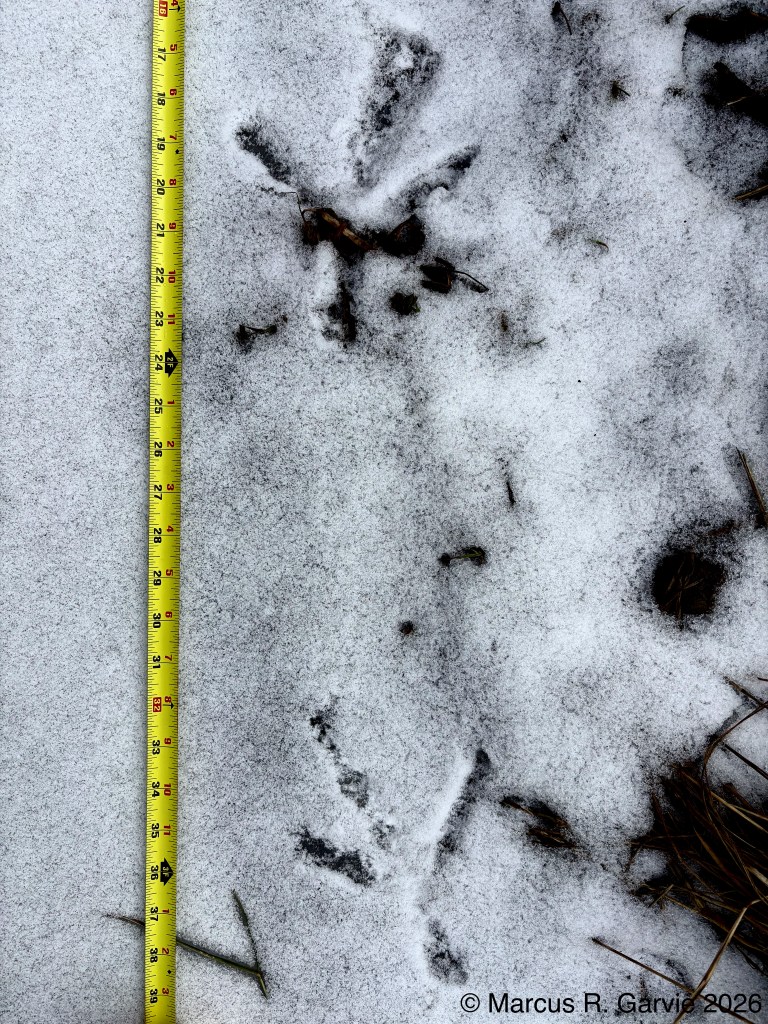
I checked that these tracks were not made by another large bird. The two other possible candidates of similar size are the Wild Turkey and the Sandhill Crane. Neither of these birds has a large toe 1. Furthermore, turkey tracks show segmented bulges along each toe (toe pads), which are not present in heron tracks [3]. Great Blue Heron tracks also show webbing between toes 2 and 3 [2], which is absent in turkey and crane tracks. I also checked some measurements:
Track length: 7 1/4 in
Track width: 5 in
Stride: 16 in
Now let’s check what is stated in [2]:
Track length: 6 1/2 – 8 1/2 in
Track width: 4 – 6 in
Stride: 10 – 18 1/2 in
This strongly supports Great Blue Heron.
My next set of tracks were made outside my house on the driveway. In the first set we can see some beautifully clear tracks of a Striped Skunk doing an overstep walk:
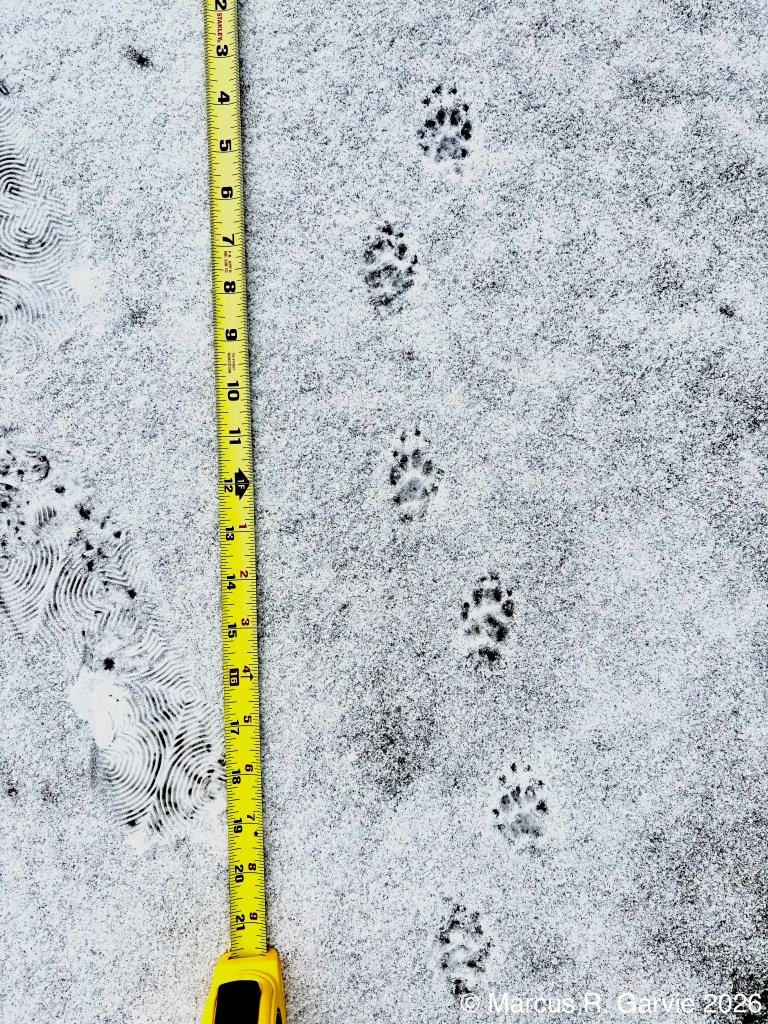
Here are three reasons why this gait is a walk :
1) stride is about 7 in (see measurements in [1])
2) left and right tracks are obvious
3) the overstep is half the distance between the front tracks
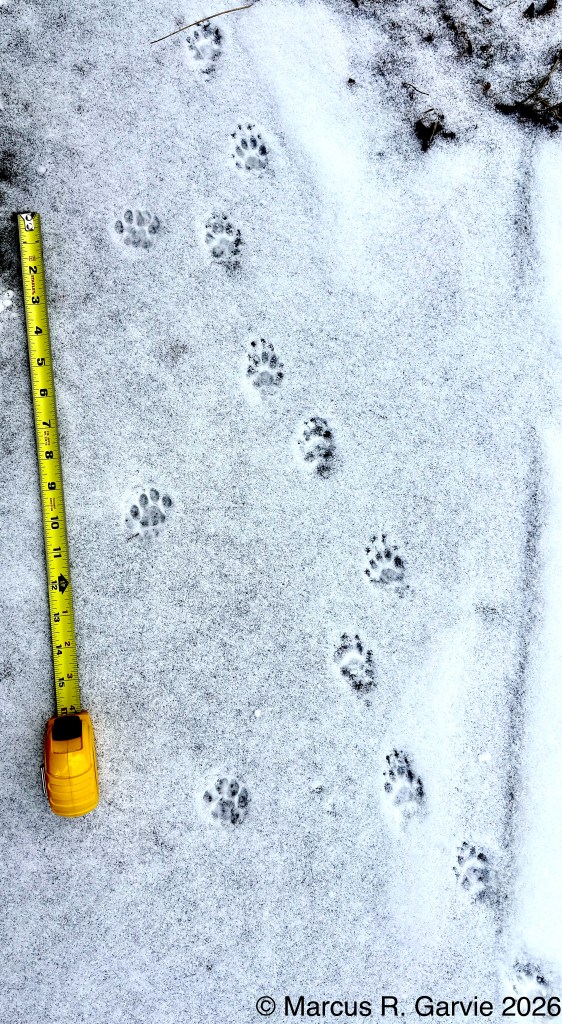
The long nail marks in the front tracks are very clear. I also observed my cat, Ash, doing a direct register trot:
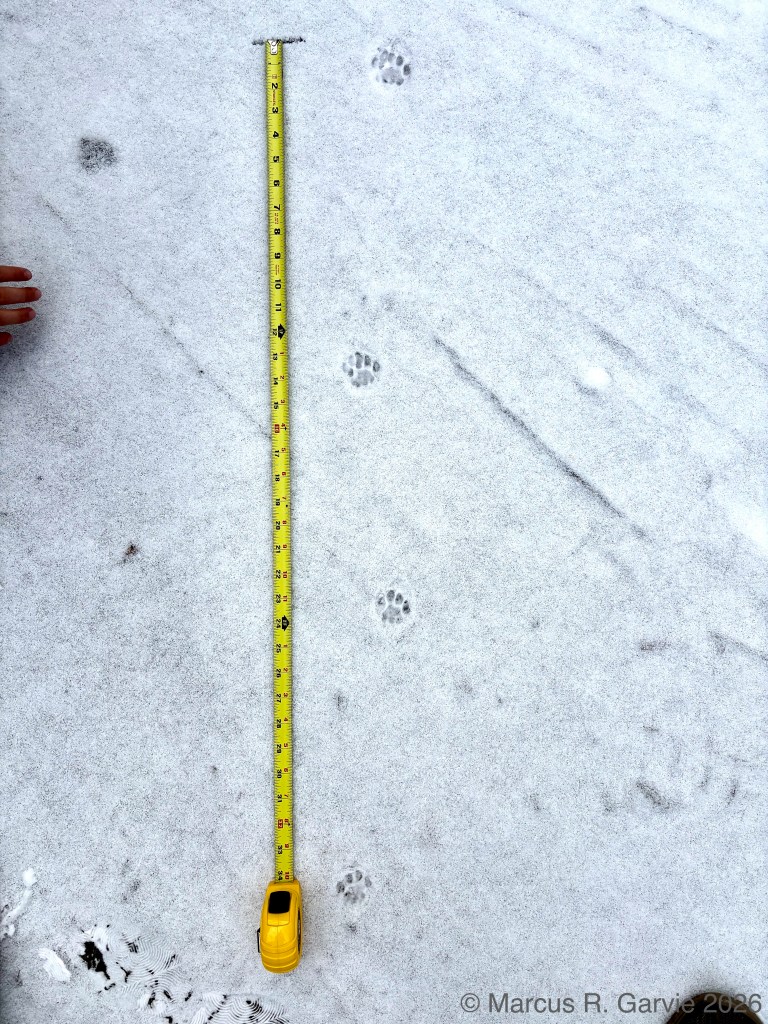
There are several reasons why I know this gait is a trot and not a walk:
1) left and right tracks are not super obvious (narrow trail width)
2) the distance from one foot to the next placement of that same foot (double step) is about 23 inches. As I learned at a recent Track & Sign Certification, 2/3 of this distance yields roughly the the hip-to-shoulder length, i.e. about 15 in, which is roughly correct for my cat. (I checked afterwards, and the hip-to-shoulder length of my cat and it’s about 12 to 13 inches, which is roughly correct).
Why the discrepancy in the predicted hip-to-shoulder length in 2? This may be because the rule is only an estimate. I have also heard an alternative rule that the hip-to-shoulder length is between one-half and two-thirds of the distance between the two front tracks.
Here is my cat using a different gait:
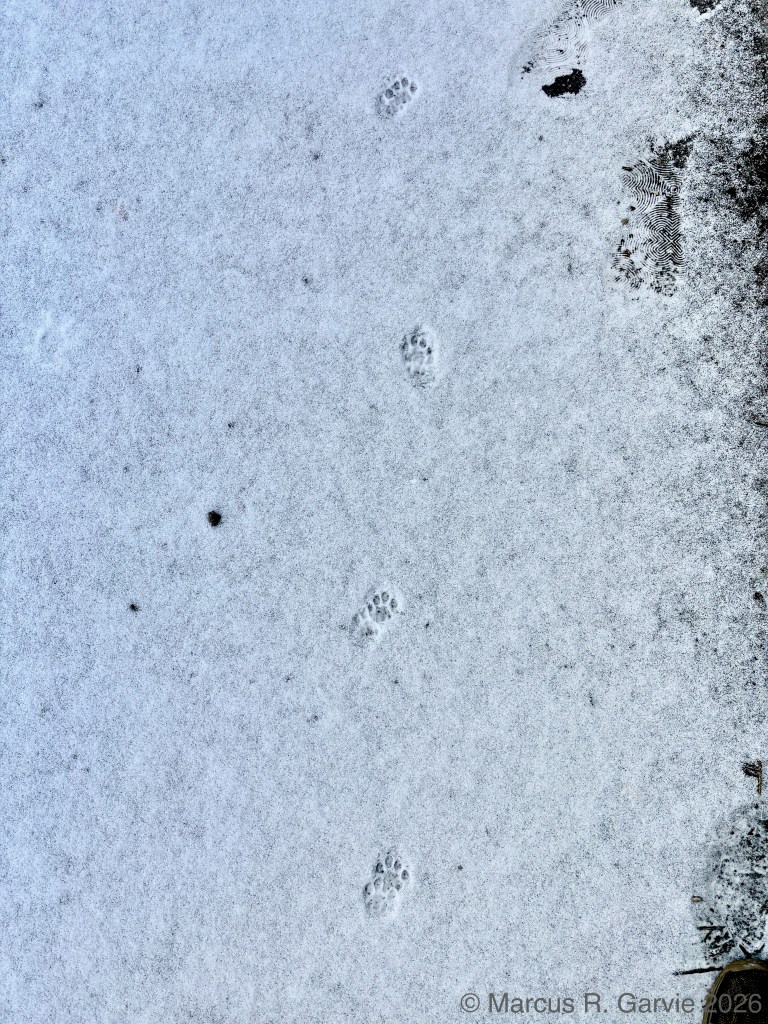
I did not place a tape measure next to these tracks, but this seems to be an overstep gait. This is because the leading tracks clearly partially overlap the trailing tracks. Therefore, the leading tracks must be hind tracks, since they must have landed after the front tracks. But is this a walk or a trot? I don’t think felines do overstep trots, so my best guess is that this is an overstep walk.
My final picture shows skunk and cat tracks together. I love when this happens because it provides a direct visual comparison between the two species.
 Field Notes of a Tracker
Leave a comment