Date: February 7, 2026
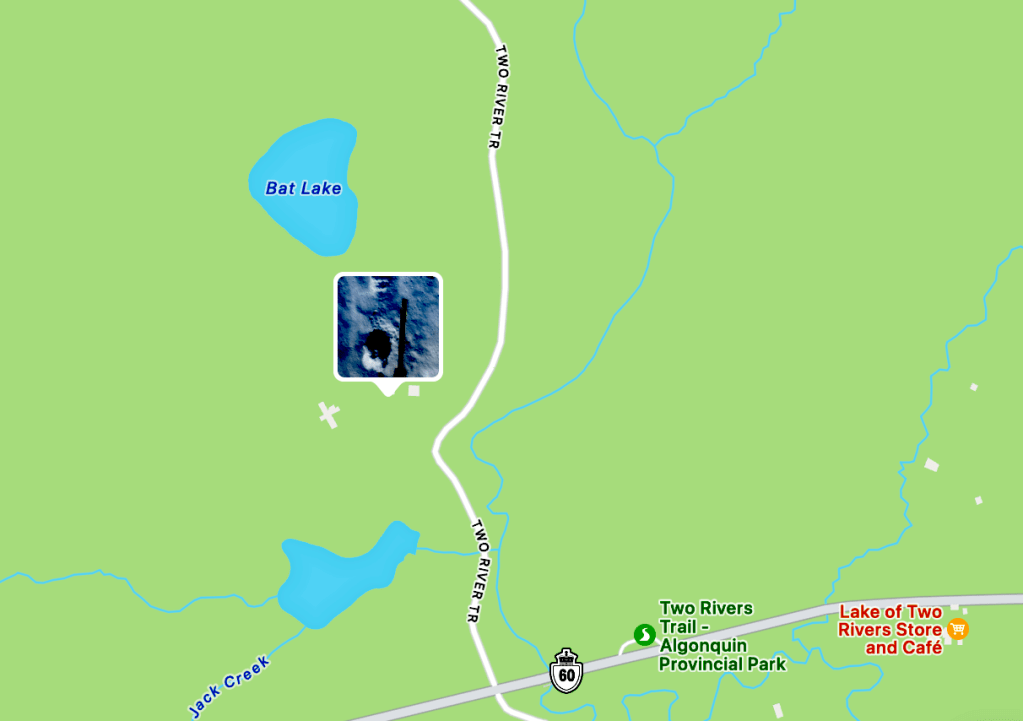
Place: In the Two Rivers area of Algonquin Park, north of Highway 60, just west of Two River Trail and near Bat Lake. See below.
Weather: extreme cold in the minus 20’s, and fairly fresh deep snow.
References:
– [1] ‘Mammal Tracks & Sign: A Guide to North American Species’, Mark Elbroch, Stackpole Books (1st and 2nd Ed.), 2003/2019
Purpose of trip:
This was the first day the Tracking Apprenticeship group from Earth Tracks met in Algonquin Park for the weekend. I had tracked in Algonquin Park once before and was excited to look for animals we don’t get in Guelph, such as moose and wolves.
Observations:
We started by driving along a side loop of the Two River Trail road and very quickly found a wolf doing a side-trot:
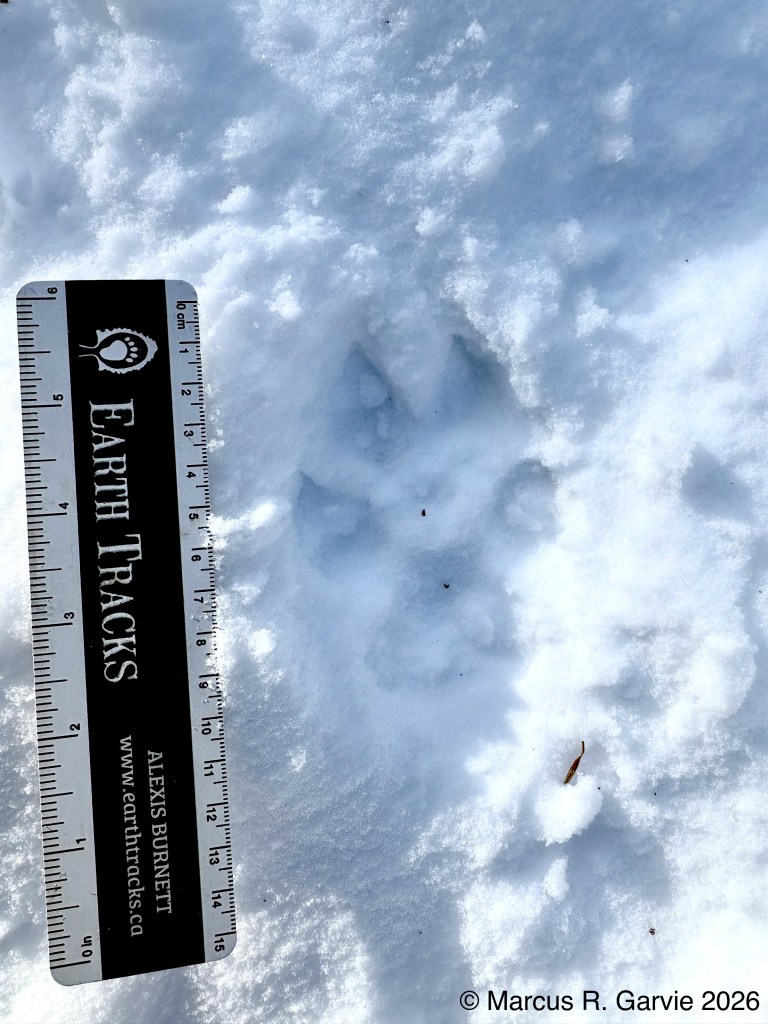
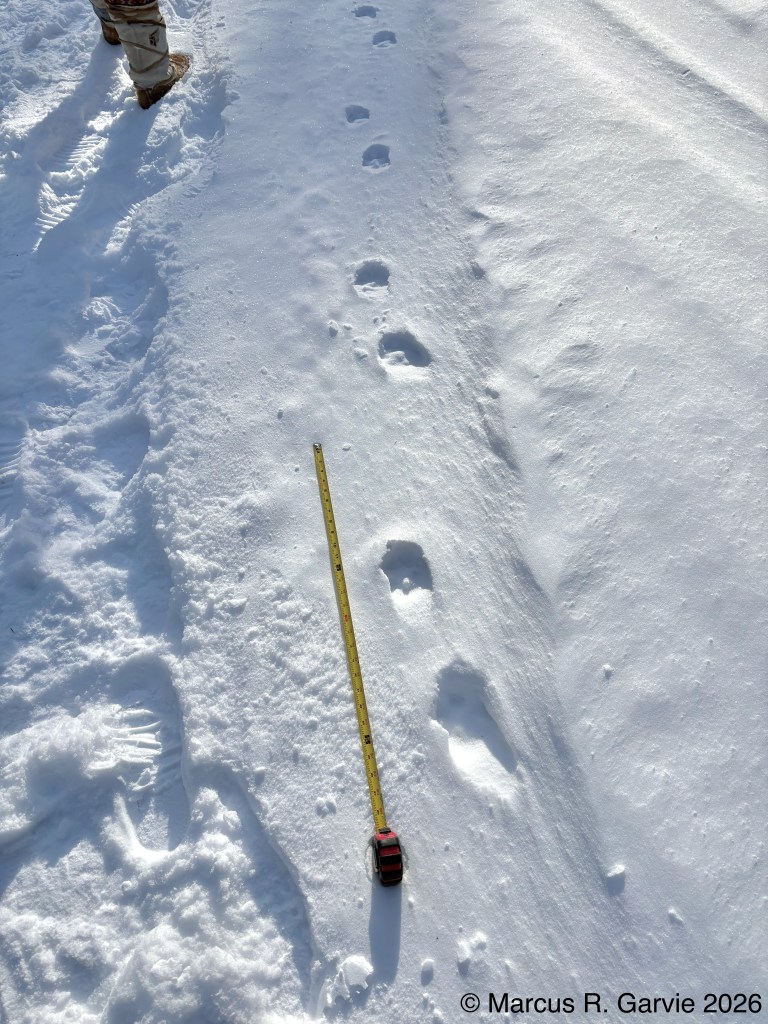
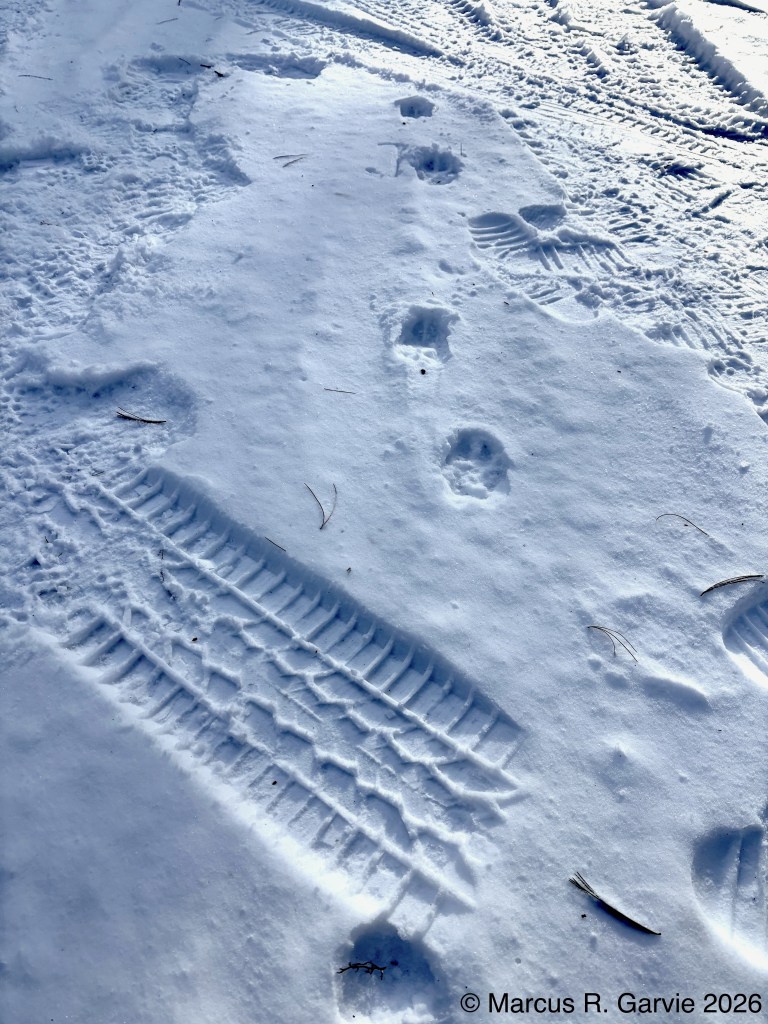
The size of these tracks does overlap somewhat with Eastern Coyote (see the 2nd ed. of [1]), but Alexis Burnett (Earth Tracks) was confident they were from an Eastern (Algonquin) Wolf. Wolves are the dominant wild canid inside Algonquin Park, and true coyotes are relatively uncommon there.
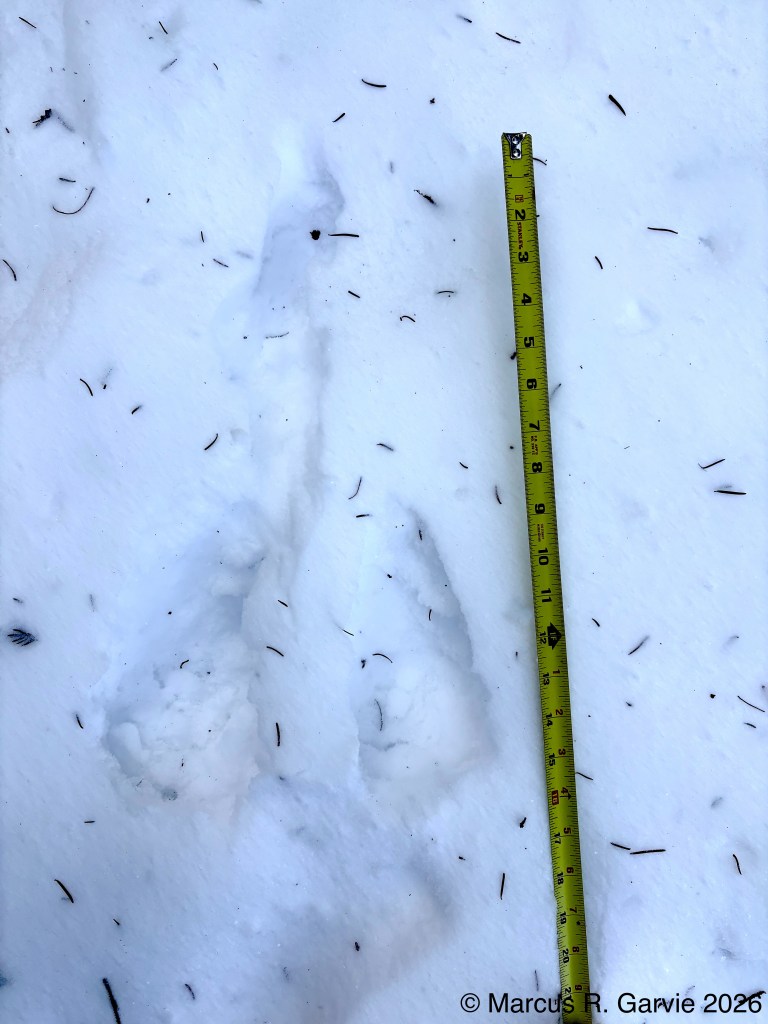
Fairly often, we saw tracks of Snowshoe hare. Here, the hind feet are quite splayed. The DOT is to the bottom of the photo.
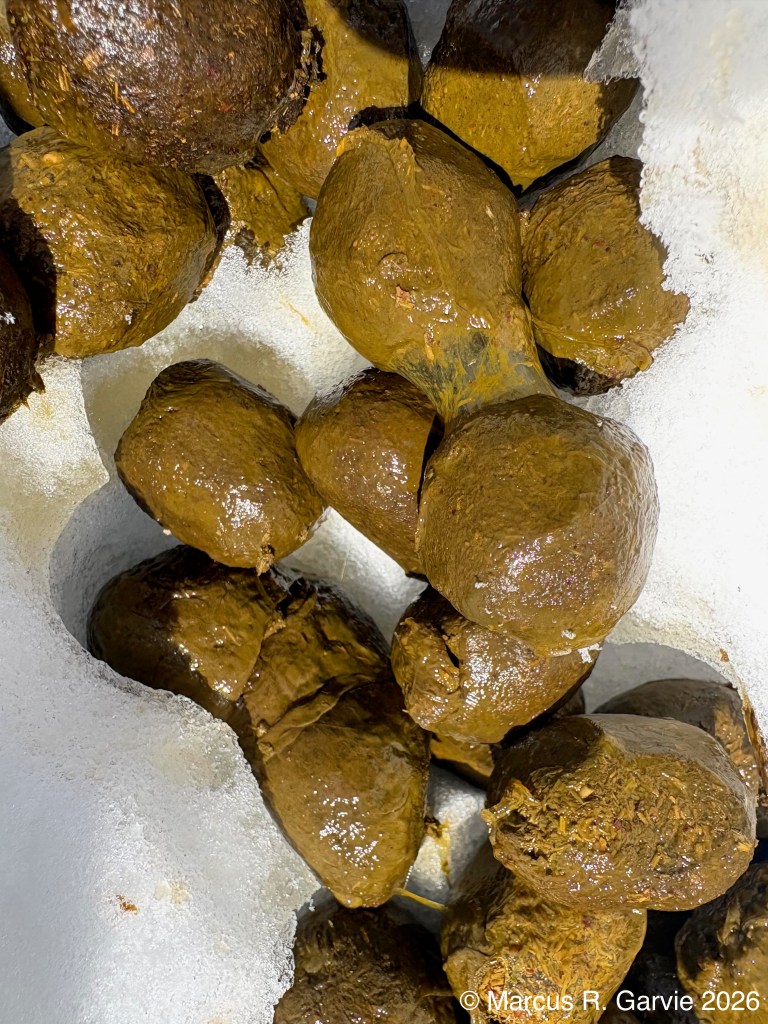
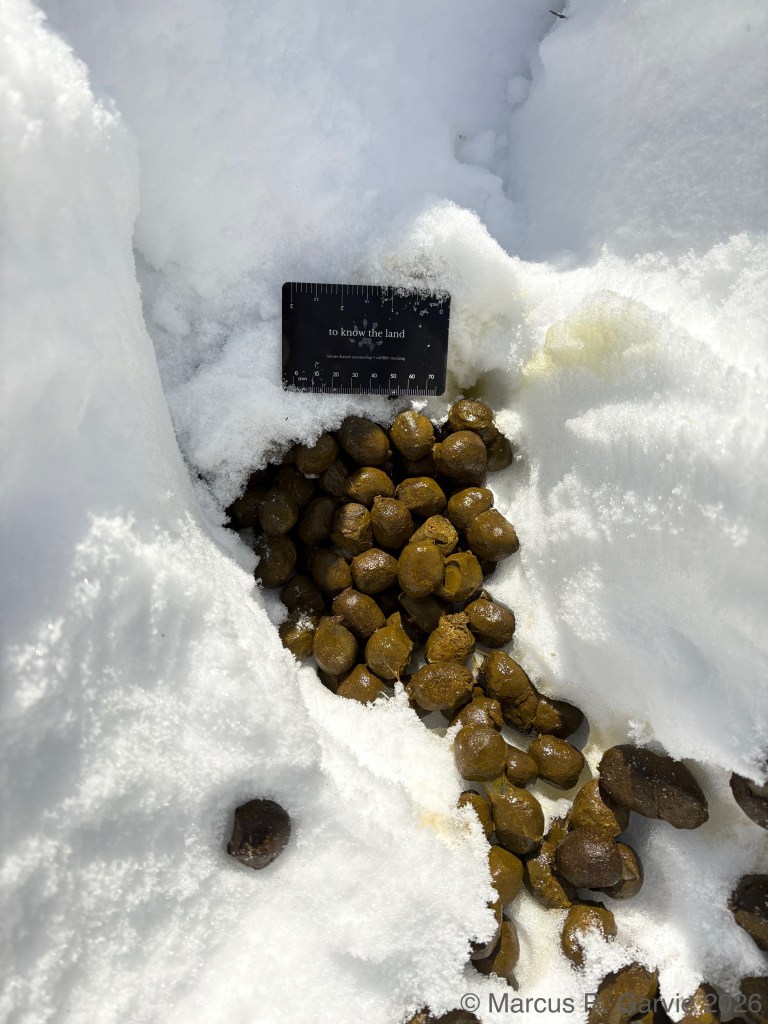
We spent quite a long time trailing moose. Eventually, after crossing a frozen lake, we saw a cow moose and her calf, which trotted away once they became aware of us. I didn’t take many photos of moose tracks because I’ve covered them in other posts, but a tracking friend shared some new information with me. Apparently, the dewclaws on the front feet of moose tend to angle slightly outward, whereas the hind-foot dewclaws point more directly backward. Another thing I learned was how to tell whether moose (or white-tailed deer) scat is very fresh: fresh scat often has a mucus coating that disappears after a few hours. The moose scat shown in the photos below is therefore very fresh.
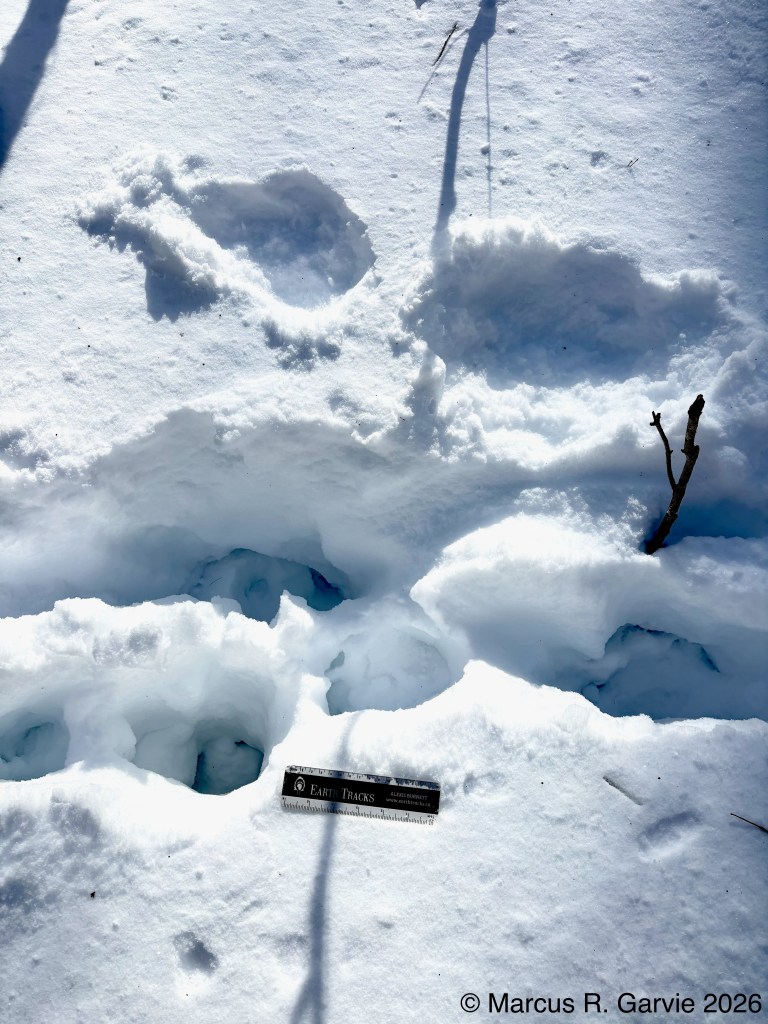
Alexis also pointed out several times where moose had been eating snow, showing the broad muzzle impressions. This is shown in the two impressions at the top of the photo below:
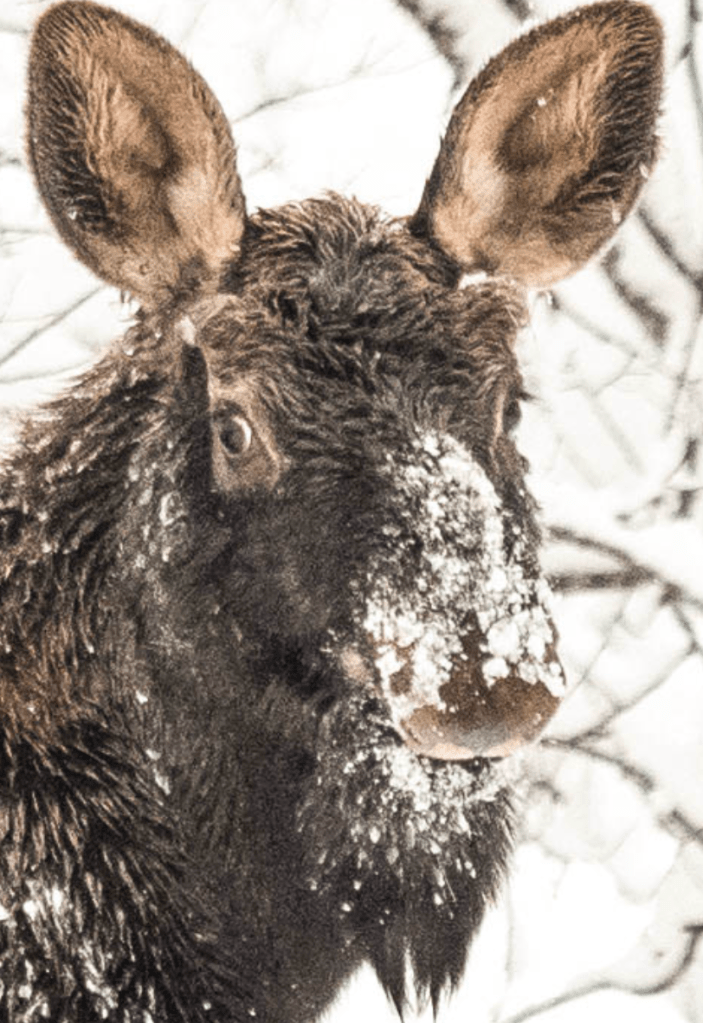
This made me want to see a closer look at the muzzle/lips of a moose. The following image was found at https://tourhaines.com/2020/02/the-impossible-face-of-the-moose/, showing the long snout:
One of the things I’m always looking for when tracking is animal sign as well as tracks. The photo below shows holes made in a living tree by either a Hairy Woodpecker or a Pileated Woodpecker.
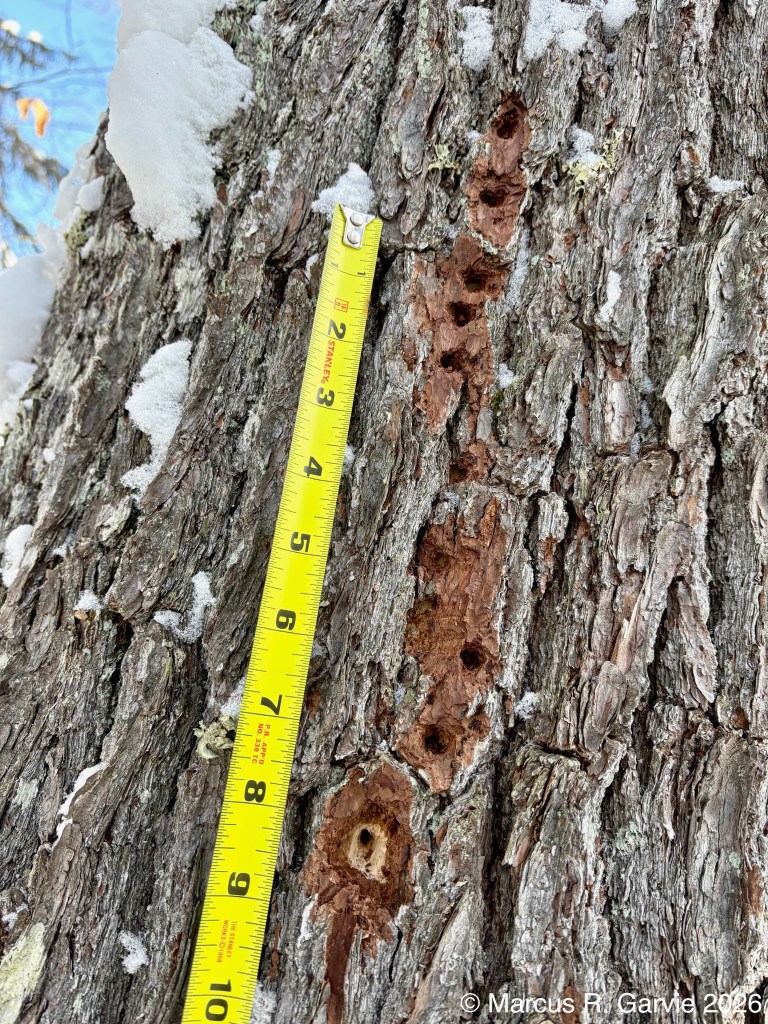
I need to do more research to see if Hairy Woodpeckers can do this too.
One of my goals during this trip was to find the tracks of an American Marten. At the end of the day, while driving back, we found some visible on a bank beside Highway 60. I think the marten is moving in a 2×2 lope. The DOT is toward the top of the next photo, which is upslope. The trail width is about 3 inches, which is consistent with the range given in [1] (2 1/2 – 4 1/2 inches).
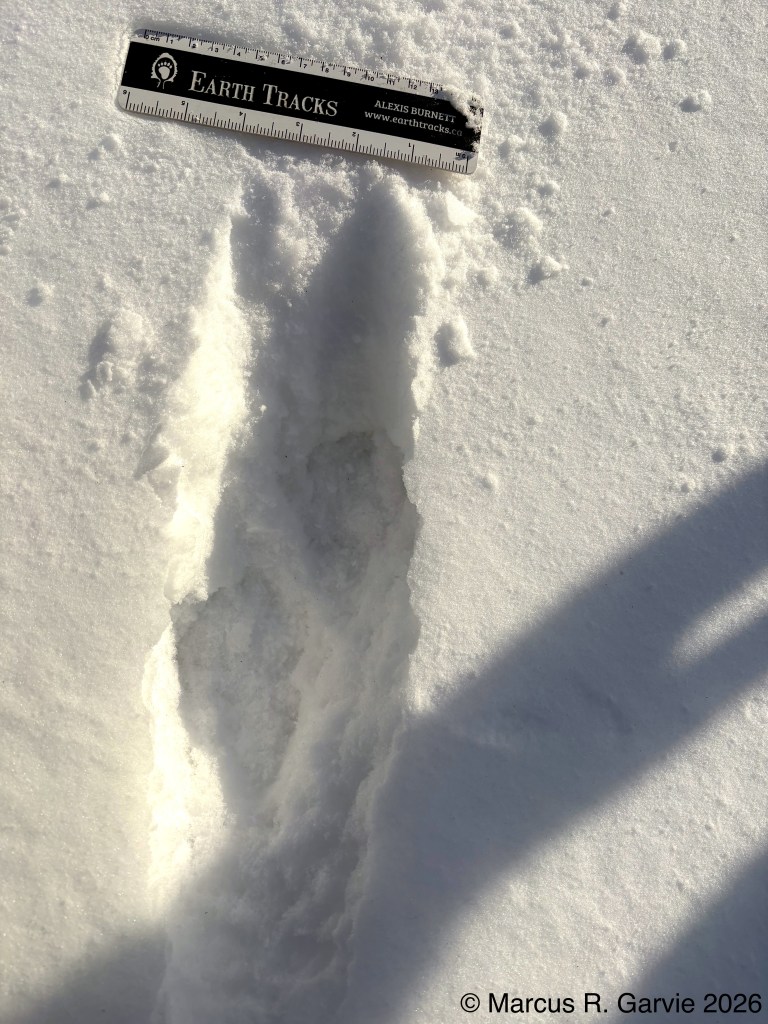
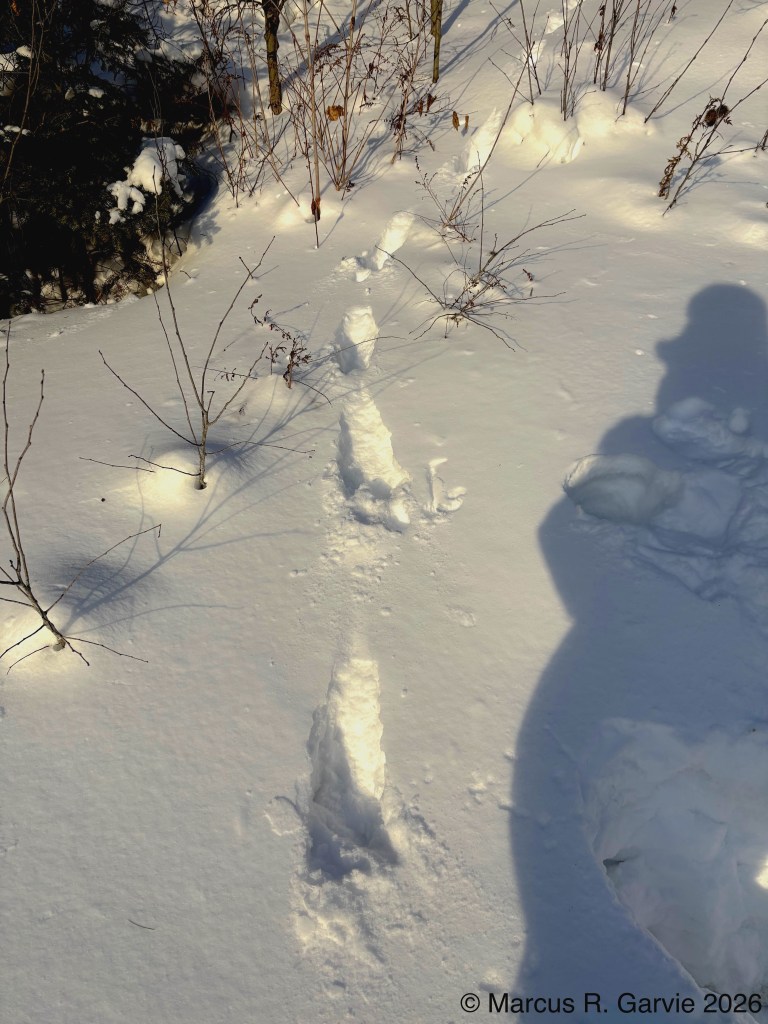
Unfortunately, because of sexual dimorphism in weasel species, the measurements of male marten and female fisher can overlap, so other clues are needed to be certain of the species. In the next photo we see what has been called a “box stop,” where all four feet form a box shape because the marten paused. This is helpful because, even when the track sizes of a marten and fisher overlap, the overall pattern made by a fisher is typically larger.
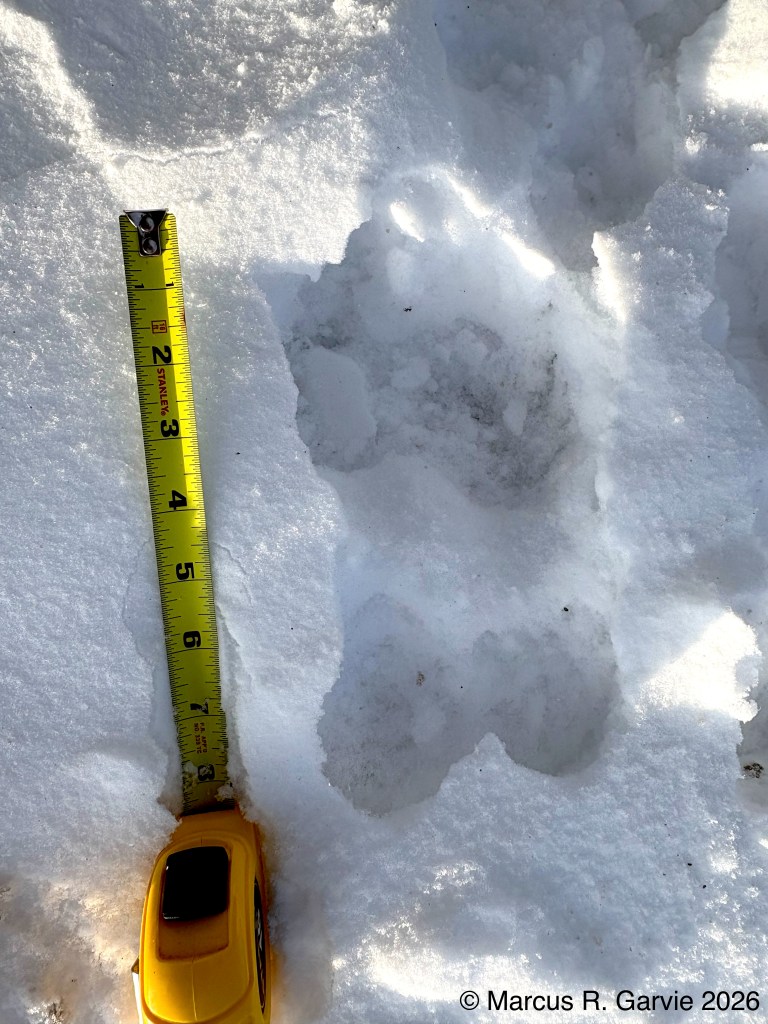
I estimate the distance from the hind feet to the front feet to be about 6½ inches, which is roughly the hip-to-shoulder distance of the animal. It seems reasonable that this distance is approximated by the stride of a marten in a direct-register walk, which in [1] is given as 5–9 inches. So again, our measurements are consistent with marten. In another post (see December 29), I photographed a “box stop” for a fisher in which I measured the hind-to-front distance to be about 10 inches (and the walking stride for a fisher is 7–11½ inches [1]). So the comparisons fit together nicely.
 Field Notes of a Tracker
Leave a comment