Date: January 1, 2026
Place: A group of us went tracking in the north end of Guelph at the Ignatius Jesuit Centre in Guelph. Our starting point was behind the Walmart next to the centre.
Weather: temperature between -15 C and -10 C. Fresh snow (a few inches) from the previous day.
References:
– [1] ‘Mammal Tracks & Sign: A Guide to North American Species’, Mark Elbroch, Stackpole Books (1st Edit), 2003
– [2] ‘The Tracker’s Field Guide: A Comprehensive Manual for Animal Tracking’, James Lowery, A Falcon Guide (2nd Edit), 2013
– [3] ‘Bird Tracks & Sign: A Guide to North American Species’, Stackpole Books, Mark Elbroch, 2001.
– [4] ‘Animal Tracks of the Midwest’, Jonathan Poppele, Adventure Publications (2nd Edit), 2022.
Observations:
This was a quick 3-hour excursion. My first observation was cottontail chew marks on some low-hanging aspen branches. There were cottontail tracks everywhere and cottontail scat:
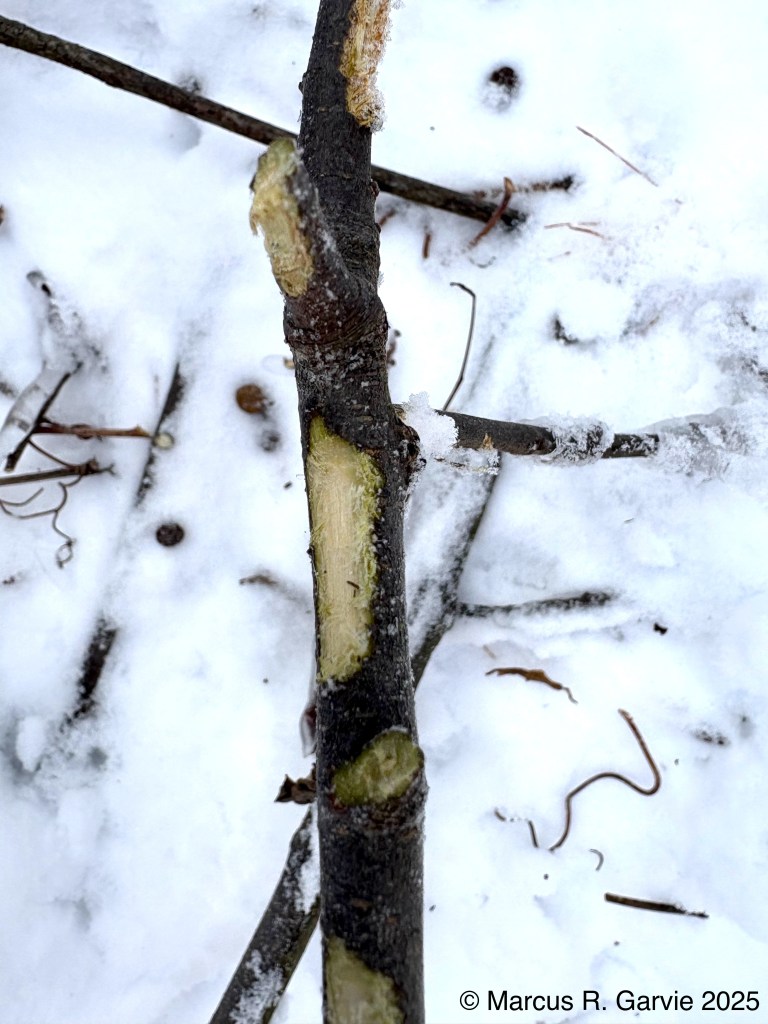
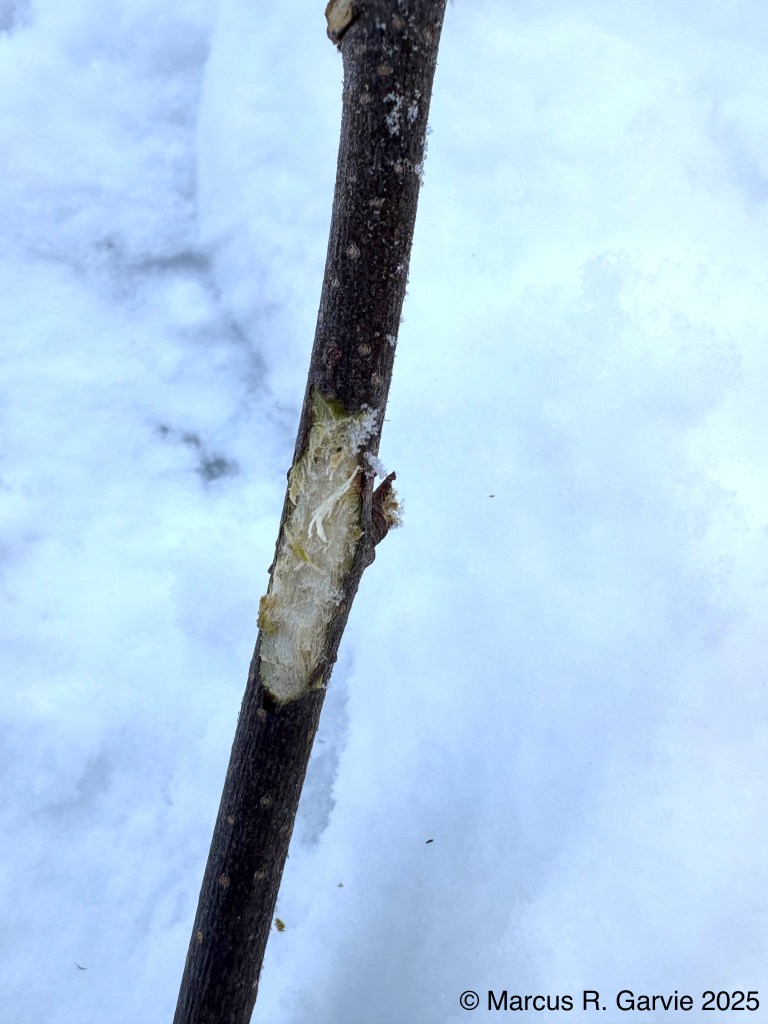
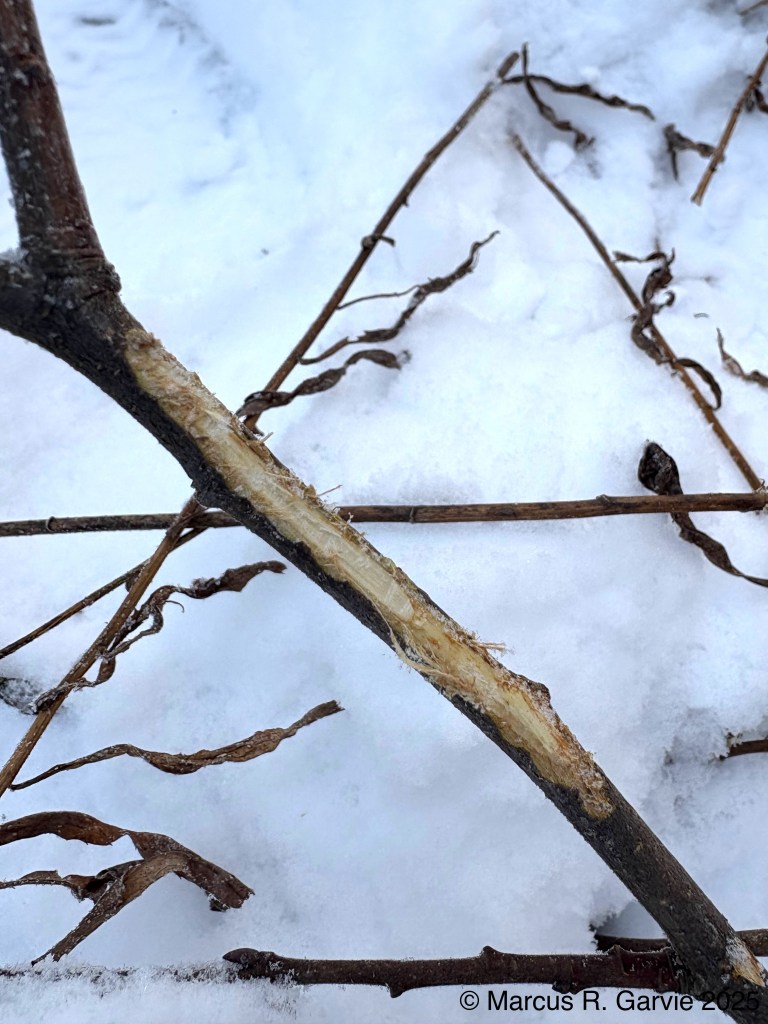
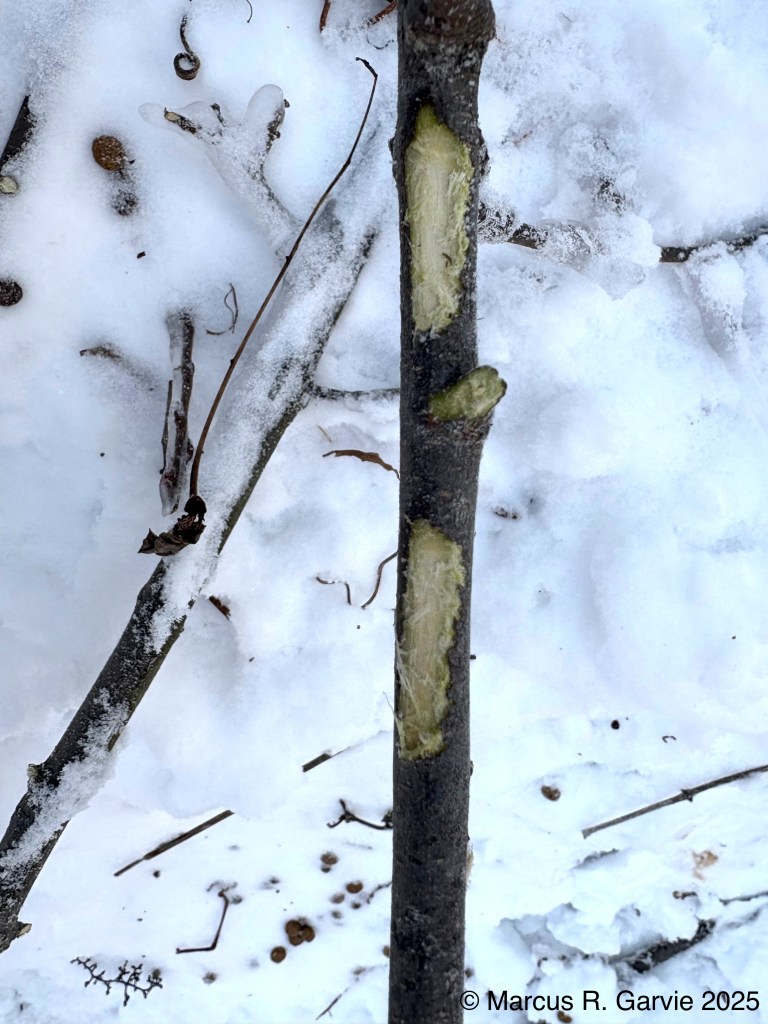
Byron Murray explained that the chew marks from a vole would look different: (a) the chew marks would not be so deep, and (b) voles tend to chew larger continuous lengths of branches.
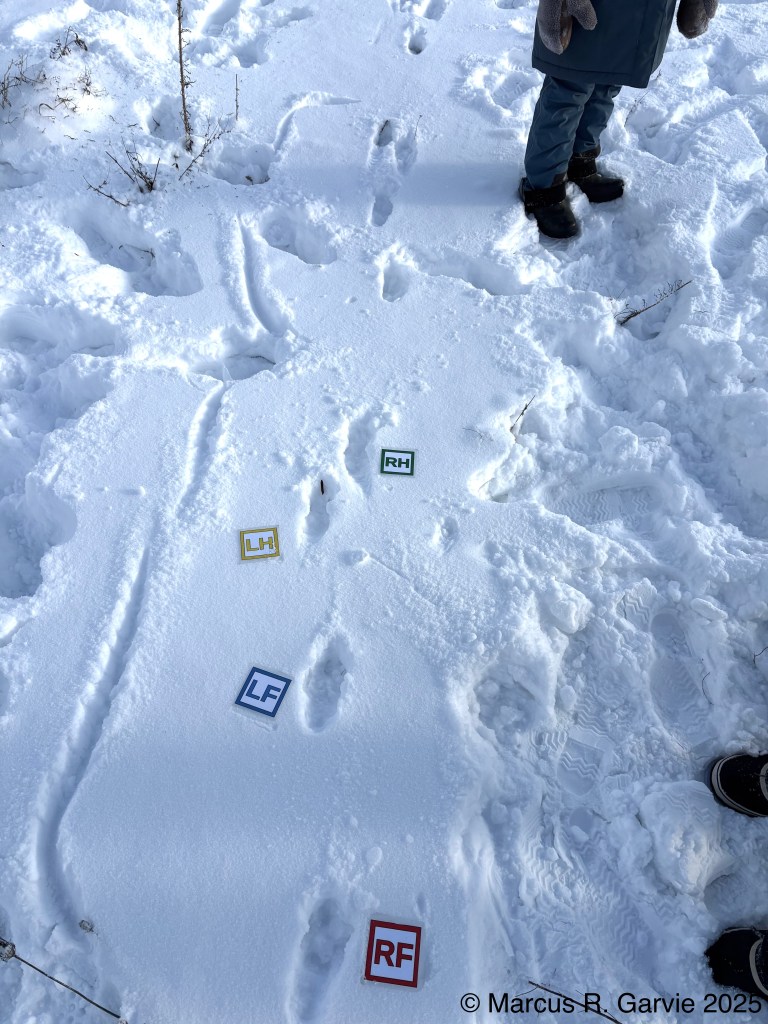
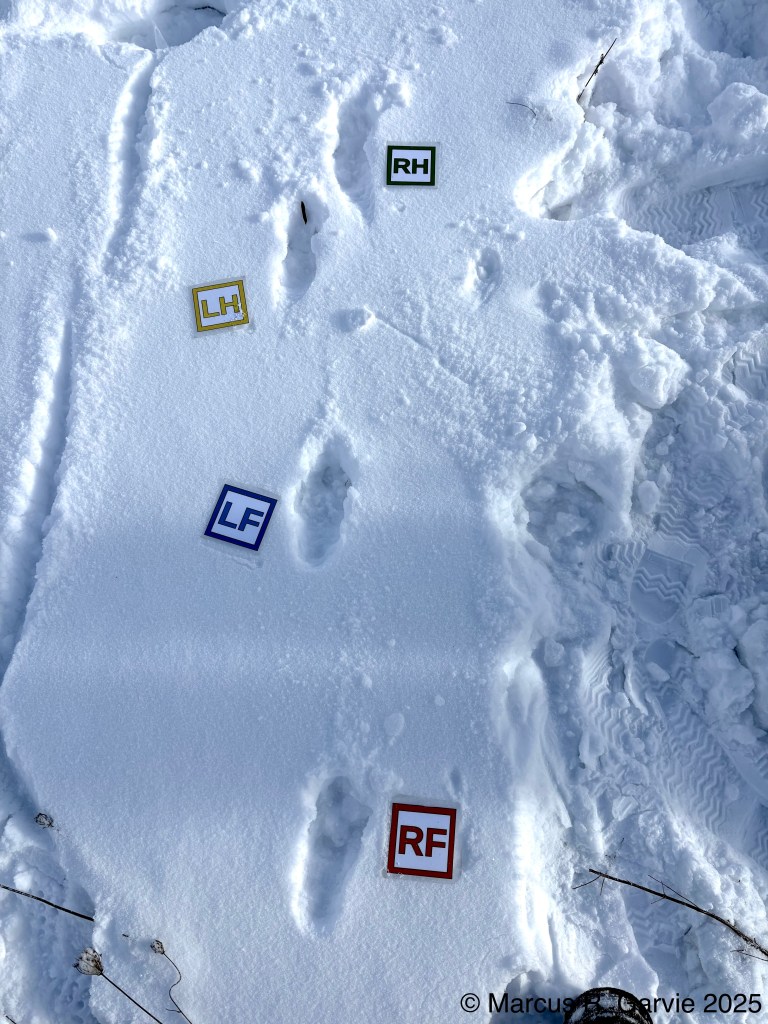
We quickly found coyote tracks and spent much of the time trailing what appeared to be a single individual. It was interesting to follow the trail and observe how the coyote searched for the many small mammals present, often circling, backtracking, making exploratory digs (a cache?), stopping, and showing frequent head turns. Much of the movement was in a direct (and at times indirect) walk, but at intervals the coyote transitioned into a transverse gallop:
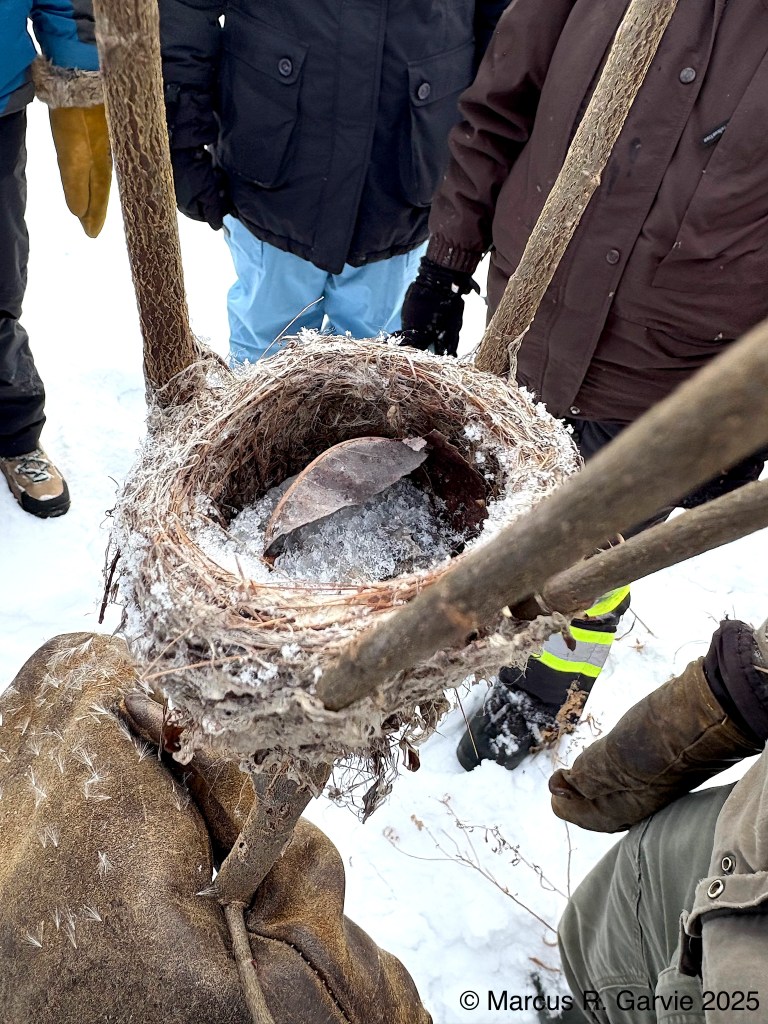
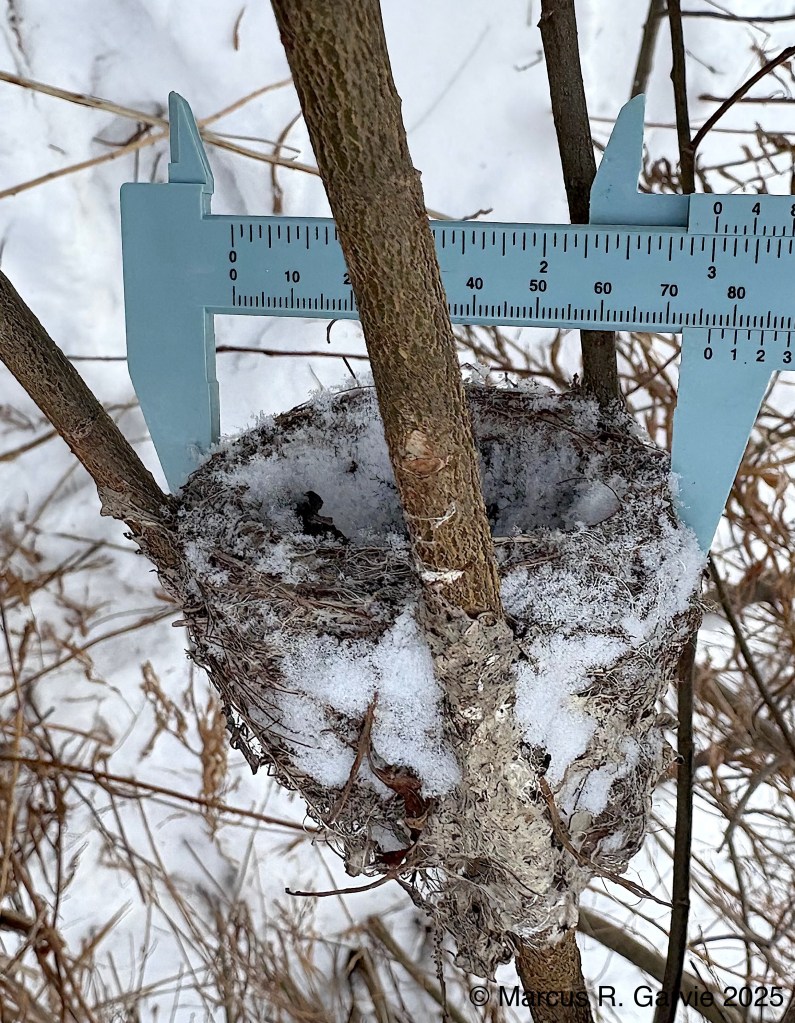
Later, we skirted a wetland area with willow trees, goldenrod, and cattail. We found a bird’s nest nestled in the crook of four branches, approximately 3 meters off the ground. The nest was beautifully constructed, with no mud, but instead made of a fluffy material that appeared to bind everything together.
Byron Murray took the following measurements: 8.5 cm outside diameter, 7.5 cm outside height, approximately 5.5 cm inside diameter, and a cup depth of about 3.5 cm. Using field guides with nest descriptions, Byron concluded that the nest was likely made by either a Goldfinch or a Yellow Warbler. I clearly need to add a field guide that includes nests to my library.
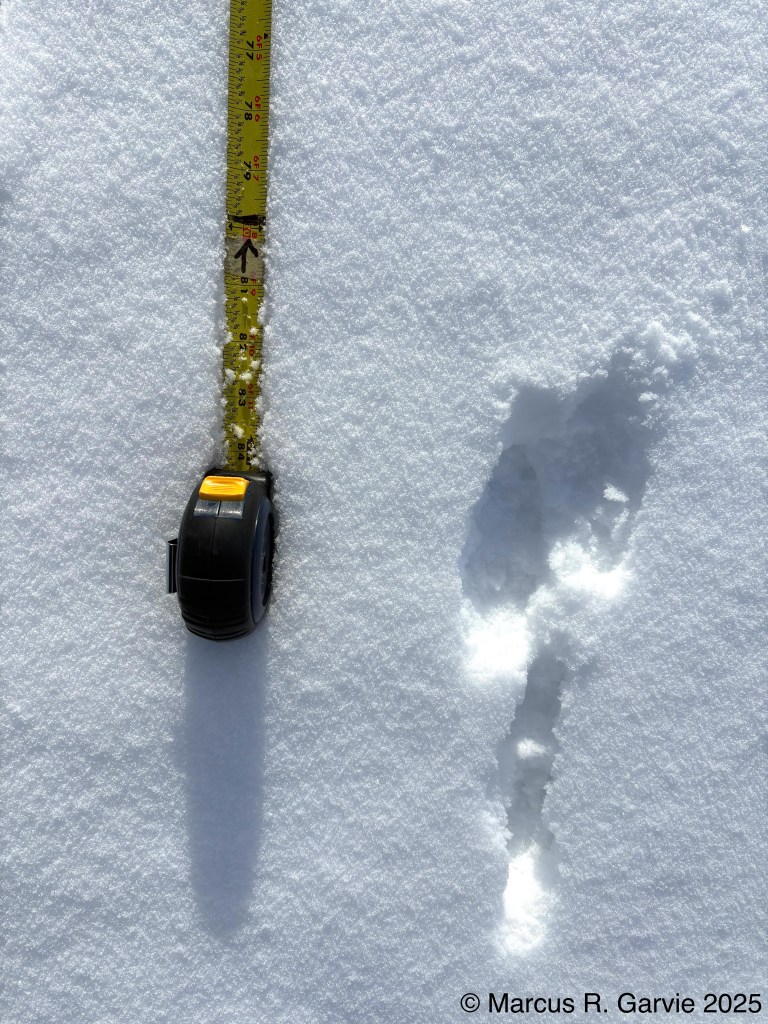
Near one set of coyote trails, I found a cottontail making an exceptionally long bound – close to 83 inches. The usual range (see [2]) is about 9½ to 48 inches. Was the rabbit panicked by the nearby coyote?
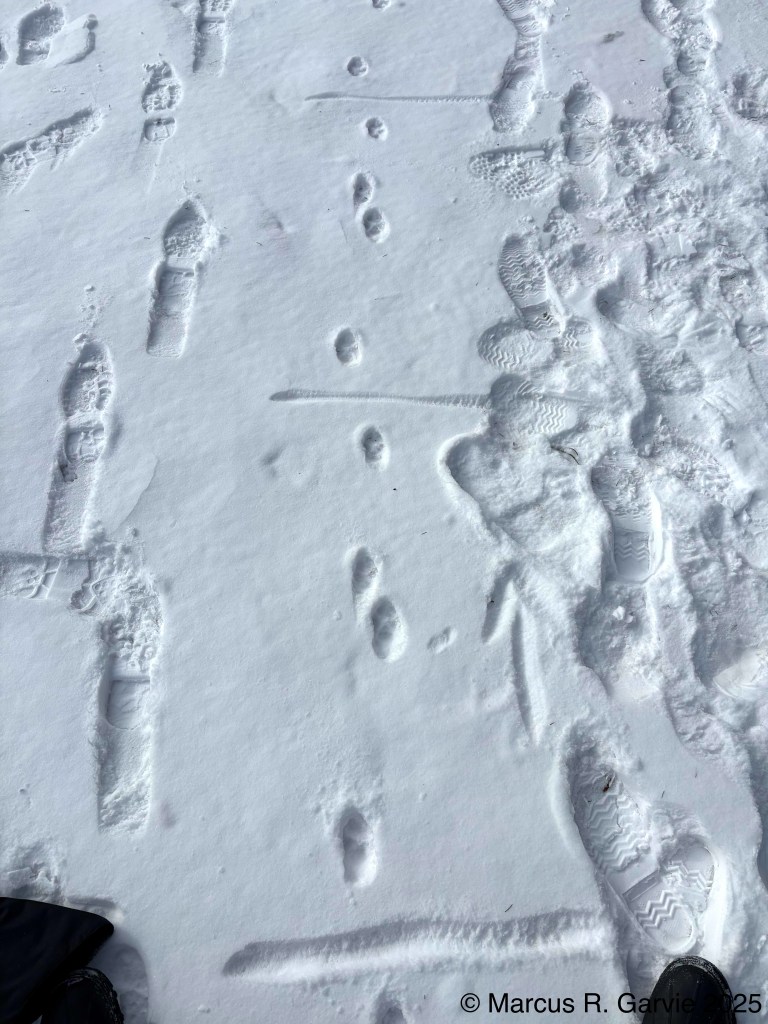
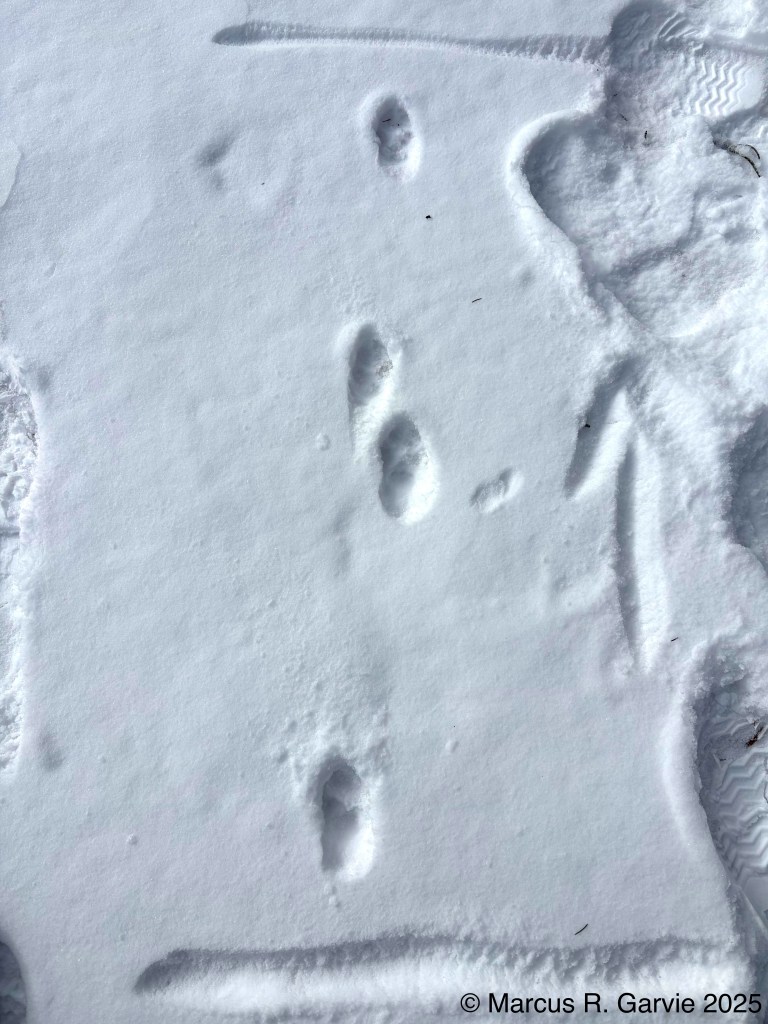
Finally, just as we were leaving the area, we saw three or four Dark-eyed Juncos landing in the snow to feed on the seeds of some small, dried-up flowering plants. This was a rare opportunity to record the tracks of a bird we could definitively identify because we observed the bird directly.
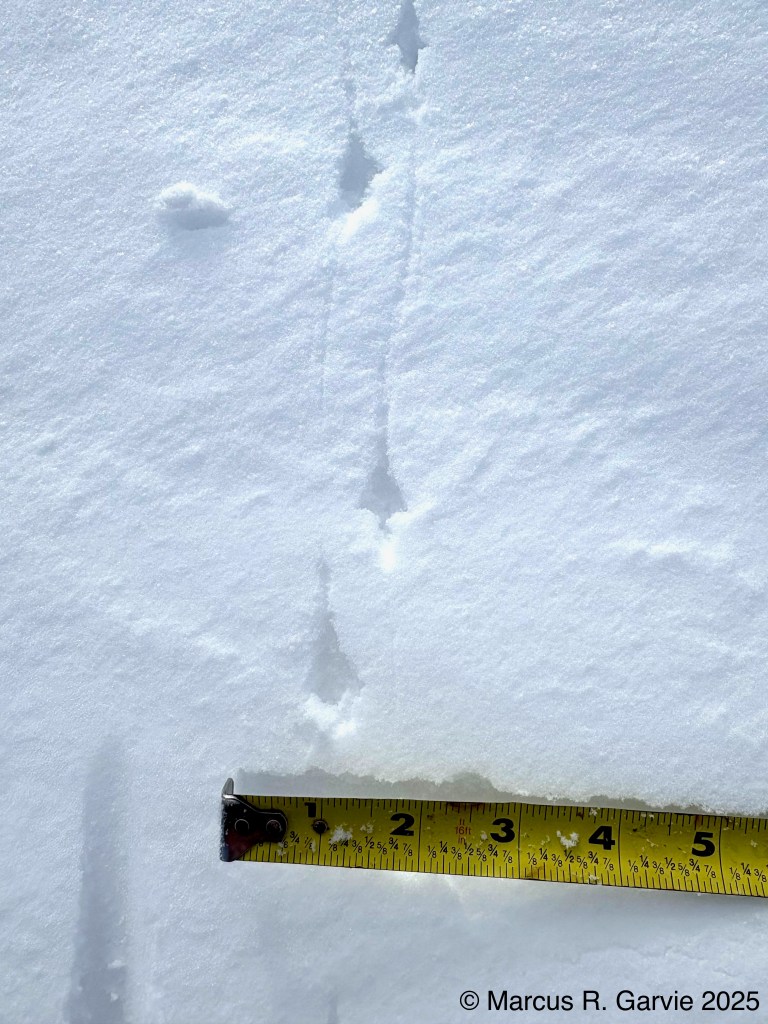
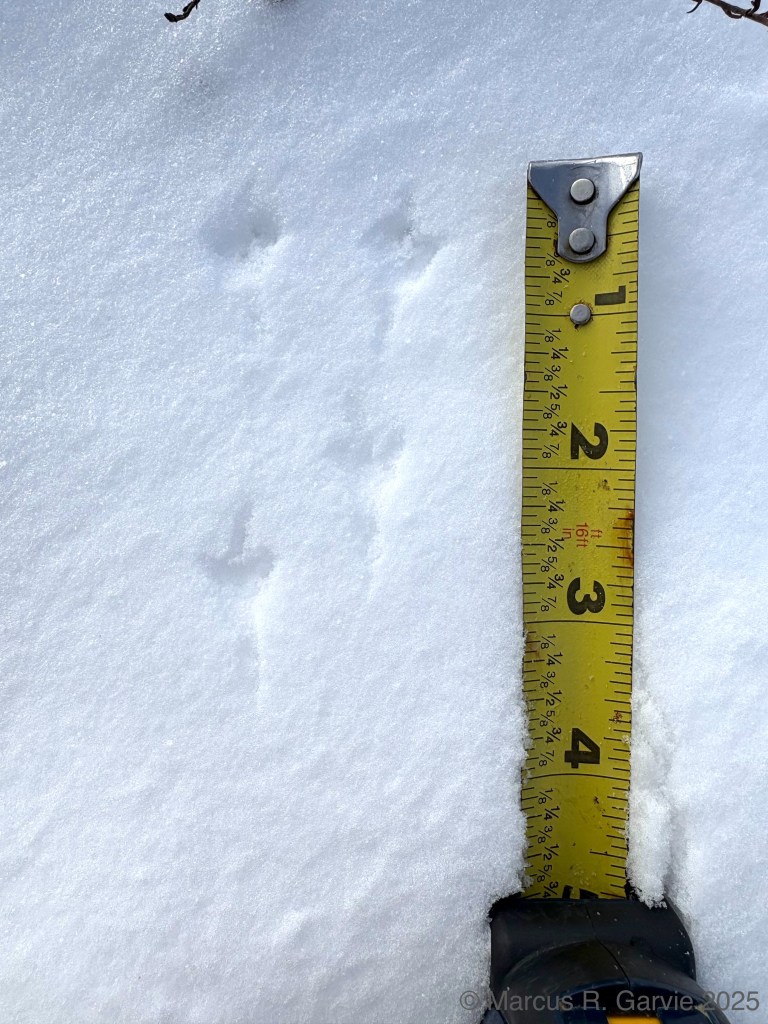
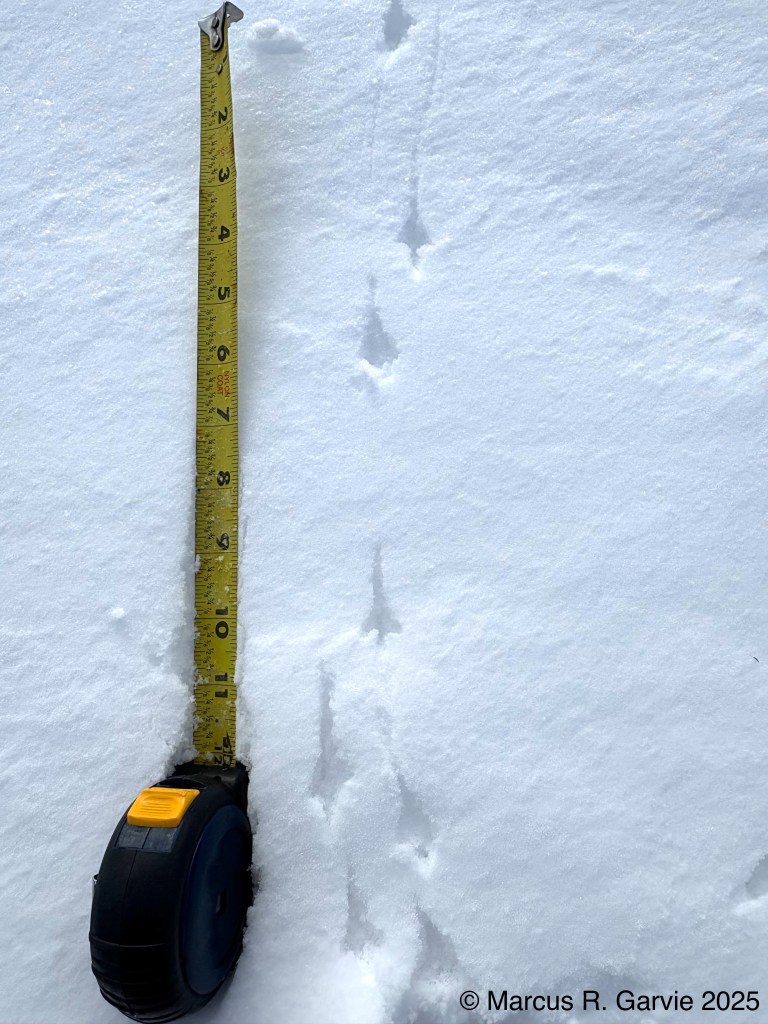
Apparently, juncos will both hop and skip. I was initially confused about what is meant by a skip (clearly not a human skip!). A member of the Animals Don’t Cover Their Tracks explained, “A hop is where 2 feet land at the same time creating 1 pause – 1 pause if you could hear it and the pattern is 2 tracks side by side. Most small songbirds and for example blackbirds often move like that. A skip is where 1 foot lands separately from the next, creating a 1-2 pause 1-2 pause and 1 foot stands a bit in front of the other. This is a movement magpies (and orher corvids) use.” And in [4] it says
“Hops are small jumps made with both feet together. Hops leave side-by-side pairs of tracks. Skips are a cross between a hop and a run — similar to a child “galloping” on a hobby horse. Skips leave offset pairs of tracks. Perching birds, especially smaller ones, typically hop or skip.”
So in the first photo above, we have a skip. In the 2nd photo, the bird is hopping, and in the 3rd photo, we have a skip transitioning into a walk at the bottom.
The tracks are anisodactyl (classic bird tracks) with three toes pointing forward and one toe pointing back. These are my measurements:
Track length: 1 1/4 in
Track width: 1/2 in
Hop trail width: 1 1/2 in
Hop stride: 1 1/2 – 2 1/2 in
This is consistent with the measurements given on page 49 of [3]. It was interesting to learn that a junco is a type of sparrow, and most sparrows have a longer toe 1 in proportion to the overall track length.
Final thoughts:
I was initially confused by what authors mean when they say that a bird “skips.” And yet, most of us have probably seen crows skipping. I have also seen House Sparrows hop, and American Robins both hop and run. It is important not to forget the everyday knowledge we have of the common animals that live around us. For example, many of us live with cats and dogs, and we can learn a great deal from watching them about the behavior of their wild relatives.
 Field Notes of a Tracker
Leave a comment