Date: December 5, 2025
Place: I spent the weekend at the house of Diana Clements, a fellow tracker, who lives in a remote, forested area of the Parry Sound District, east of Highway 400, north of Nobel, and southwest of Nine Mile Lake, surrounded by lakes and wetlands. We went for a short night walk near Diana’s property (Friday, Dec 5, approx. 7:30pm – 8:30pm ) and found marten tracks.
Weather conditions: approximately 6 inches of fairly fresh snow was present, with light additional snowfall occurring sporadically. Temperatures ranged around the −10 °C mark.
References:
– [1] ‘Mammal Tracks & Sign: A Guide to North American Species’, Mark Elbroch, Stackpole Books (1st Edit), 2003
– [2] ‘The Tracker’s Field Guide: A Comprehensive Manual for Animal Tracking’, James Lowery, A Falcon Guide (2nd Edit), 2013
Night walk:
Diana had recently seen marten tracks near her property so we went for a quick night walk to investigate. The American pine marten (Martes americana) is a small member of the weasel family (Mustelidae), smaller and more slender than the closely related fisher. It inhabits mature boreal and mixed forests across northern North America, where its light body and furred feet allow it to hunt and travel efficiently in deep snow. The feet of marten have more fur than fisher, and fisher have more fur on their feet tha mink. Due to the heavy fur on marten feet, toe pads are often indistinct or create a “blurry” appearance in their tracks, particularly in dry or powdery snow.
Apparently, male American mink, American martens, and fishers are all larger than females, with males having greater body length and mass, and the size difference being especially pronounced in fishers. This is called ‘sexual dimorphism’. See
https://animaldiversity.org/accounts/Martes_pennanti/?utm_source=chatgpt.com
https://en.wikipedia.org/wiki/American_marten
https://nsojournals.onlinelibrary.wiley.com/doi/10.1111/j.0030-1299.2004.12830.x?utm_medium=article&utm_source=researchgate.net
These differences in size between males and females means that the track measurements can overlap between species (i.e., male mink and female marten, and male marten and female fisher), as shown in the table below (from [1]):
| Species | Gait | Trail width (in) | Group length (in) | Stride length (in) |
|---|---|---|---|---|
| Fisher | 2×2 | 3–5.5 | 6–13 | 17–45 |
| Fisher | 3×4 | – | 12–26 | 5.75–30 |
| Marten | 2×2 | 2.5–4.5 | 3.5–7.5 | 10–34 |
| Marten | 3×4 | – | 7.5–20 | 8–32 |
| Mink | 2×2 | 2–3.75 | – | 9–38 |
| Mink | 3×4 | – | 5–14 | 6–36 |
Note: all three species occur in the Parry Sound area. We see that stride is very variable, so trail width is a better guide to use when differentiating between these animals. So we have the following averages for trail widths:
- Fisher: 4.25 in
- Marten: 3.5 in
- Mink: 2.9 in
These averages highlight the clear size gradient in trail widths (fisher > marten > mink).
We should also briefly consider the relative sizes of the front and hind tracks for these three mustelids (again measurements from [1]):
| Species | Front length (in) | Front width (in) | Hind length (in) | Hind width (in) |
|---|---|---|---|---|
| Fisher | 2 1/8–3 7/8 | 1 7/8–4 1/4 | 2–3 1/8 | 1 1/2–3 1/2 |
| Marten | 1 5/8–2 3/4 | 1 5/16–2 5/8 | 1 1/2–2 3/4 | 1 3/16–2 1/4 |
| Mink | 1 1/8–1 7/8 | 7/8–1 3/4 | 13/16–1 3/4 | 15/16–1 5/8 |
Again, we see similar overlap between these three species. Averaging:
- Fisher: front tracks average about 3.0 in long × 3.1 in wide, while hind tracks average about 2.6 in long × 2.5 in wide.
- Marten: front tracks average about 2.2 in long × 2.0 in wide, while hind tracks average about 2.1 in long × 1.7 in wide.
- Mink: front tracks average about 1.5 in long × 1.3 in wide, while hind tracks average about 1.3 in long × 1.3 in wide.
These averages highlight the clear size gradient in track sizes (fisher > marten > mink), while also showing that front tracks tend to be slightly larger and broader than hind tracks in all three species.
Here are some photos I took of what we observed:
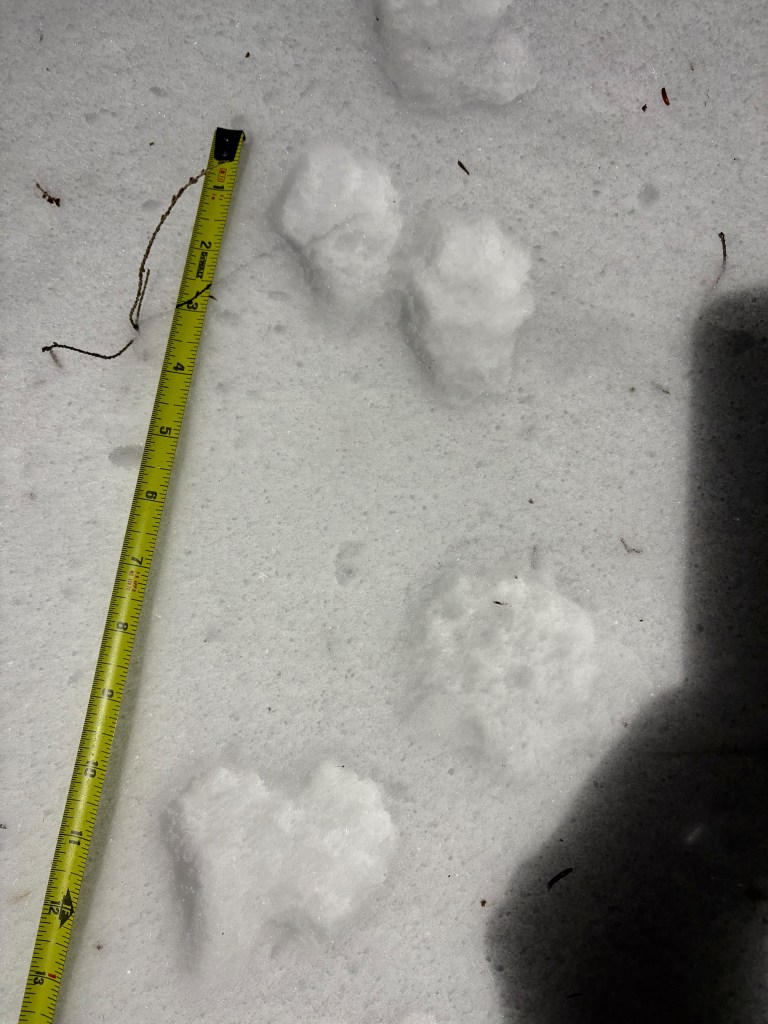
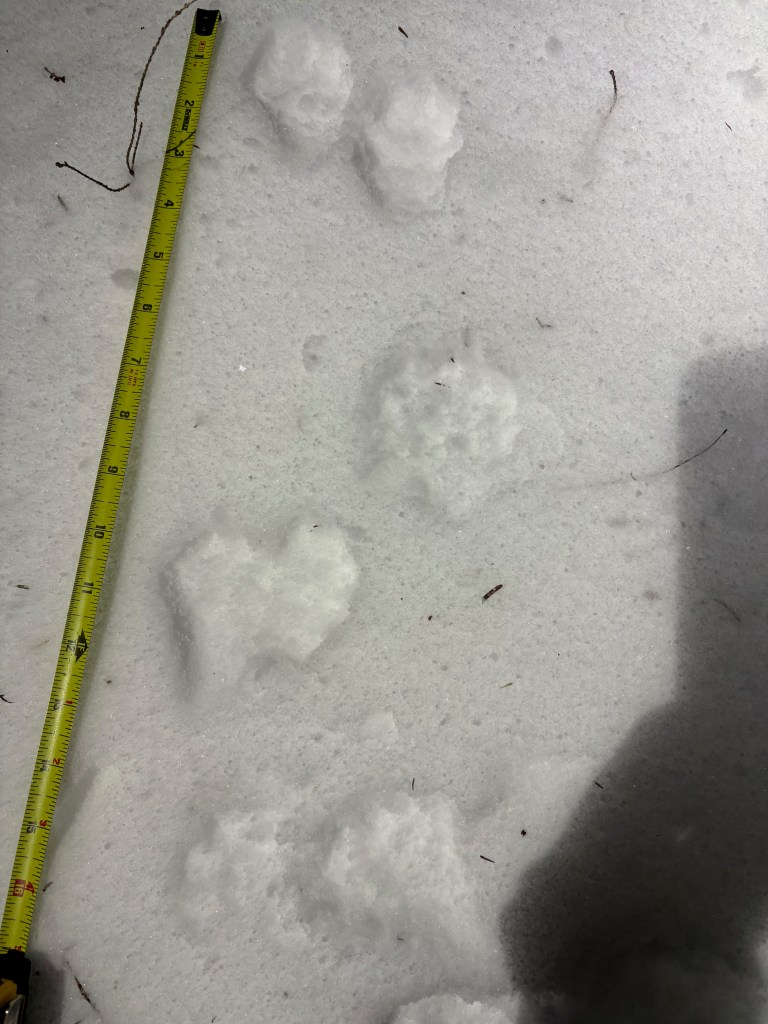
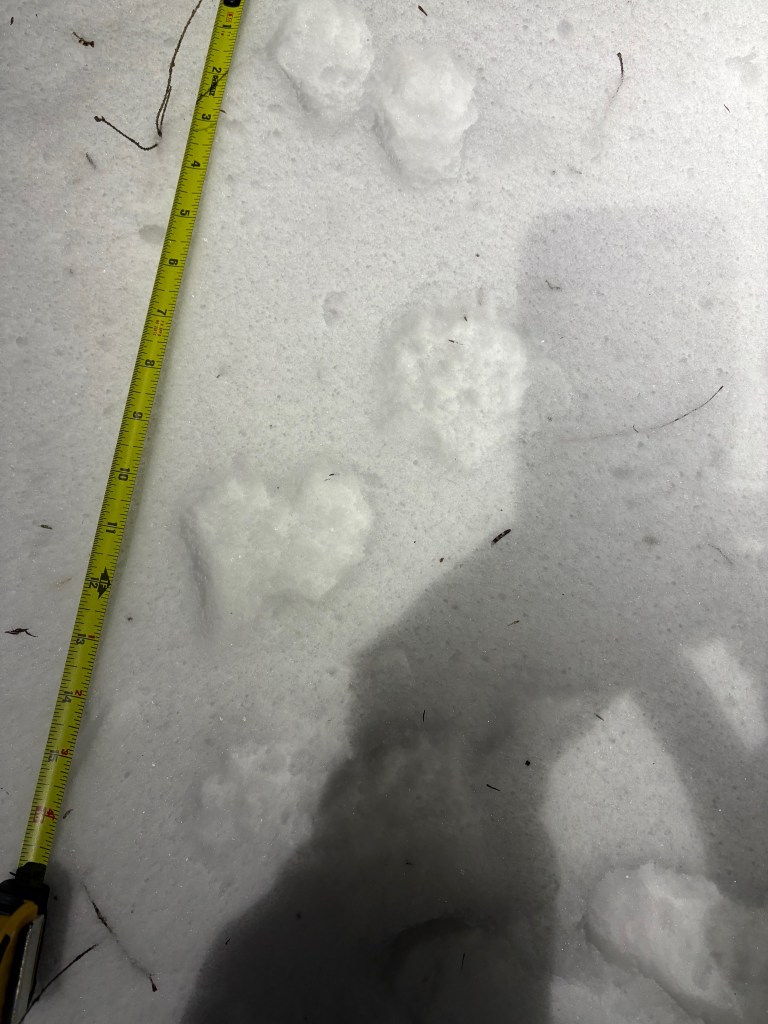
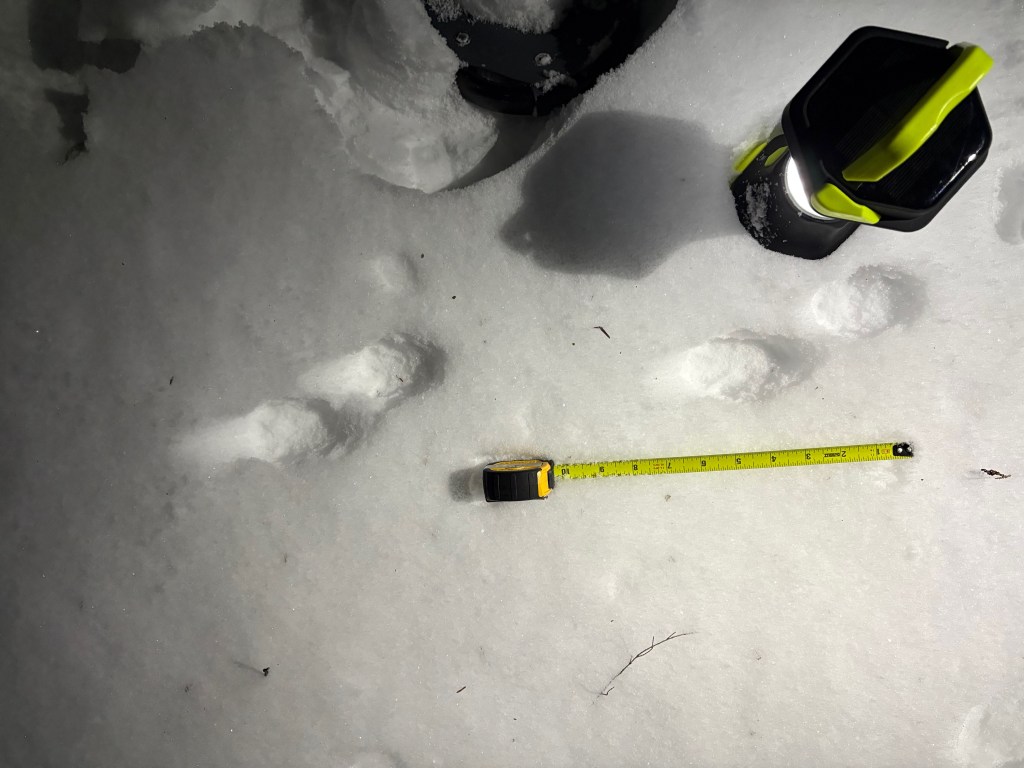
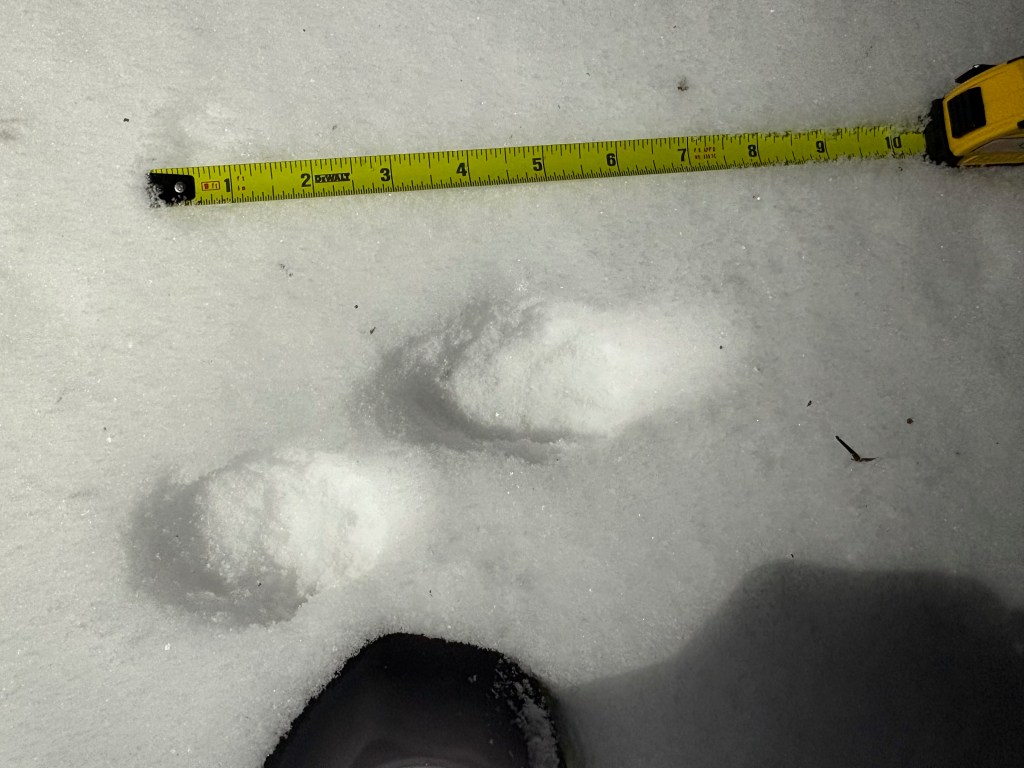
The animal is clearly doing a 2 x 2 lope, where the hind feet land exactly where the front feet were. So each track is a double track. This is illustrated in [1], reproduced below:
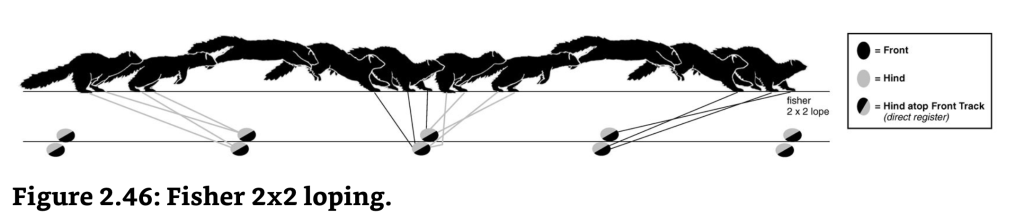
Based on the pictures on p. 161 of [1], the direction of travel in the 4th picture is left-to-right.
Let’s now have a look at the track observations we made for track length, track width, group length, and trail width (I wish I had taken better, and more, measurements):
- Observed group length: 6 3/4 in, 6 1/2 in
- Observed trail width: 3 5/8 in, 3 1/2 in
- Track lengths (double print): 2 3/8 in, 2 5/8 in, 2 3/4 in
- Tracks width (double print): 1 1/4 in, 1 1/2 in, 1 3/4 in
All of these measurements are more consistent with marten than fisher or mink.
Final thoughts and rules-of-thumb:
As I’m taking part in a tracking evaluation in the Parry Sound area at the end of February (2026), I need a reliable way of telling fisher tracks apart from marten tracks, without the use of a ruler or tape measure. (Telling mink tracks apart from fisher tracks or marten tracks is much easier, e.g. due to the smaller size of mink and presence of webbing.) I need easily recalled ‘rules-of-thumb’. Trail width and track length/width averages seem the best measures to recall, which are roughly:
Marten rules-of-thumb for 2 x 2 lope:
- trail width average: 3 1/2 in
- track length x width (roughly): 2 x 2 in
Fisher rules-of-thumb for 2 x 2 lope:
- trail width average: 4 1/4 in
- track length x width (roughly): 2.8 x 2.8 in (so close to 3 x 3)
Other than differences in track measurements, there are other clues that can help us distinguish between marten and fisher. According to [2] as fisher are so much heavier than marten they make much deeper tracks. Also, marten feet tend to have more hair in Winter than the feet of fisher, therefore showing a less distinct palm-pad area and other details. Finally, fisher walk rather than bound in deep snow compared to marten, which rarely do [2].
Finally, the article at
https://winterberrywildlife.ouroneacrefarm.com/2020/04/01/american-marten-tracks-and-sign/
really takes our understanding of tracking the marten (and fisher) to the next level!
 Field Notes of a Tracker
Leave a comment