Aim: My aim in this post is to examine enough photographs of real track patterns for lopes and gallops to reliably distinguish between them in the field. It was hard finding real examples online. I also realized I was unclear on the precise definitions of these gaits (the reasons for this became clear once I started looking at lopes and gallops in more detail). What became evident is that one must first be able to differentiate front and hind tracks, which depends on both size and characteristic features of the print (e.g., number of toes, symmetry, shape of the metacarpal pad, etc.). In this post I am focusing initially on what one actually sees on the ground, and then later thinking about what the animal is actually doing from a biomechanical point of view. Another thing that became clear was that the distinction between a lope and a gallop is somewhat artificial as there is a continuum of gaits between the two. Furthermore, authors do not agree on tracking terminology for gaits [5], and the distinction between lopes and gallops is somewhat subjective [3].
References:
- [1] ‘Field Guide to Animals Tracks and Scat of California’, Mark Elbroch, Michael Kresky, Jonah Evans, University of California Press, 2012
- [2] ‘Mammal Tracks & Sign: A Guide to North American Species’, Mark Elbroch, Stackpole Books (1st Edit), 2003
- [3] ‘Animal Tracks of the Midwest’, Jonathan Poppele, Adventure Publications (2nd Edit), 2022
- [4] iTrack Pro app (Jonah Evans)
- [5] ‘The Tracker’s Field Guide: A Comprehensive Manual for Animal Tracking’, James Lowery, A Falcon Guide (2nd Edit), 2013
- [6] ‘Mammal Tracking Workbook II: Gaits & Track Interpretation’, Jim Lowery, 2014.
Introduction: It has frequently been stated that all animals can do all gaits. However, each animal has its preferred gaits, or baseline gait, the pattern of movement that’s most efficient for the animal to use. According to [5] “The lope is an easygoing gait regularly used by weasel family members such as skunks, otters, fishers, and wolverines, but is also sometimes seen among cats, dogs, and ungulates.” The gallop is are not typically a baseline or traveling gait (https://crowspath.org/natural-history/wildlife/gaits/).
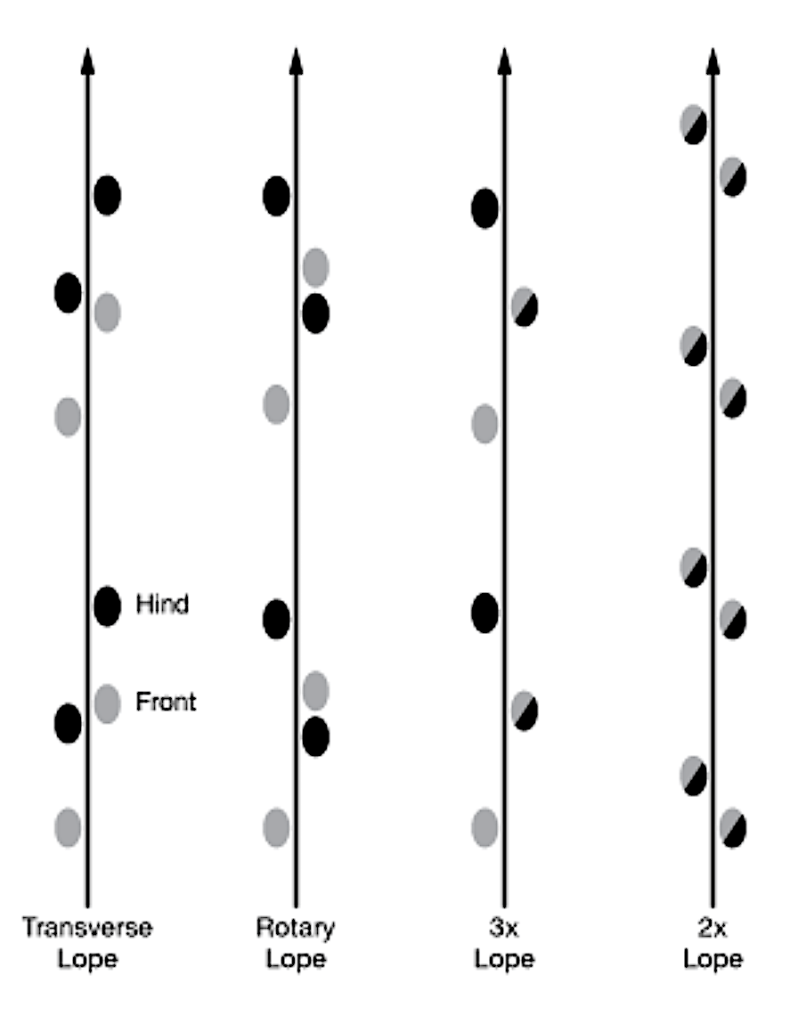
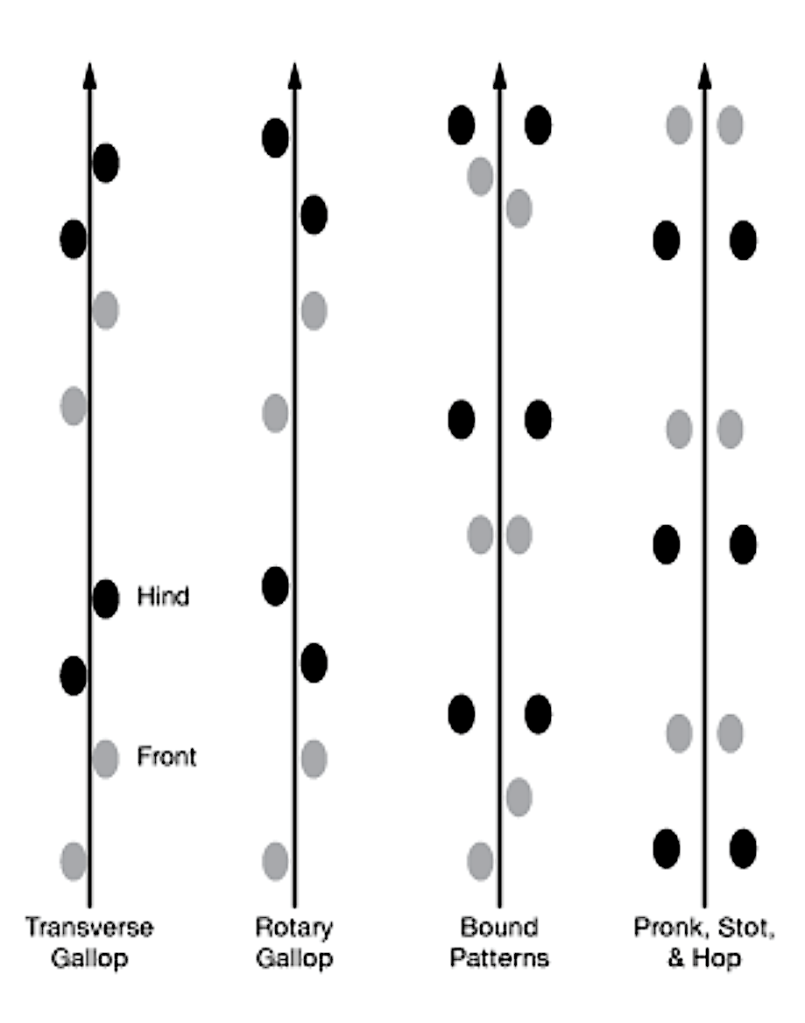
I have found the iTrack Pro app [4] very useful in understanding the track patterns for a lope and a gallop. I have added the relevant screenshots below (darker tracks represent hind tracks).
I had a rough idea of what a lope or gallop was, but there was still some confusion in my mind. Before trying to pin down a precise definition, I looked at a number of real examples using photographs. In each case, I indicated which foot was which, following the identifications provided by the original author.
LOPES
In this gait, the tracks occur in groups of four (F = front, H = hind, R = right, L = left), typically – though not always – in the order F, H, F, H in the direction of travel. Each group is separated from the next by a visible gap, corresponding to the period of suspension when the animal is airborne.
- Stated as a rotary lope of a Marten (or technically is this a rotary gallop?):
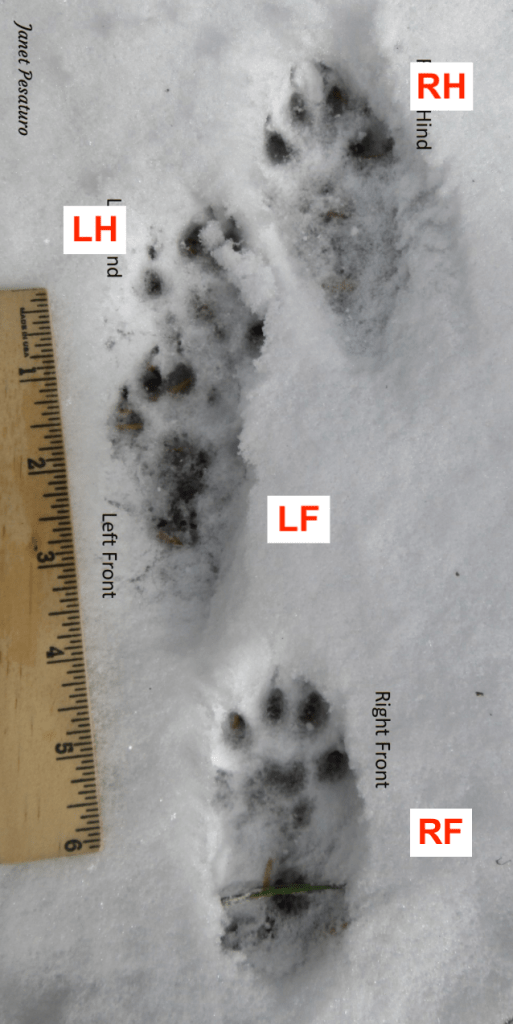
See https://winterberrywildlife.ouroneacrefarm.com/2020/04/01/american-marten-tracks-and-sign/ where these Marten tracks came from. Note: the front feet of a Marten are slightly larger than the hind feet.
- Rotary (almost 3 x 4) lope of a Gray Wof:
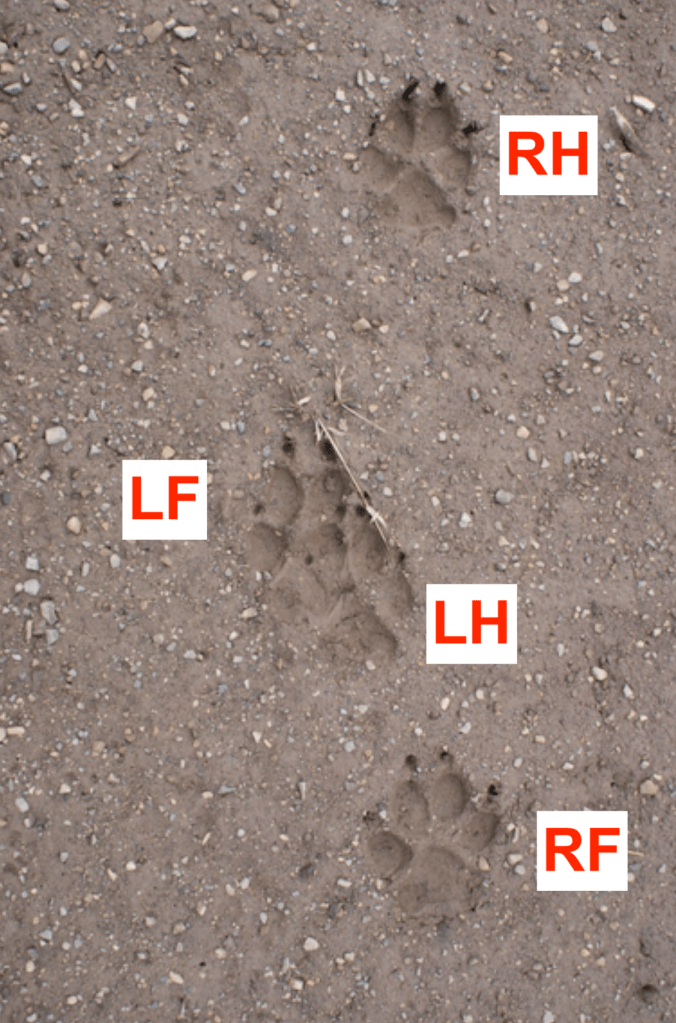
From [4]. Notice how the positions of the two inner tracks has reversed compared to the previous Marten example! Front feet are larger.
- Rotary lope of a Fisher:
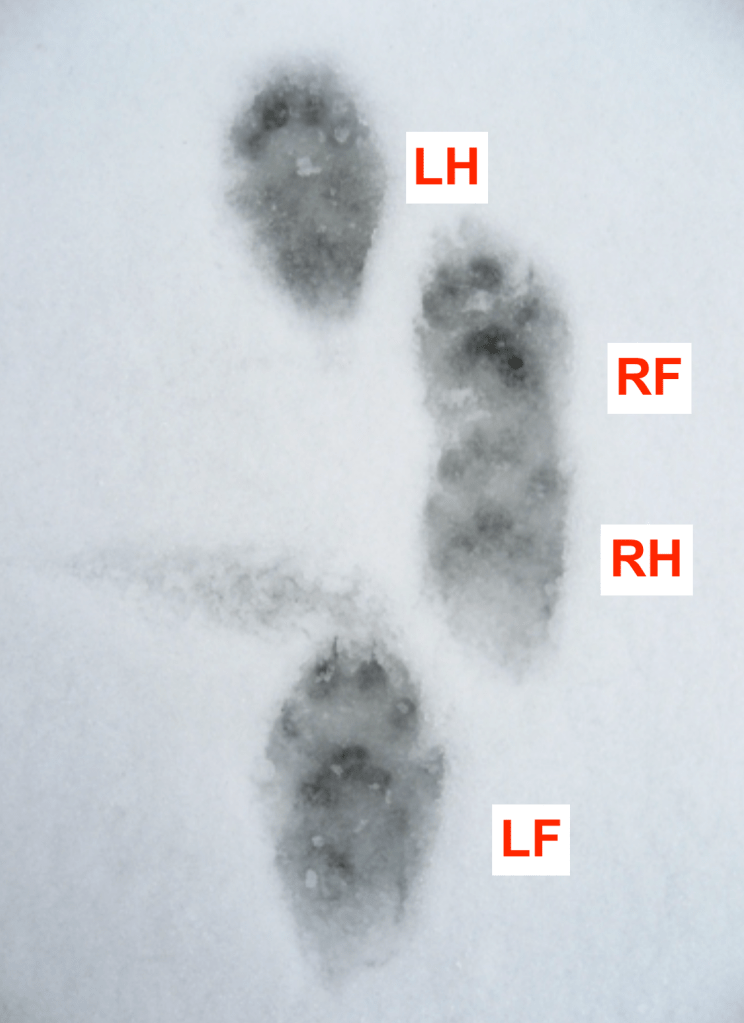
From [4]. The metacarpal pad seems more defined in the front tracks than the hind tracks. I think I also see the posterior heel pad in the LF track, which sometimes show. Otherwise the front and hind tracks look very similar to me.
- Transverse lope of an otter:
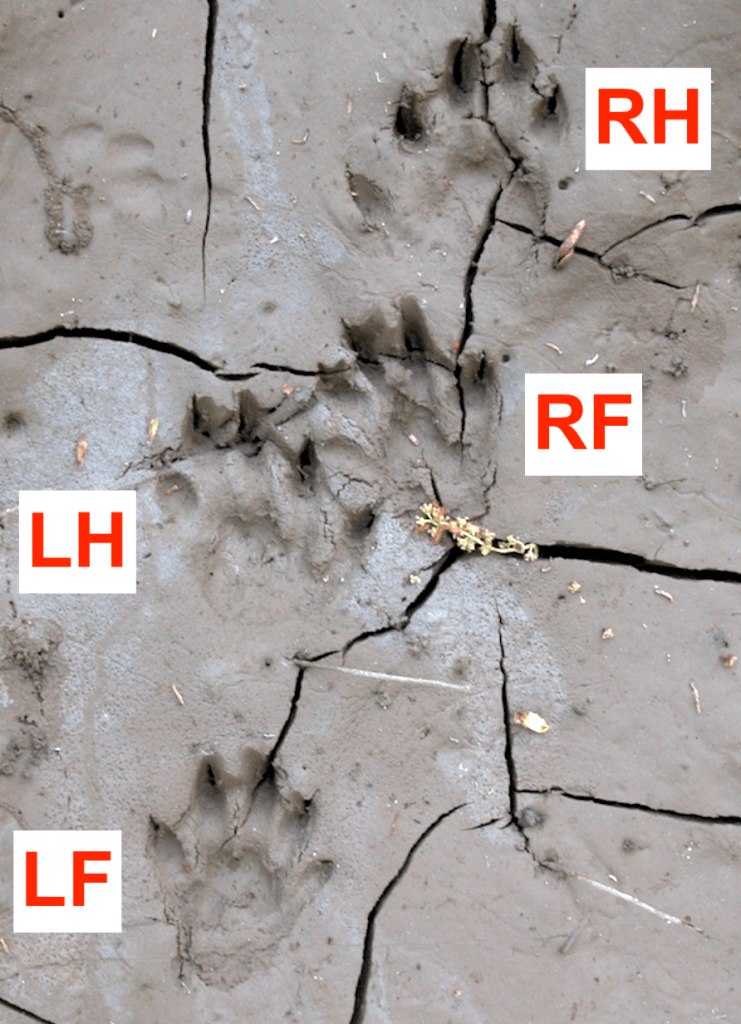
From [4]. Note that the hind tracks are less symmetrical and toe 1 is the lowest. Front tracks are relatively symmetrical.
- Tranverse lope of a skunk:
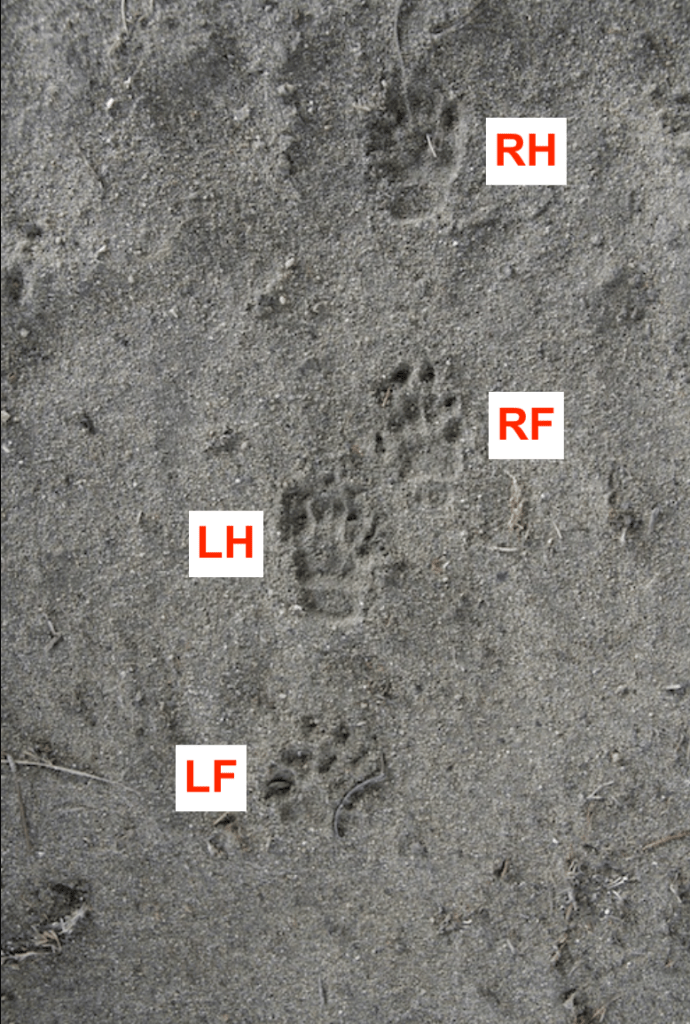
From [4]. The front tracks have more prominent claw marks.
- Rotary (3 x 4) lope of a Fisher:
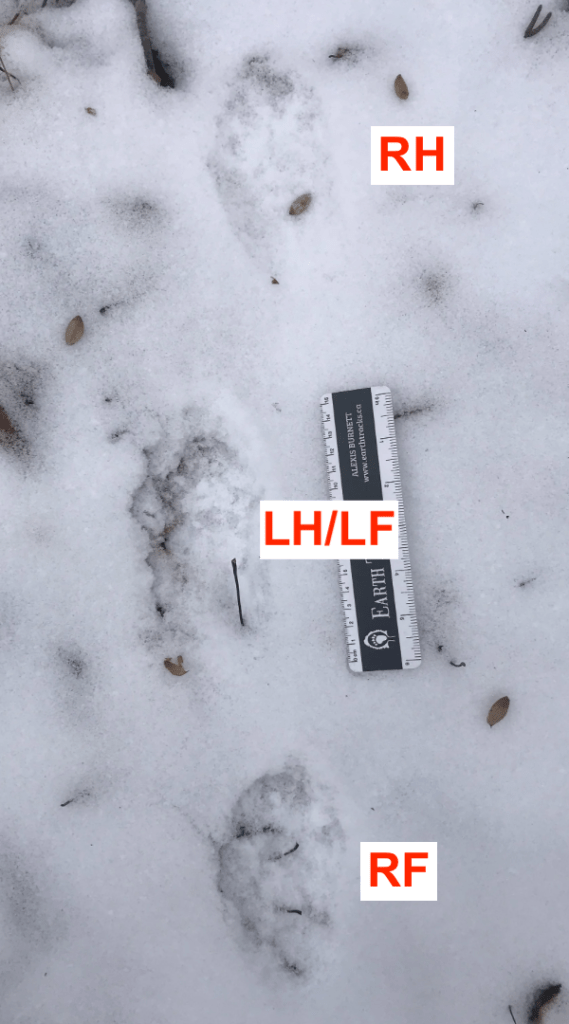
From https://www.toknowtheland.com/blog/trailing-a-fisher-at-old-baldy
- Stated to be a transverse lope of an unknown animal (Bobcat?). Or is this technically a gallop?
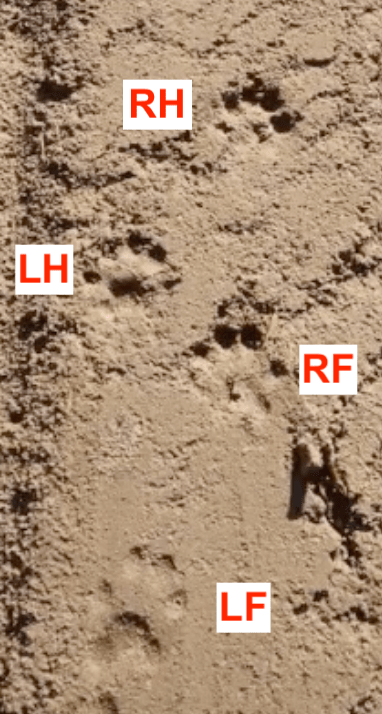
From https://www.youtube.com/watch?v=hY3wtJI-MG0&t=2s
- Transverse lope of a dog:
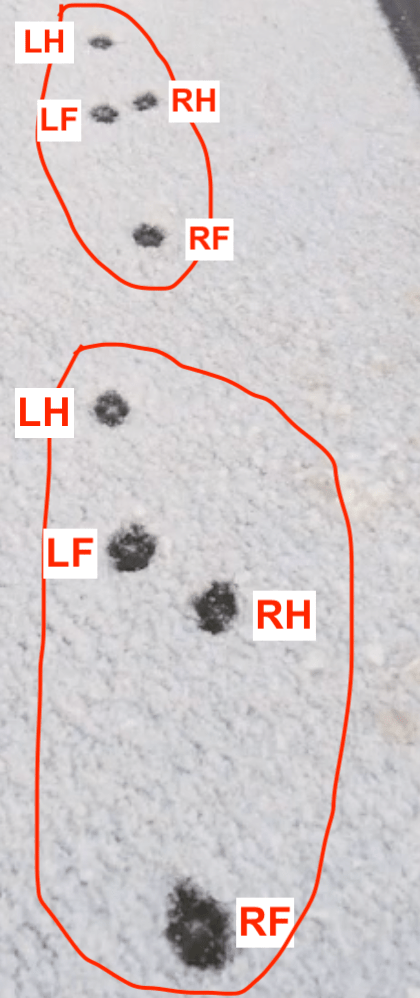
From https://www.youtube.com/watch?v=hY3wtJI-MG0&t=2s
Observe how in the 2nd group of 4 tracks (top) the LF and RH tracks have reversed positions, so is the 2nd group a gallop? Front tracks are bigger than hinds.
- Transverse lope of a muskrat
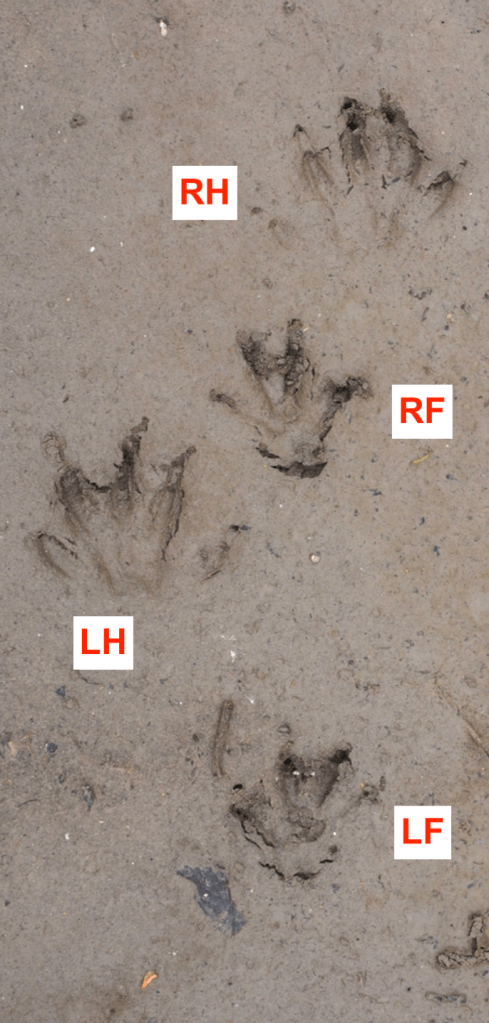
From https://www.inaturalist.org/observations/46264651
Notice how front tracks are smaller and have 4 toes while the hind tracks are larger and have 5 toes. Initially I had trouble distinguishing LF from RF as they are almost perfectly in a vertical line, but then I read on [4] that the toes of the front feet point in.
- Transverse lope (or gallop?) of a red fox (close to a 3 x 4 lope):
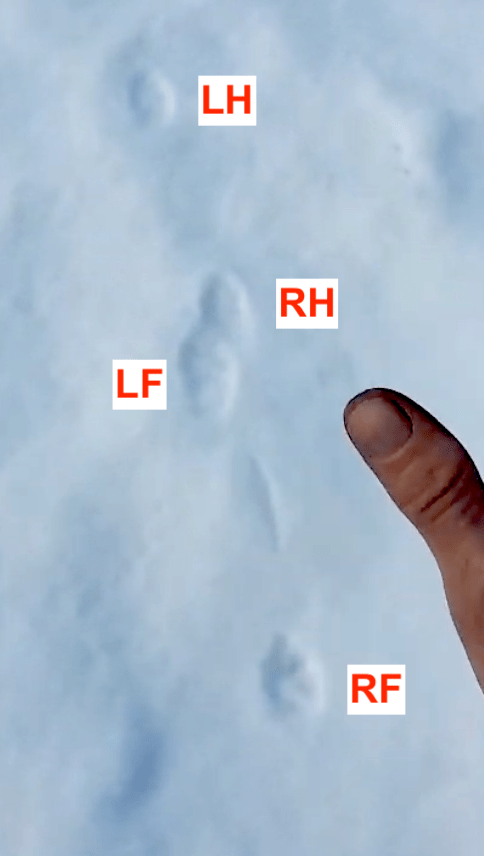
From https://www.youtube.com/watch?v=xbMp_NO0uXs at about the 5.03 min section. (Front tracks are a little bigger and have a ‘chevron’ shaped metacarpal pad.)
- Transverse lope (and 3×4 transverse lope) of a fisher:
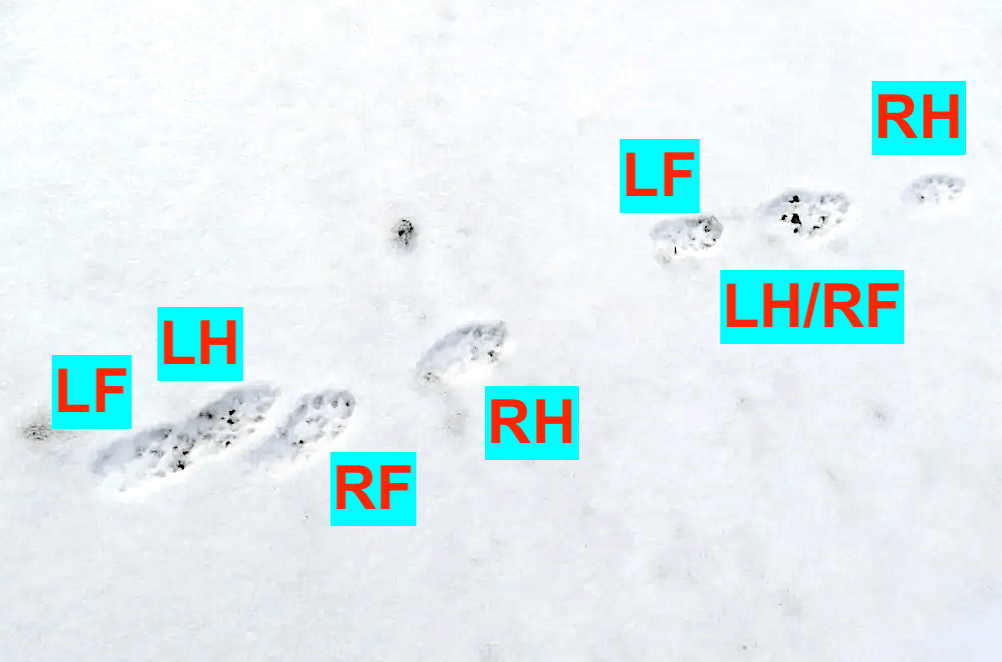
From https://lindajspielman.com/tag/lope/. The direction of travel is from the bottom left to the top right.
GALLOPS
In this gait, the tracks occur in groups of four (F = front, H = hind, R = right, L = left), in the order F, F, H, H in the direction of travel. Each group is separated from the next by a visible gap, corresponding to the main period of suspension when the animal is airborne.
- Tranverse gallop of a dog:
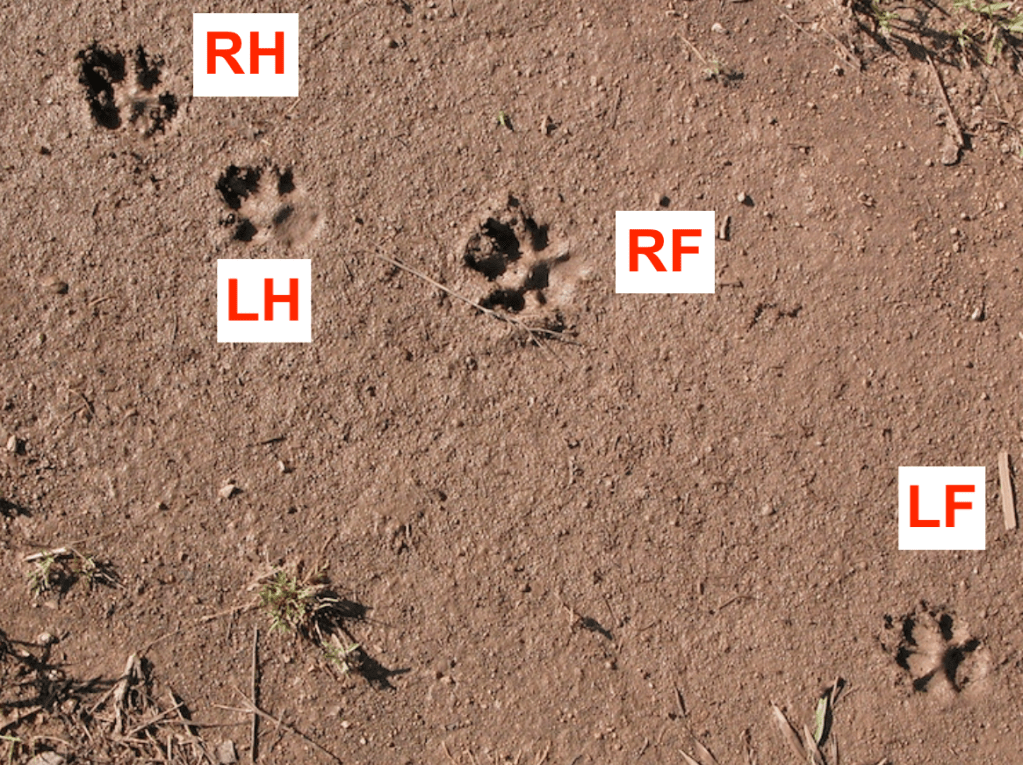
From [4]. Front tracks are larger.
- Tranverse gallop of a marten:
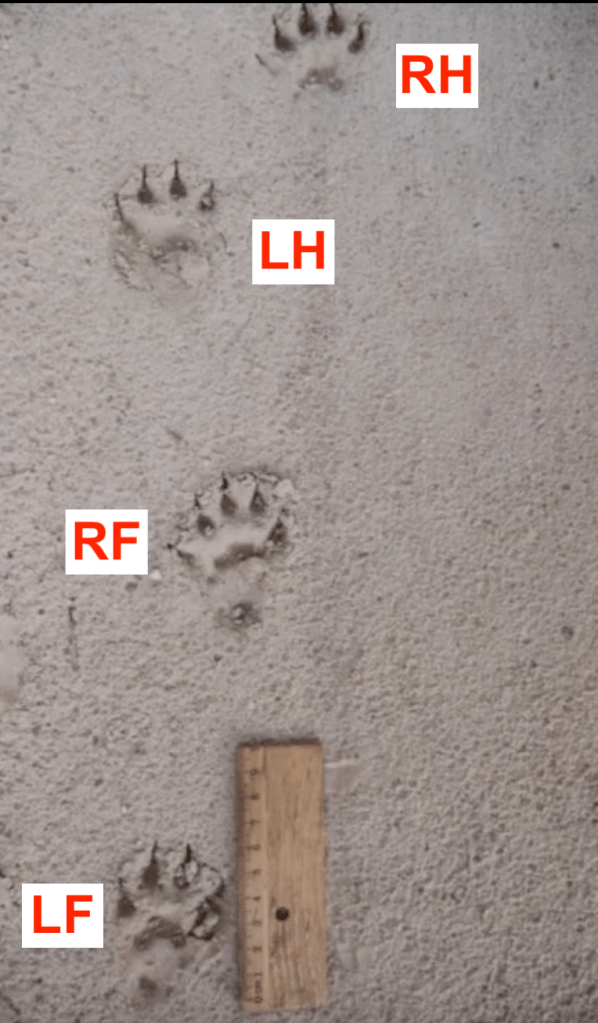
From https://www.youtube.com/watch?v=CwEAJW9FsY8
Note (e.g., [3]) the front tracks are larger and more splayed.
- Transverse gallop of a red fox:
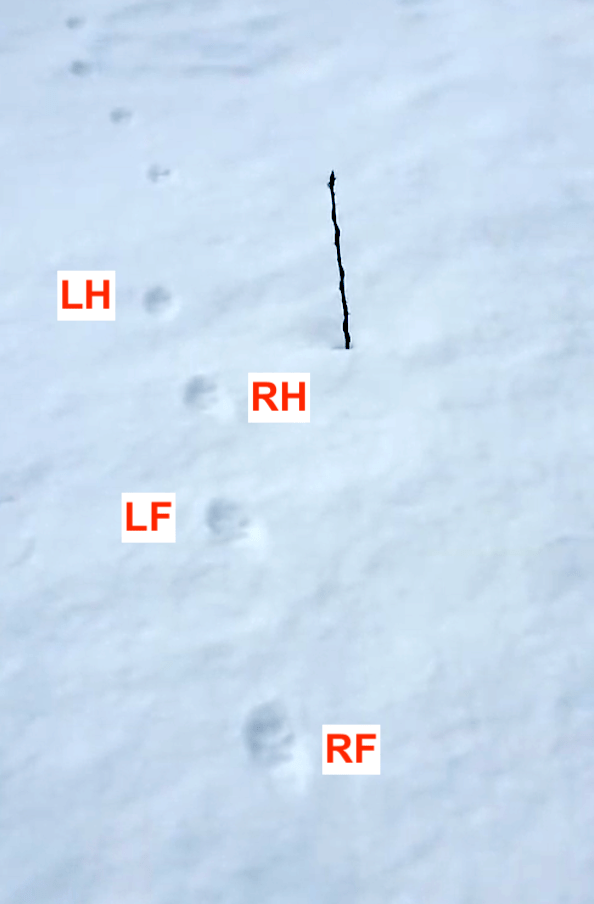
From https://www.youtube.com/watch?v=xbMp_NO0uXs at about 0.28 mins. This track pattern might have been interpreted as a direct register trot if we didn’t recognize that the fronts came before the hinds, and the lack of double prints. At the top of the photo we see the gap that separates the current group of 4 tracks from the next group. (Front tracks are a little bigger and have a ‘chevron’ shaped metacarpal pad.)
- Transverse gallop of a red fox:
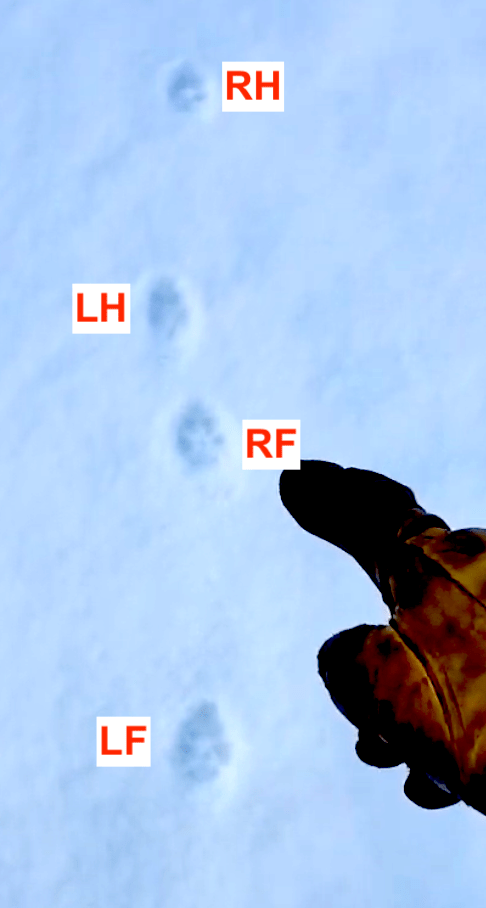
From https://www.youtube.com/watch?v=xbMp_NO0uXs about at the 8.30 min point. (Front tracks are a little bigger and have a ‘chevron’ shaped metacarpal pad.)
Defining lopes and the gallops based on the track pattern
I realized I needed to have a better understanding of how trackers define lopes and gallops. The order in what we see spatially is different from the order of what happens time. Trackers focus on the spatial interpretation of the tracks on the ground, while people who study the biomechanics of a gait are thinking about what happens in time. Let’s look at things from the tracker perspective first.
In [3] they state “… we might reasonably expect a gait to be a lope if the track groups are compact and the intergroup distance is short, or if the track group shows one hind foot behind or beside one of the hind tracks.” This would seem to allow the pattern F, F, H, H, provided the two inner tracks are close to one another (see the very first lope photo given above). However, “If both hind tracks land beyond both front tracks and the track groups are stretched out, the gait was likely not a lope.” (i.e., a gallop) [3].
In [5] they give a narrower definition for a lope: “… one of the hind feet lands either between the front track impressions or on top of the farthest one, while the other hind foot lands beyond the two front tracks.”
The definition in [1] is more vague: “… a lope typically becomes a gallop when both hind feet land beyond both front feet, but this is not always the case. If the order of tracks on the ground in a single set of four prints is front, hind, front, hind, then it is a lope. If the order is front, front, hind, hind, then it is more likely a gallop.” I guess this is at least consistent with the more nuanced definition in [3].
Perhaps the most precise definition of a lope versus a gallop can be given based on the diagram shown below (from [6]). Lowery doesn’t define it, but this is my interpretation of his diagram.
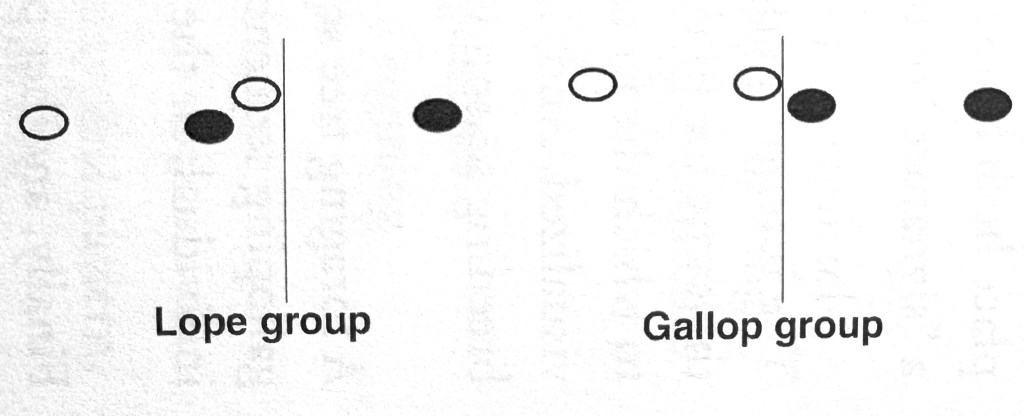
Assume the direction of travel is left-to-right. Draw a vertical ‘lope line’ that just touches the 2nd front track on its right. If the 1st hind track is to the left of this line we have a lope. If it is to the right of this line we have a gallop. What about when this hind track intersects the line? Lowery does not explain this case and again we have a grey area for this definition!
I asked my tracking mentor Alexis Burnett (Earth Tracks) about this and he said the tracking books define a gallop as described above. But if the 1st hind track intersects or is behind the lope line we have a lope (so even when the order of the tracks in the direction of travel is F, F, H, H). So in summary, here are my definitions:
“Lopes” and “gallops” are gaits that produce groups of four tracks consisting of two front and two hind tracks, separated from other groups by an intergroup distance. A “lope line” is defined as a line drawn perpendicular to the direction of travel, positioned just beyond the second front track of a four-track group. A gait is classified as a lope if at least one hind track lies on or behind the lope line. A gait is classified as a gallop if both hind tracks lie entirely ahead of the lope line, leaving a clear gap between the front tracks and the hind tracks in a group of four tracks.
I should clarify what the terms ‘rotary’ and ‘transverse’ mean, which are applied to both lopes and gallops. These terms are used consistently by different authors. The term rotary indicates that the order (in time) of footfalls progresses around the animal; for example, in a lope we might have the tracks on the ground LF, RH, RF, LH. This may seem contradictory but in a group of 4 tracks on the ground the front tracks land before the hinds (more about this below). Thus in this case the order of tracks in time is LF, RF, RH, LH.
The term transverse indicates that the order of footfalls moves across the animal; for instance, in a lope we might see the group of 4 tracks in the order LF, LH, RF, RH. Again, because the fronts land first, the sequence of footfalls cuts diagonally across the animal. Thus in this case the order of tracks in time is LF, RF, LH, RH.
On the ground, the rotary gaits produce a “C”-shaped pattern of tracks, whereas the transverse gaits produce a “Z”-shaped pattern.
Defining lopes and the gallops based on leg movement sequence
To improve my understanding of lopes and gallops, I needed a clearer sense of what the animal is actually doing in time during these gaits. I have re-written this section numerous times because I just wasn’t getting it! I had to watch numerous videos on YouTube of animals (and even humans!) performing them to understand this. The two videos below on lopes and gallops helped me the most:
https://www.youtube.com/watch?v=hY3wtJI-MG0&t=21s https://www.youtube.com/watch?v=CwEAJW9FsY8
As described in [6], in both lopes and gallops the two front legs move forward and hit the ground, followed by the hind legs which swing forward and hit the ground. The two front legs or hind legs may move simultaneously or independently. Now if both hind feet swing forward beyond where the front feet have landed then we have a gallop. If one of the hind feet land between where the front feet land its a lope. It’s also often said that when an animal is loping, its motion resembles that of a rocking horse.
What we hear in time in for a gallop is a “four beat” gait 1-2-3-4 – pause – 1-2-3-4, etc. For lopes we may hear a “four beat” gait, or a “three beat” gait 1-2-3 pause 1-2-3, etc. as is the case with a horse canter. A gallop has two periods of suspension. The first occurs when the hind feet leave the ground, and it’s during this period that yields the spatial gap between the groups of four tracks on the ground. But the 2nd period of suspension happens when the front feet leave the ground, and it’s this suspension that is longest (most ‘airtime’), corresponding to the ‘pause’ in the “four beat” gait (looking at the videos of a gallop it seems to take a long time for the hind feet to swing forward beyond the front feet). This explains why If you watch an animal gallop or listen to the sounds of their footfalls, you will hear H, H, F, F – pause – H, H, F, F, etc. (Jonah Evans, personal communication, Dec 2, 2025, See also [4]), however, what we see on the ground is F, F, H, H – gap – F, F, H, H, etc. Note with a lope there is only a single period of suspension after the front feet leave the ground. And as stated in [4], the sequence of footfalls for this pattern is: H, H/F, F – pause – H, H/F, F, etc. This may seem counterintuitive because the groups of tracks on the ground are: F, F/H, H – gap – F, F/H, H, etc. (Lowery is assuming here that the lope is a “three beat” gait.)
In summary we could define a “stride” for the gallop as either:
Biomechanical stride → start at hind foot contact → H, H, F, F
or
Track group stride → start at the first print in the visible group → F, F, H, H
Both describe the same physical movement, just from different starting points (with similar definitions for the lope).
Finally, I should mention that not every “gallop-like” gait includes a suspension phase. The idea of suspension mainly comes from observing horses. Skunks and bears often do a slow lope or gallop with no moment of all four feet off the ground (Jonah Evans, personal communication, Dec 5, 2025).
The first two videos below show dogs doing a gallop. The 3rd video shows a horse doing a canter (a kind of lope).


 Field Notes of a Tracker
Leave a comment